
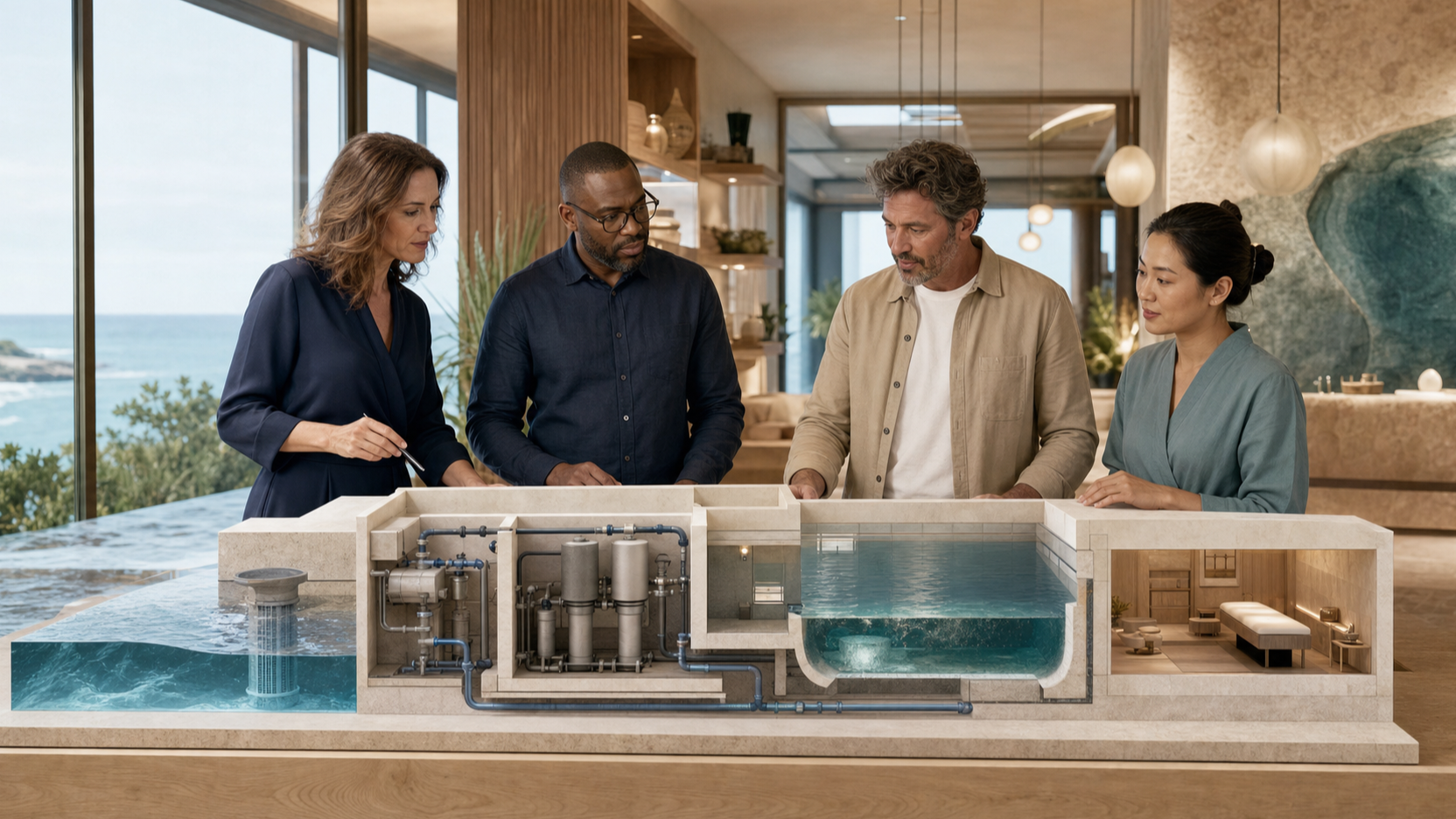
Thalassotherapy spa operations begin with seawater, but they cannot end with a sea-inspired story. A recent Spa Business report describes the reopening of Bel Hotel Oléron Thalasso & Spa on France’s Atlantic coast, with 27 treatment rooms, an indoor pool and marine treatments. Accor’s original July announcement confirms the MGallery opening on Île d’Oléron, while the property’s current thalasso page presents a seawater pool, hydromassage, marine treatments, sauna and hammam.
Those records establish an open property and a marketed offer. They do not disclose the source-water engineering, treatment train, surveillance results, maintenance history, discharge controls, clinical governance, guest outcomes or commercial performance. They do not prove a visit, independent test, Spa Awards nomination, judging or merit.
A second signal makes the operating question especially timely. France published a new pool-water surveillance order on 27 June 2026. It is scheduled to enter into force on 1 January 2027 in metropolitan France, so it must not be described as the rule already in force in August 2026. Its structure nevertheless offers a useful professional lesson: water drawn from the natural environment, water feeding the treatment system and water in the guest pool are related but distinct control points.
What the Oléron reopening actually establishes
The specialist report says a 1970s Novotel Thalassa was redesigned as a 102-room MGallery property between the Atlantic-facing Plage de Gatseau and pine forest. It lists 27 treatment rooms, an indoor pool, hammam, hot tub, sauna and marine beauty services. The official Accor release establishes the opening and location, but it is a brand announcement, not an engineering or outcomes audit.
The property page gives a more service-specific record. It describes massages under affusion, hydromassage baths, seaweed rituals and a seawater pool. It does not, on that public page, identify the intake point, sampling programme, water-treatment configuration or current analysis results. Spa professionals should not manufacture those details from the word “thalasso” or from the property’s coastal position.
France’s Directorate General for Enterprise describes thalassotherapy as the combined use, under medical supervision, of elements of the marine environment, including climate, seawater, muds, algae and sands, for preventive or curative purposes. That is a French government tourism description. It should not be treated as a universal legal definition, automatic medical status for every marine spa, or evidence that a particular treatment produces a promised result.
Thalassotherapy spa operations need three linked files
A credible marine programme should separate three evidence files while connecting their decisions.
The source-water file covers where water is drawn from, what can change its condition, which permissions and environmental duties apply, how the intake is protected, what is sampled, and which events stop abstraction or use. It also covers alternative supply when the normal source cannot be used.
The pool-system file follows water after it enters the facility: storage, treatment, filtration, disinfection, hydraulics, temperature, ventilation, bather load, cleaning, monitoring, corrective action and safe reopening after an exception. A pool containing seawater is still a shared treated-water environment.
The treatment-and-claims file defines which marine inputs are used in each service, who may deliver it, what information is needed, which exclusions or referral boundaries apply, how products are traced and what the spa may responsibly say about experience or outcomes.
These files should meet at a controlled interface. A source-water alert may pause a pool, alter a treatment input or activate a substitute. A treatment claim may depend on a specific marine material that needs its own supplier and quality record. A maintenance intervention may affect water, guest access and marketing at the same time. One “ocean wellness” folder is too vague to manage those relationships.

Source water is an operational input, not a mood board
Operators should map the full route from marine environment to plant room before writing the guest story. Record the authorised intake, operating envelope, responsible roles, sampling points, laboratory arrangements, pre-treatment, holding time, cross-connection protection, alarms, seasonal risks and stop rules. Review the map after storms, pollution alerts, algal events, unusual turbidity, equipment changes or nearby works.
The new French order of 23 June 2026 says the surveillance programme includes the pool water and, where the supply does not come from a drinking-water distribution network, water drawn from the natural environment and water intended to feed the pool-treatment system. It assigns the programme to the person responsible for the pool, requires specified accredited sampling and analysis, and keeps results available to public authorities. Its natural-source annex includes microbiological and chemical parameters and additional conditions linked to treatment choices.
Timing matters. Article 4 schedules metropolitan entry into force for 1 January 2027 and later application in certain overseas territories. The 2021 French order remains the current reference until replacement. An operator preparing now can map the transition, but cannot call future compliance a present result.
Do not substitute beach information for facility evidence. The World Health Organization’s 2021 coastal and fresh-water guidance addresses recreational waters and promotes health-based targets, risk-management plans, surveillance and communication. The WHO’s separate pool guidance covers treated swimming pools and similar environments. A favourable public beach classification may inform the wider environmental picture; it does not prove the safety of water after abstraction, storage, heating, treatment and repeated guest use.
Treat the seawater pool as a controlled public system
France’s new order defines collective use broadly for public and private pools open to everyone or to a defined group when the water is not emptied between bathers. It categorises pools partly by theoretical maximum attendance and the nature of the establishment. The practical point is international: capacity, guest type and water system determine the control plan, not a poetic distinction between “pool” and “lagoon”.
The same order requires a sanitary log containing surveillance results, daily attendance, water-meter and flow readings, treatment and ventilation observations, maintenance, regulator checks and actions taken after water-quality exceptions. That is an evidence system, not just a laboratory folder. It connects what happened in the plant room to how many people used the pool and what the operator did next.
The 2021 French surveillance order remains relevant during the 2026 transition. A responsible property should confirm the currently applicable national and local requirements rather than merging the two versions or assuming a press summary captures every duty.
The World Health Organization’s guidelines for pools and similar environments organise hazards around drowning and injury, microbial contamination and chemical exposure. They discuss control and monitoring so facilities can operate safely. For a marine pool, the safety plan still needs treatment performance, clarity, pH and disinfectant controls where applicable, hydraulics, cleaning, ventilation, incident response and competent staff. Salt does not replace those controls.
Commission the actual journey. Observe peak entry, showers, wet circulation, steps, handrails, hydromassage positions, accessible transfer, lifeguarding or response coverage, towels, treatment crossover and quiet areas. Test alarms and staff handovers. Establish who closes the pool, who communicates with booked guests, which evidence authorises reopening and how a material exception is retained for review.
Build operating limits into treatments and marketing
Marine provenance can be meaningful without carrying every claim attached to it. For each treatment, list the materials used, supplier or source, batch traceability, storage, preparation, contact route, duration, cleaning, competence, contraindication information and escalation boundary. Keep the pool-water route separate from a cosmetic product, seaweed wrap, aerosol, affusion shower or mud application; they do not share one risk profile simply because all are marine-themed.
Create a claims register. For every public statement, record whether it describes a sensory experience, a material’s provenance, a measured service attribute or a health outcome. Link the statement to evidence that actually matches the product, dose, population and setting. Remove language that converts tradition, minerals, ocean air, medical supervision or a brand partnership into a guaranteed therapeutic result.
Reception and therapists need the same boundaries. Ask only service-relevant questions; explain what will happen; make alternatives and stopping easy; and refer questions beyond staff competence. A thalassotherapy spa should not diagnose a condition merely because its heritage language includes prevention or cure. Applicable professional, consumer, product and health rules still depend on the jurisdiction and the actual service.
The Journal’s guide to contrast-therapy commissioning offers a compatible discipline: commission water, heat, flow, facilitation and claims as one journey while keeping each control legible. Marine spas add a natural-source layer and coastal asset exposure, but they do not receive an exception from evidence.
Coastal ecology belongs in the operating plan
The site context is more than scenery. An official Natura 2000 management document for the dunes and coastal forests of Île d’Oléron identifies the Saint-Trojan-les-Bains forest and dune sector and the Gatseau marsh within the protected landscape. This confirms an environmentally sensitive setting; it does not establish the hotel’s individual environmental performance.
For operators, the response is a location-specific asset and ecology register. Map permissions, water and wastewater interfaces, chemical storage, discharge conditions, dune and habitat protections, noise and light, guest routes, delivery access and emergency arrangements. Engage competent local authorities and specialists rather than translating a protected-area label into a sustainability claim.
Salt, humidity and wind also change maintenance. Review corrosion at fasteners, plant, glazing, doors, electrical enclosures, air-handling equipment and accessibility hardware. Record inspection intervals and failure consequences. Connect ventilation and humidity control to both worker exposure and fabric durability. A beautiful ocean-facing room is not resilient if maintenance evidence cannot keep pace with the environment.

The Journal’s analysis of the Great Spa Towns as an operating duty makes the parallel clear: a valued place is not a decorative halo. It creates management responsibilities, change controls and a need to return value to the living destination.
What does this mean for spa and wellness professionals?
For owners and asset managers, fund the intake, treatment, ventilation, corrosion, laboratory and resilience systems behind the marine proposition. Approve claims only after engineering, service and evidence teams agree on what is established.
For spa directors, own one control map connecting source water, pool operation, treatments, capacity, staff competence, guest information and stop rules. Ensure the website, booking confirmation and daily brief reflect current operating reality.
For facilities and water-safety leaders, keep source, feed and basin sampling points distinct. Reconcile the present legal programme with the documented 2027 transition, test incident response and make reopening authority explicit.
For therapists and product teams, trace marine materials, preserve treatment scope, present uncertainty honestly and stop when information, guest suitability or environmental conditions fall outside the agreed service.
For marketers and awards researchers, separate a reopening, seawater pool, protected setting, treatment menu and directory listing from measured quality. None alone proves safety, environmental performance, guest benefit, nomination or award merit.
A 90-day marine operations review
Days 1–30: map. Draw the water route and identify every source, feed, basin and treatment input. List permits, current rules, future rule changes, sampling points, laboratories, responsibilities, records, alerts, alternative supplies and closure criteria. Mark every unknown instead of filling it with brand language.
Days 31–60: test. Review peak bather load, treatment performance, hydraulics, ventilation, corrosion, cleaning, maintenance and emergency response. Rehearse a source-water alert, failed analysis, plant outage, unusual guest symptoms and delayed laboratory result. Verify who communicates and who authorises reopening.
Days 61–90: reconcile. Match treatment protocols and marketing statements to the evidence file. Audit supplier and material traceability. Confirm the transition plan for rules that are published but not yet effective. Report exceptions to leadership and retain decisions for the next review.
For directory context, readers can browse Les Thermes Marins de Saint-Malo and Tiara Miramar Beach Hotel & Spa. These active listings do not establish either property’s current seawater source, controls, treatments, visit, testing, nomination, judging, result or endorsement. Current property-level verification remains necessary.
What remains unproven
The reviewed sources do not reveal Bel Hotel Oléron’s detailed water engineering, analysis results, environmental permissions, treatment outcomes, guest satisfaction, profitability or long-term asset performance. They do not show that one French operating model can be copied into another country. The June 2026 order is published, but its metropolitan requirements are not in force until 1 January 2027.
The defensible conclusion is narrower. Thalassotherapy can create a distinctive sense of place when marine origin is supported by operational proof. Professionals should be able to show where the water or material came from, what happened before guest contact, which limits govern use, how exceptions are handled and which claims the evidence supports. The sea is the beginning of the story; controlled operation is what makes it publishable.
Frequently asked questions
Does seawater make a spa pool naturally safe?
No. A shared seawater pool still needs a property-specific safety plan, treatment and monitoring appropriate to its system, competent operation and compliance with current local rules.
Does good beach water prove indoor pool quality?
No. Coastal monitoring concerns the outdoor water body. Abstraction, storage, heating, treatment, hydraulics and bather load create a separate facility evidence chain.
Is France’s June 2026 pool order already in force?
Not in metropolitan France in August 2026. Its stated entry date is 1 January 2027, with a later date for specified overseas territories. Operators must follow the currently applicable rules while preparing accurately for the transition.
Does thalassotherapy prove a health outcome?
No. The term and tradition do not establish the result of a particular service. Claims should match evidence for the actual treatment, material, population and setting, within applicable professional and consumer rules.
