
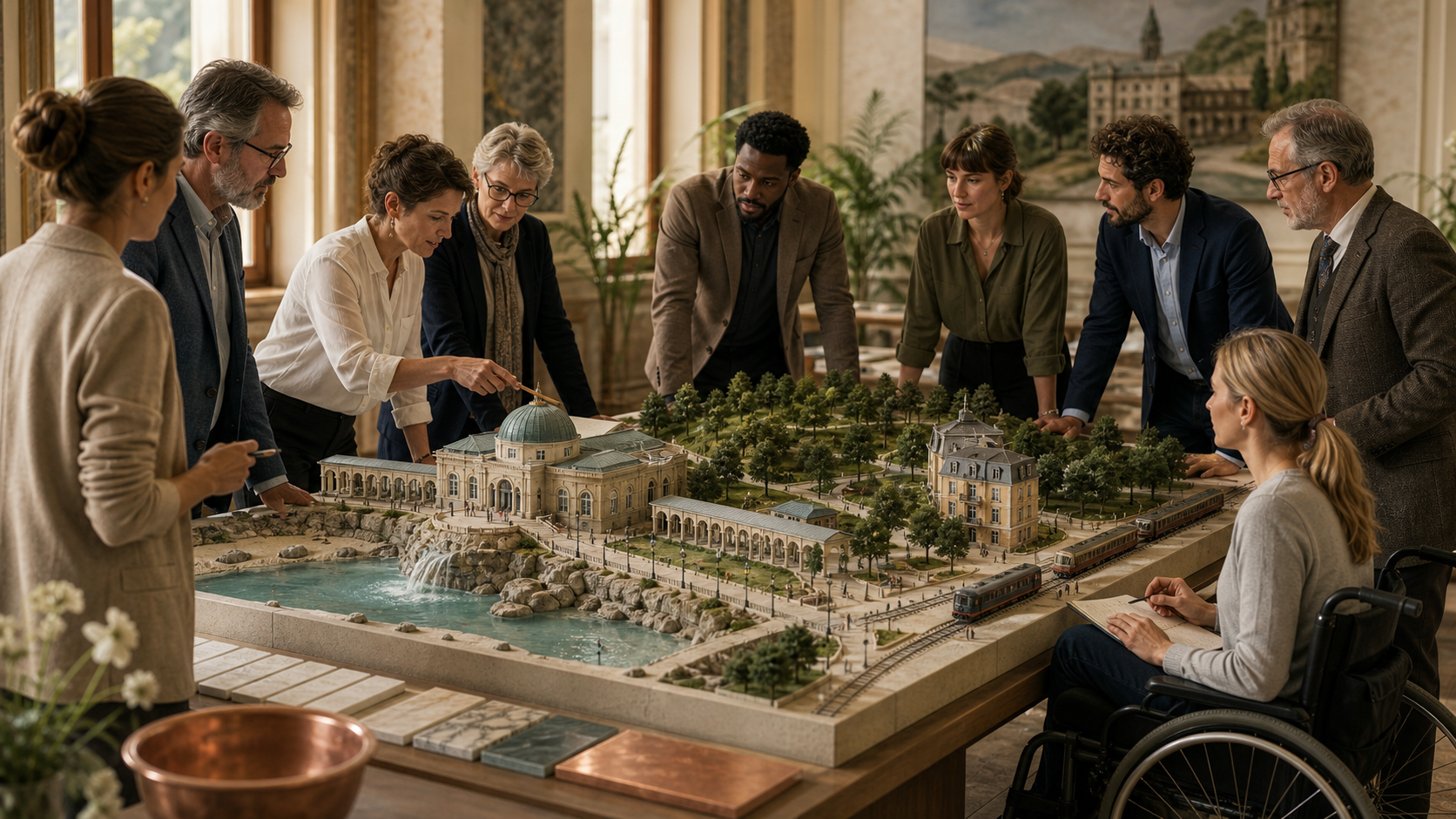
What five years of the Great Spa Towns actually establishes
The fifth anniversary of the Great Spa Towns is a prompt for operating discipline, not a certificate that every heritage building, thermal service or visitor outcome is already secure. The transnational property was inscribed on the UNESCO World Heritage List on 24 July 2021. Its official anniversary account describes events across 11 spa towns in seven countries during 2026, while Spa Business used the anniversary as a current industry signal.
UNESCO defines the site as one serial, transnational property comprising Baden bei Wien, Spa, Františkovy Lázně, Karlovy Vary, Mariánské Lázně, Vichy, Bad Ems, Baden-Baden, Bad Kissingen, Montecatini Terme and the City of Bath. Its World Heritage record connects natural mineral springs with bath buildings, pump rooms, drinking halls, colonnades, parks, hotels, cultural venues and the infrastructure that made the European spa-town model possible.
That scope matters for contemporary operators. A heritage spa is not an isolated treatment menu inside an old building. It participates in a living system of water, architecture, landscape, access, local business, public space, community memory and visitor movement. The inscription recognises Outstanding Universal Value under cultural criteria; it does not license a spa, inspect current hygiene, verify therapeutic claims, confirm accessibility, prove resident benefit or confer a Spa Awards result.
The useful anniversary question is therefore operational: how can a spa business benefit from a globally recognised setting while helping to protect the attributes on which that setting depends? The answer begins with shared evidence, because reputation can be borrowed quickly while stewardship has to be maintained every day.
World Heritage status is a management system, not a halo
UNESCO’s description identifies both physical attributes and continuing use: springs, spa architecture, treatment infrastructure, designed landscapes, leisure facilities and the spatial relationships between them. An operator may control only one part of that network, yet changes to ventilation, drainage, signage, lighting, delivery access, visitor flow or building fabric can affect other parts. Governance must therefore connect property owners, spa teams, municipal services, heritage specialists, water authorities, residents and tourism bodies.
The current conservation record shows why inscription is the beginning of a duty rather than the end of a competition. In its 2025 decision on the property, the World Heritage Committee welcomed progress but also encouraged stronger legal protection, continued monitoring and integrated impact assessment. It addressed development pressure around Bath, requested revision of a combined management plan there, and asked the seven States Parties for a joint updated state-of-conservation report by 1 December 2026.
Those requests should not be exaggerated into a claim that all 11 towns or their spas are failing. They do establish that protection, plans, impact assessment and reporting remain active work. For a commercial spa, the corresponding discipline is a responsibility map: identify which organisation owns the spring, pipework, structure, public realm, visitor data, emergency plan and conservation decision. Record who must be consulted before change and who receives evidence after it.
A World Heritage emblem or anniversary campaign cannot replace this map. Marketing belongs downstream of governance. If a claim about authenticity, thermal heritage or regeneration cannot be traced to a current source and a defined scope, it should be narrowed before publication.
Treat the thermal heritage system as one operating asset
Mineral water is the organising element in UNESCO’s account of the Great Spa Towns. In practice, the guest encounters the end of a much longer chain: source and catchment, abstraction permissions, distribution, storage, temperature control, treatment where applicable, historic pipework, modern plant, bathing space, discharge and environmental monitoring. Splitting that chain between institutions does not remove the need for an end-to-end view.
Start with an asset and evidence register. For each component, record ownership, location, function, material, condition, monitoring method, maintenance interval, legal or conservation constraint and failure response. Link the register to current operating procedures rather than leaving it as a heritage inventory. A beautiful historic valve that is not part of the active system needs different controls from an old pipe still carrying water.
Modern service standards can create tensions with historic fabric. Ventilation, moisture control, electrical safety, accessibility, water management and energy performance may require intervention. The goal is not to freeze the property or to treat any upgrade as automatically beneficial. It is to define the problem, consider alternatives, document the effect on heritage attributes, install with competent oversight and monitor the result.
The same distinction applies to guest claims. Historic use, mineral composition and a town’s association with balneology do not by themselves prove a present-day health outcome. Describe the source, service and tradition accurately; keep medical or therapeutic statements within the applicable evidence, professional and regulatory boundaries. The Journal’s guide to commissioning heat, cold and flow offers a related operational principle: the route, water controls, facilitation and staff exposure need evidence as a connected system.
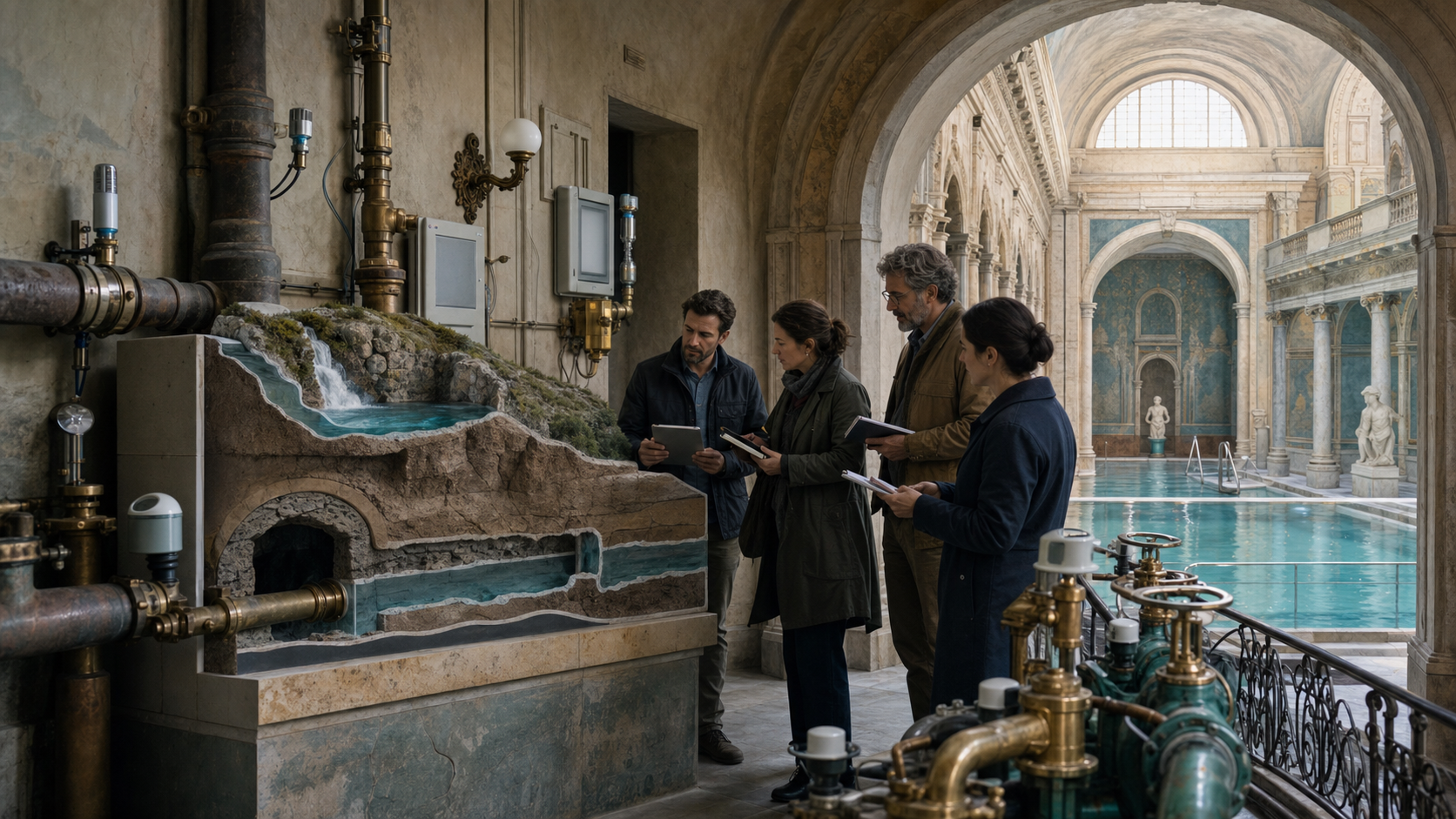
Assess change before the design becomes a promise
Historic spa properties need to evolve. Guest expectations, climate risk, building regulations, workforce needs and operating costs change, and vacant or underused structures can deteriorate. The control point is timing: impact assessment should influence whether and how a proposal proceeds, not arrive after the concept has become a public commitment.
The joint UNESCO, ICCROM, ICOMOS and IUCN impact-assessment guidance is designed for projects inside or around World Heritage properties and for both small and large proposals. Its relevance to spa operators extends beyond major construction. Plant replacement, new wet areas, a rooftop addition, illuminated signage, a revised access route, an event programme or a change in water demand can all alter heritage attributes or cumulative pressure.
Keep an alternatives record
For every material change, state the need first. Then record the options considered, including a no-change or maintenance-only option where credible. Identify the heritage attributes, guest groups, workers, residents and environmental systems that could be affected. Separate temporary construction effects from permanent operating effects, and assess cumulative change rather than reviewing each intervention in isolation.
The decision file should name mitigation, monitoring, stop rules and responsibility. If the proposal is still conceptual, label costs, dates, capacities and benefits as plans or projections. A rendering, planning application, funding announcement or contractor appointment is not an open facility, measured improvement or conserved outcome.
Preserve reversibility where possible
Reversible interventions can reduce long-term risk, but “reversible” should not become an untested slogan. Document the fixing method, affected material, removal process and likely residue. Prototype sensitive details before scaling them. Photograph and measure the baseline, and retain the approved specification so later maintenance does not quietly substitute a more damaging solution.
This process also improves commercial decisions. It exposes hidden dependencies, maintenance costs and approval risk before launch. Heritage stewardship is not an aesthetic surcharge; it is part of project definition, operating continuity and truthful communication.
Return visitor value to the living town
An anniversary can increase attention, but attention is not automatically useful. Visitors may concentrate at a small number of landmarks, arrive at peak times, photograph public spaces without using local services, or create pressure that residents experience more strongly than businesses do. The correct scale for management is the destination, not only the spa entrance.
UNESCO’s Sustainable Tourism Toolkit joins governance, community and business engagement, infrastructure, visitor behaviour and monitoring. Its visitor-management guidance stresses measurement of where and when pressure occurs. For spa towns, that suggests a shared view of seasonality, day and time peaks, bathing capacity, public-space use, mobility, accessible routes, resident complaints, local spending and the condition of heritage attributes.
Commercial partners can contribute without claiming control of the whole destination. A hotel or spa can smooth appointment times, communicate low-impact arrival options, direct guests to locally governed interpretation, source from appropriate businesses, share anonymised demand patterns and fund agreed conservation or public-realm work. It can also design packages that extend stays without overloading one facility.
Resident value needs its own measures: access to public space and bathing traditions, year-round employment, procurement, housing and transport pressure, participation in decisions, and response to complaints. Visitor expenditure is not a complete community-benefit measure. A higher-spending guest can still create concentrated costs, while a modest cultural event may produce strong local value when it is co-designed and accessible.
The Journal’s review of responsible retreat principles provides a useful parallel: transparent booking, inclusion, qualified roles, risk controls and reciprocal local relationships matter more than a broad ethical label.
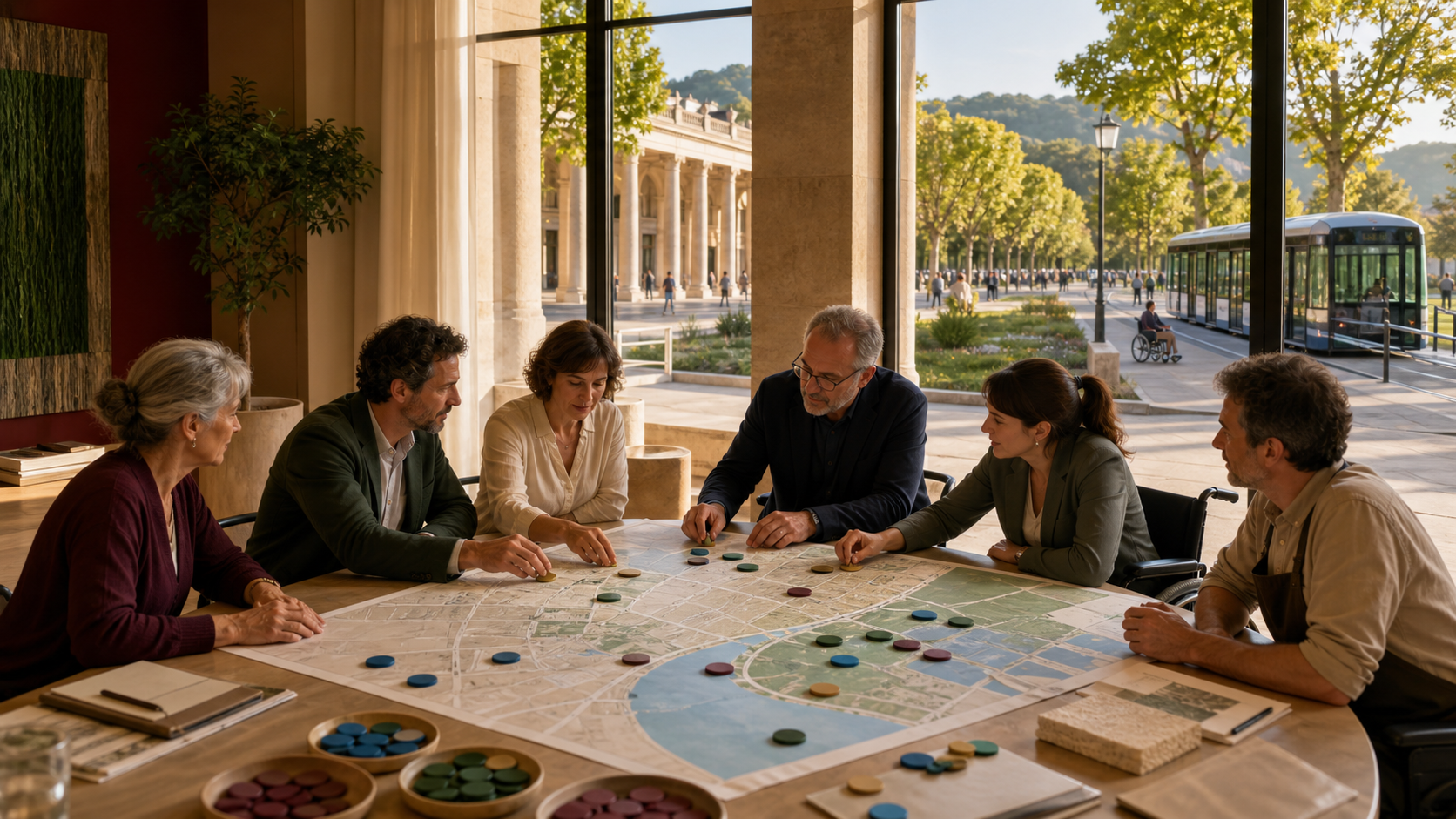
Put climate adaptation into the operating calendar
The Great Spa Towns association’s 2026 General Assembly account says its management work includes climate-adaptation and disaster-risk frameworks. It also reports knowledge-sharing around a Climate Vulnerability Index workshop and participation by four members in the Preserving Legacies programme. These are verified activities and plans; they are not proof that every town or spa has completed adaptation.
UNESCO’s current climate action material identifies climate change as a significant threat to World Heritage integrity, authenticity and local development. For spa operators, the risk register should translate that broad warning into property-specific exposure: heat, drought, intense rain, flood, groundwater change, freeze-thaw, wildfire smoke, energy interruption, water scarcity, vegetation stress and altered visitor seasons where relevant.
Assign thresholds and actions. What water, moisture, temperature or weather condition triggers inspection, reduced capacity, temporary closure or specialist review? Which historic materials and plant are most vulnerable? How will staff and guests receive accessible instructions? Which suppliers, authorities and neighbours share dependencies? Review these questions before the high-risk season and after any incident.
Adaptation claims need the same discipline as heritage claims. A shaded route, restored park, efficient plant or flood intervention may be valuable, but it should be described by its actual function and measured performance. Do not convert an intention to improve resilience into a guarantee that the property is climate-proof.
What does this mean for spa and wellness professionals?
For spa owners and asset managers, place heritage, water, access and climate dependencies in the operating risk register. Budget for monitoring and conservation-informed maintenance, not only guest-facing renovation.
For spa directors, connect treatment menus and thermal experiences to the systems that support them. Train teams to distinguish historical interpretation, current service facts and health claims, and give them a route for reporting defects or misleading language.
For engineers and facilities leaders, maintain an end-to-end asset register and involve heritage specialists early. Record alternatives, installation details and post-change monitoring so maintenance decisions remain legible years later.
For designers and developers, assess impact before promotional renderings become promises. Show what is existing, proposed, reversible and still subject to approval. An anniversary, designation or attractive concept does not establish operating readiness.
For tourism and municipal leaders, manage demand at destination scale. Share bounded data, map resident and visitor pressure, protect accessible public routes and measure where value and costs land.
For awards researchers and editors, World Heritage status, a directory listing, investment announcement or anniversary event does not prove a visit, nomination, judging, winner, water quality, conservation performance or guest outcome. Request current evidence for the specific spa and claim under review.
A 90-day Great Spa Towns stewardship review
Days 1–30: map the system. Identify the attributes and infrastructure on which the spa depends. Record ownership, condition, monitoring, approvals, emergency roles, climate exposure, visitor peaks and unresolved claims. Link each issue to a responsible organisation and evidence source.
Days 31–60: test the change process. Select one planned intervention and complete a proportionate alternatives-and-impact review before commitment. Test one visitor-pressure or resident-value question with shared data. Review how heritage and health language appears across the website, booking flow, treatment menu and staff scripts.
Days 61–90: publish a bounded record. Approve, redesign or stop the intervention based on evidence. Report what changed, what remains planned and what will be monitored. Share lessons with destination partners without exposing personal guest or employee information.
Readers exploring active directory examples can view Thermae Bath Spa and Baden-Baden Kurhaus Spa. These are contextual directory links in cities within the transnational property. They do not establish a Spa Awards visit, nomination, judging, award, current UNESCO compliance or endorsement by the Great Spa Towns association.
What remains unproven
The anniversary sources do not prove that inscription caused investment, visitor growth, resident benefit, conservation success or stronger spa performance across all 11 towns. The reviewed material does not establish current water quality, accessibility, service standards, climate resilience or commercial results for every property. Association plans and workshops verify activity and intent, not completed outcomes.
UNESCO status applies to the defined serial property and its Outstanding Universal Value. It should not be extended into a medical promise, a blanket certification of businesses, or an award claim. Professionals can celebrate the anniversary while keeping plans, implementation and measured results in separate columns.
Frequently asked questions
Does UNESCO list every spa business in the 11 towns?
No. UNESCO lists one transnational serial property made up of defined component areas and attributes. Individual businesses require their own current evidence, permissions and operating controls.
Does World Heritage status verify a thermal treatment’s health benefits?
No. The designation recognises cultural Outstanding Universal Value. Present-day health claims need their own evidence and must remain within applicable professional and regulatory boundaries.
Can a modern upgrade be compatible with spa heritage?
Potentially, but compatibility is not automatic. The need, alternatives, heritage effects, approvals, installation method, mitigation and monitoring should be assessed before the project is presented as a benefit.
