
What the WorldSprings update establishes
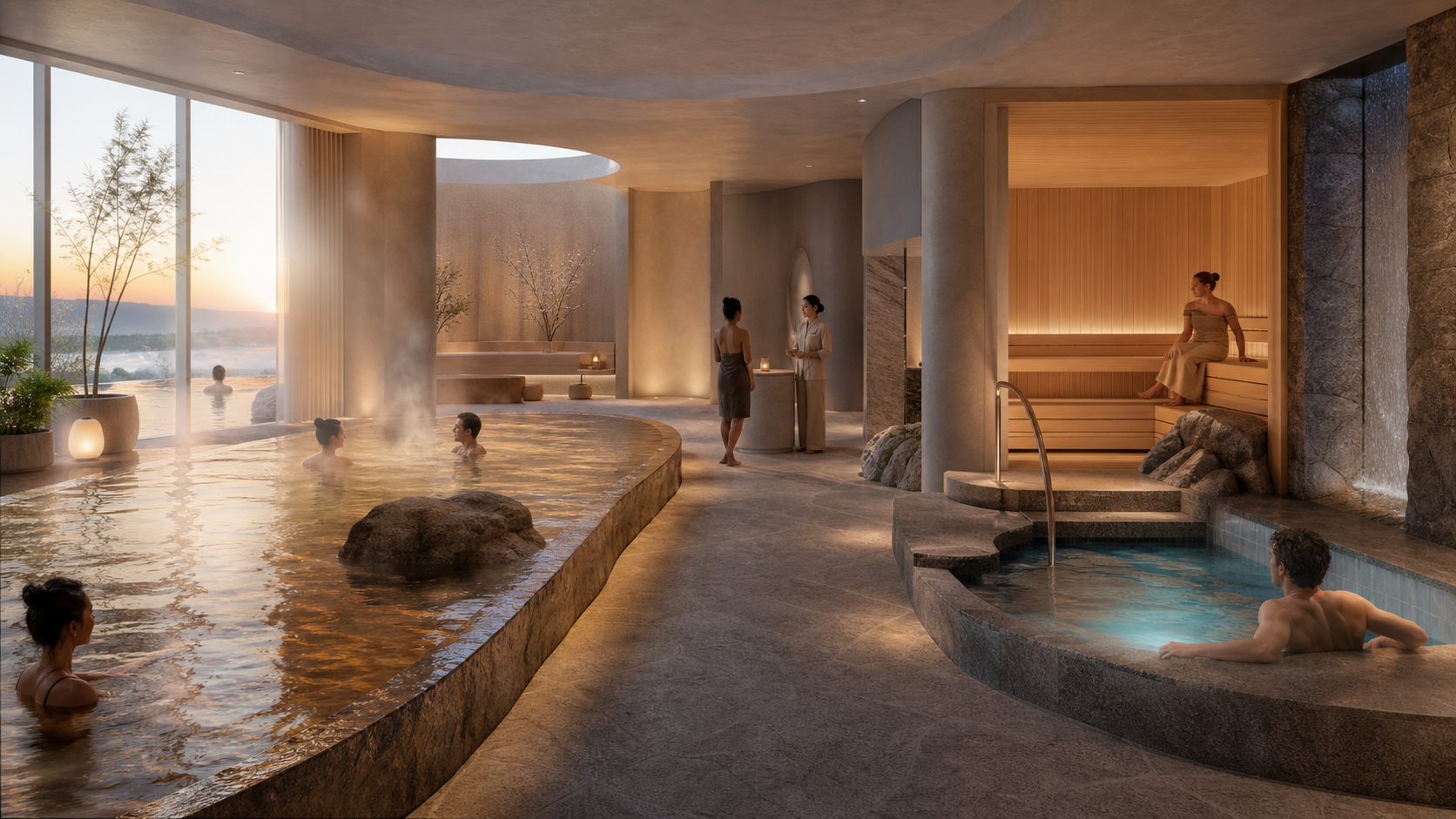
Contrast therapy in spas is becoming a larger operating proposition, not just a hot room beside a cold pool. On 25 July, Spa Business reported that WorldSprings Dallas had introduced new thermal facilities for its second anniversary. The story is a useful signal because the venue already combines mineral pools, cold plunges, saunas, spa treatments and guided circuits at substantial scale.
The operator’s own evidence is more granular. Its property-improvement page described a phased programme: one of two red-light saunas was open in its June update, the Sauna Sanctuary was still being framed, existing saunas were being replaced in stages, and outdoor showers, shade and landscaping were also in progress. An earlier WorldSprings company announcement said guided contrast circuits and sauna-stretch classes were operating and that further recovery programming was planned.
Those sources establish an active venue, an expansion and a phased commissioning story. They do not establish one simultaneous completion date for every element, independent health outcomes, universal suitability, profitability or an award result. That distinction is the starting point for professionals: an attractive thermal collection becomes a credible spa experience only when temperatures, water, air, guest flow, facilitation, claims and staff exposure work as one controlled system.
Contrast therapy in spas is a sequence, not a promise
“Contrast therapy” is often used as a convenient label for alternating heat and cold. In practice, the offer can involve hot pools, cold plunges, saunas, steam, showers, rest, hydration and guided rituals in many combinations. Different facilities, temperatures, exposure times and guest populations make those combinations materially different. Operators should resist turning a category name into a standard dose or guaranteed result.
A 2025 systematic review and meta-analysis of cold-water immersion found limited high-quality evidence for general populations. Protocols and study populations varied, long-term data were sparse, and several outcomes depended on small or single studies. That does not make cold water meaningless. It means a hospitality business should describe the experience it actually provides and avoid upgrading emerging, context-dependent findings into promises about immunity, sleep, mood, inflammation or recovery.
The operational product is therefore a sequence of choices and controls. Guests need to know what each zone is, how to enter and leave, where to rest, whom to ask, and that opting out is acceptable. Staff need authority to slow a session, close a zone or redirect a guest. Management needs evidence that the complete journey works under ordinary demand, not only when an expert is demonstrating it to a small invited group.
Commission the route, not only the rooms
A new sauna can pass an equipment check while the guest journey around it still fails. Commissioning should begin with a route map that follows a person from booking to departure. It should include changing, showers, heat, cold, rest, drinking water, toilets, circulation, staff sightlines and emergency access. Every transition adds a potential bottleneck or hazard.
Heat needs recovery capacity
Rated sauna capacity is not the same as safe programme capacity. A guided session adds arrival waves, facilitator space, sensory inputs and a shared end time. The adjacent rest and cooling areas may set a lower limit than the benches. Operators should test door movement, air exchange, surface temperatures, lighting, guest communication and how quickly the room can be reset without rushing staff.
Cold needs choice and a clear exit
A plunge is not a test of character. Entry should be deliberate, the route out unobstructed and the next rest point obvious. Signage and facilitation should not shame people who decline, shorten or stop. Staff should be able to see when competitive behaviour, breath-holding, alcohol use or crowd pressure is changing the risk profile. A compelling experience respects self-selection instead of rewarding extremity.
Flow needs a tested denominator
Count how many people can complete the whole circuit during one period, not how many bodies fit into its largest zone. Include dwell-time variability, accessibility, cleaning, water testing, maintenance closures and facilitator breaks. The narrowest controlled step should determine starting inventory. This is closely related to the Journal’s review of healthy-building operations: design intent becomes meaningful only when commissioning and daily maintenance preserve it.
Water controls remain foundational
The US Centers for Disease Control and Prevention describes the Model Aquatic Health Code as guidance for safer public pools, hot tubs and related aquatic venues. Its 2024 scientific annex notes that cold plunge pools can present concerns because of temperature extremes and sudden change. It also explains the widely used 104°F (40°C) maximum for spa water and the need for strong warnings around alcohol and vulnerable users.
The MAHC is guidance rather than universal law. The applicable code still depends on jurisdiction and facility type. For the Dallas case, the Texas Department of State Health Services publishes the state laws and current administrative rules for public pools and spas. Operators elsewhere need their own documented legal and technical review.
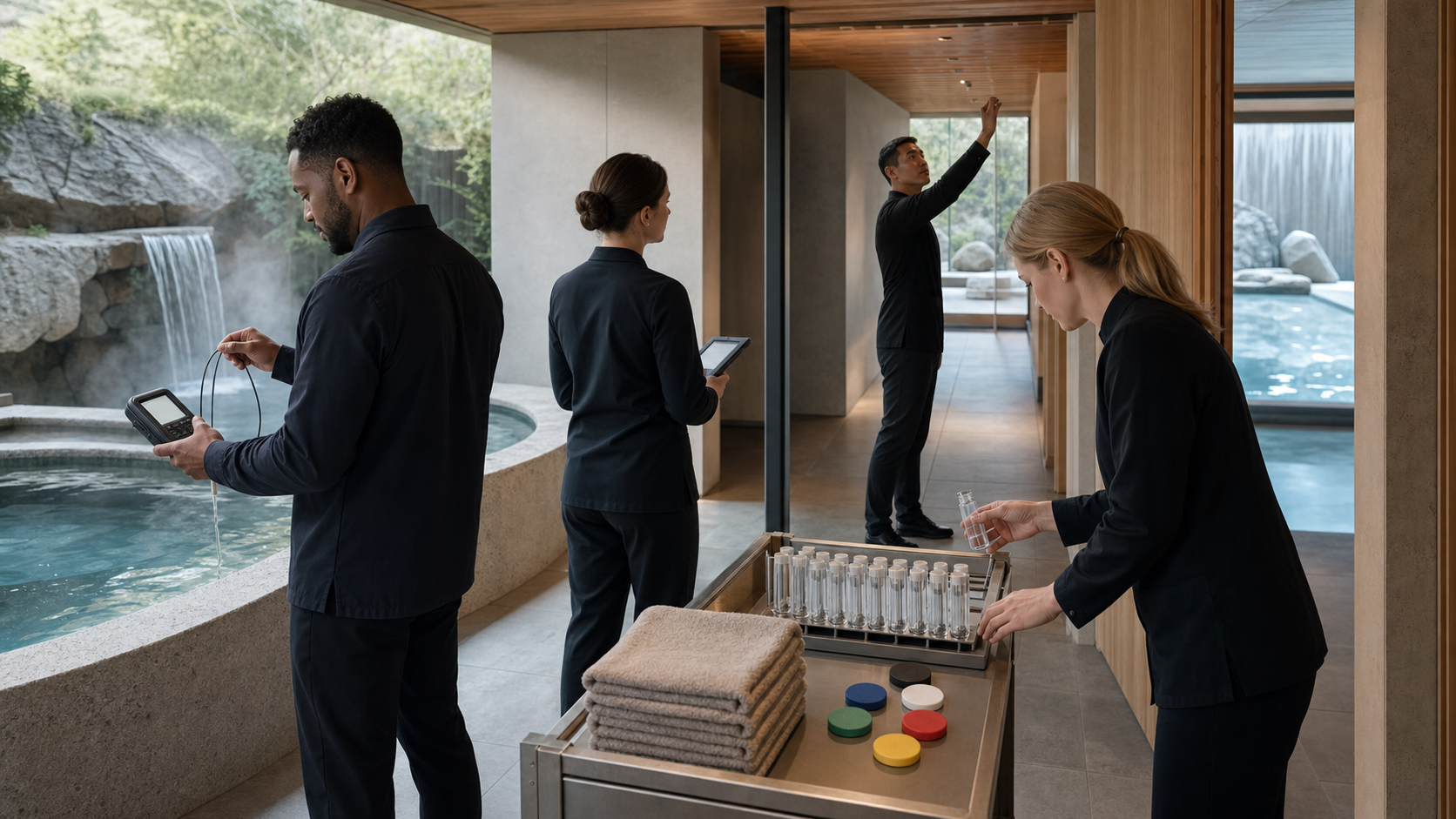
Daily evidence should cover more than a pass/fail chemical reading. Record temperature, disinfectant and pH checks at the required frequency; verify turnover, filtration and make-up water; document closures and corrective action; and connect maintenance records to guest load. Mineral formulation, warm water and small high-use vessels can create different operating demands. A story about global inspiration does not replace local water engineering.
Guidance should make the experience more inclusive
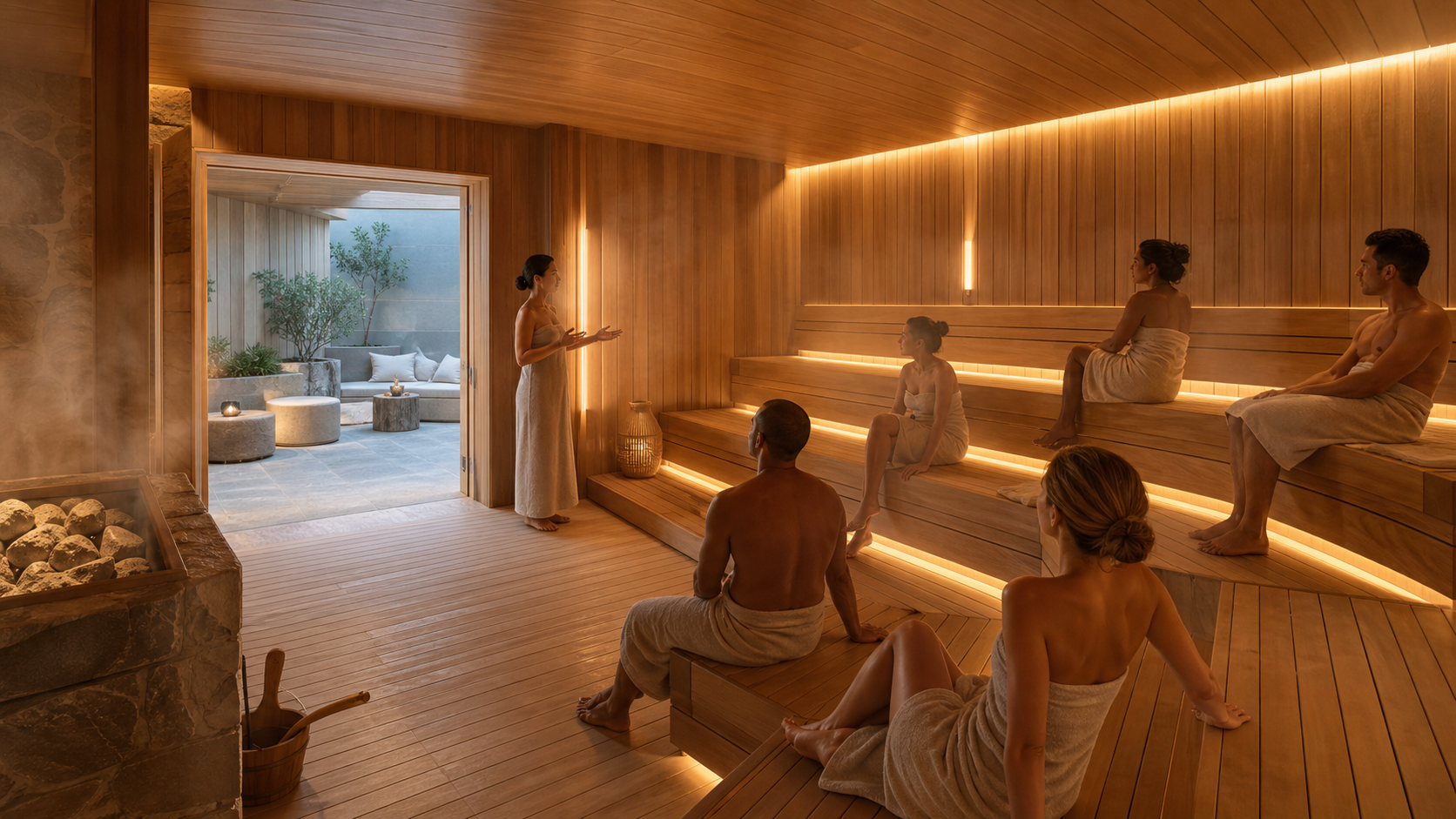
Guided thermal rituals can add culture, rhythm and confidence, but facilitation is a live service role. Define facilitator competence, session capacity, scripts, stop criteria and incident escalation. If aromas, music, light or towel movements are used, review ventilation, sensory intensity, allergy communication, slips, visibility and the needs of guests who prefer a quieter route.
Offer meaningful alternatives. A person who does not enter the cold plunge should still be able to complete a coherent journey. Lower benches, shorter exposure, neutral-temperature rest, quiet sessions and clear exits can make the experience less performative and more hospitable. Accessibility should be tested through booking information, changing areas, surfaces, transfers, routes and staff assistance rather than reduced to a single piece of equipment.
This is also a trust issue. The Journal’s pre-launch trust standard argues that technology should have a defined purpose, consent boundary and evidence plan before it shapes a guest journey. Thermal programming deserves the same discipline. Decide whether a ritual is entertainment, relaxation, general wellness, sports recovery or something else, and keep communications inside that chosen scope.
Claims need a separate commissioning file
Construction completion does not validate marketing language. Create a claim register that lists every proposed benefit, the exact evidence relied on, the population and protocol studied, material exclusions, and the approved wording. Separate measurable facility facts—such as a recorded water temperature or class schedule—from company descriptions, guest impressions and health outcomes.
Red-light and chromotherapy language requires particular care because colour, heat and light can be bundled together in the guest’s mind even when the underlying technologies and evidence differ. A warm room with red ambient light is not automatically a photobiomodulation treatment. Naming the equipment, intended use and claim boundary prevents an atmospheric feature from acquiring an unsupported clinical meaning.
Do not borrow athlete partnerships as proof for ordinary guests. An official team relationship can verify a commercial association; it does not establish that every athlete used a service, that a protocol improved performance or that the same sequence is suitable for the general population. Testimonials, media coverage and booking demand belong in different evidence columns from controlled health research.
Work design is part of thermal safety
Thermal expansion adds invisible work: opening checks, cleaning, water logs, towel and hydration supply, session hosting, guest questions, incident response, closing checks and maintenance coordination. Guided experiences concentrate that work into fixed periods. Managers should calculate labour at the route level and include the time needed to recover, document and reset.
Heat exposure also concerns staff. The US Occupational Safety and Health Administration’s water, rest and shade guidance explains that rest needs increase with heat stress and depend on the environment, activity and individual factors. A hospitality sauna is not the same as an industrial heat site, but the management principle is useful: assess the actual exposure of facilitators, cleaners and maintenance teams, provide cooler recovery space, rotate tasks where needed and make symptoms reportable without penalty.
Do not reward facilitators for endurance, room fullness or positive claims. Useful measures include sessions delivered within capacity, voluntary exits handled well, closures made promptly, water and room checks completed, incidents escalated, guest understanding and staff recovery. A quiet stop decision can be evidence of good operations.
What does this mean for spa and wellness professionals?
For owners and developers, approve a thermal sequence only with an operating concept, commissioning plan and claim boundary. A collection of impressive rooms is not yet a service system.
For spa directors, set inventory from the narrowest safe part of the full journey. Test ordinary opening hours, peak arrival waves, maintenance closures and guests with different comfort levels.
For facilities and aquatic teams, connect water, air, surfaces, temperatures, circulation and corrective action in one evidence file. Local rules take precedence over generic global inspiration.
For facilitators and therapists, define role boundaries, competence, stop criteria and recovery. Guests should never need to perform discomfort to satisfy the programme or the group.
For marketing teams, separate what is open, what is planned, what the company says and what independent evidence supports. Avoid converting colour, temperature, minerals, celebrity use or an athlete partnership into a medical promise.
For awards researchers and editors, directory presence, a new facility, a partnership or a busy session is not evidence of a visit, nomination, judging, safety, verified outcomes or an award result. Ask for logs, training, incident learning and claim governance.
A 30-day thermal commissioning review
Days 1–7: establish the operating baseline. List every zone and status: open, restricted, under commissioning, under maintenance or planned. Verify local rules, equipment manuals, water and air controls, accessibility, emergency routes and approved claims. Record normal guest and staff flow before adding new sessions.
Days 8–14: test the complete route. Run small, pre-booked sessions with conservative capacity. Observe arrival, changing, showering, heat, cold, rest, hydration and departure. Vary the route for guests who decline one element. Log temperatures, water results, dwell-time ranges, closures, cleaning and staff interventions.
Days 15–21: test facilitation and pressure. Review scripts, aromas, lighting, music, line of sight, exits and handovers. Introduce realistic arrival waves without exceeding limits. Confirm that staff can stop a session, close a zone and communicate an alternative without seeking commercial approval.
Days 22–30: decide with evidence. Compare the route with baseline incidents, guest understanding, capacity, staff exposure, maintenance and operating cost. Approve, redesign, hold or remove individual elements. Do not let a headline opening date force unresolved components into service.
What remains unproven
The reviewed sources do not independently establish the clinical effectiveness of WorldSprings’ sequences, the suitability of any named circuit for an individual, the current completion status of every facility, property-level profitability, or comparative quality. The official improvement page and later trade report describe an evolving programme, so status should be checked directly before a visit or professional assessment.
For international discovery, readers can examine directory profiles for Peninsula Hot Springs and Thermae Bath Spa. These links provide context on active spa listings only. They do not establish that Spa Awards visited, nominated, judged or awarded either property, and they do not validate a particular contrast-therapy protocol.
Frequently asked questions
Does every contrast circuit need cold immersion?
No. Operators can design coherent alternatives around warmth, cooling, rest and guest choice. The experience should not depend on pressuring every guest into the most intense element.
Can a facility copy a published time-and-temperature sequence?
Not safely by default. Equipment, water, air, supervision, local rules and guest populations differ. A published sequence is not a substitute for site-specific technical and professional review.
Does a new sauna prove a spa is ready for guided rituals?
No. Guided capacity, facilitator competence, ventilation, sensory controls, exits, rest space, staff exposure and incident procedures need separate commissioning.
