
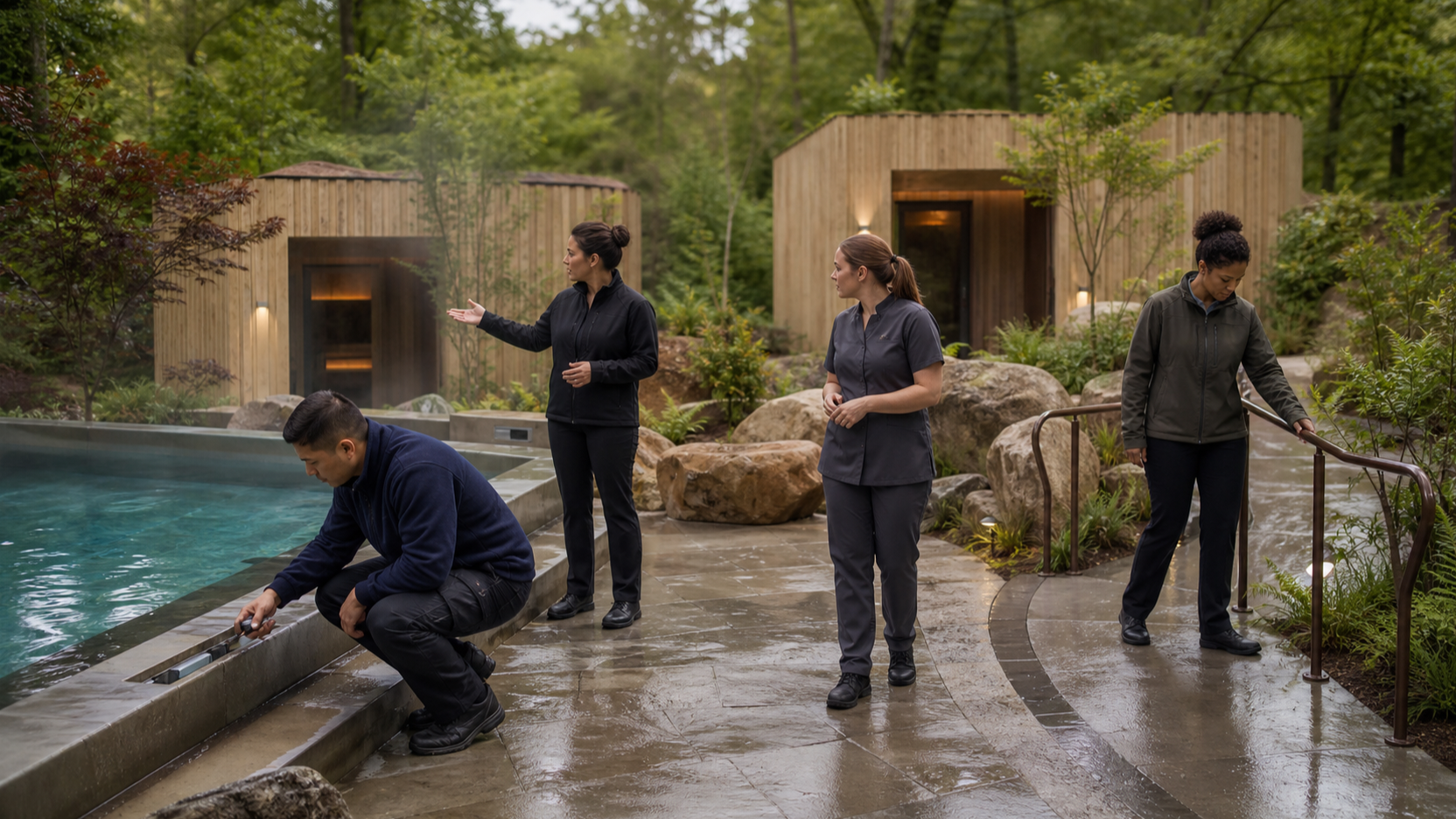
A garden thermal area can feel effortless to a guest, but outdoor spa operations are never effortless behind the scenes. Water, heat, weather, planting, lighting, access, staffing and emergency response meet in one exposed service zone. If those systems are managed separately, the most beautiful path can become the point where hospitality breaks down.
That is the professional question raised by a current UK opening. On 7 August 2026, Spa Business reported that Gisborough Hall had debuted Sakura Spa, a woodland retreat with six treatment rooms, a vitality pool, heat experiences, cold facilities and outdoor relaxation spaces. The hotel’s active booking page lists daily spa experiences and asks guests to bring suitable footwear and a reusable water bottle. These sources establish an operating offer; they do not establish safety performance, environmental benefit, accessibility, treatment outcome or award merit.
The useful lesson is therefore not a property review. No visit, treatment, interview or test was conducted for this article. Instead, the opening provides a timely prompt for an international operating framework: how can a spa make an outdoor concept reliably safe, inclusive and calm across ordinary days, sudden weather and seasonal change?
What the Sakura Spa opening establishes
The specialist report describes a woodland spa garden with a seven-metre vitality pool, three heat experiences, cold plunge and shower options, relaxation areas and a terrace used for movement and contemplative activities. The hotel’s own planning material had previously described six treatment rooms and an extensive thermal garden, while its current booking route confirms that spa-day inventory is available. Together, those records support the limited conclusion that a new outdoor-led spa offer has entered service.
They do not show how many guests have attended, how the water is monitored, which weather triggers alter the service, how access works for different bodies, whether advertised sustainability practices have been measured, or whether any wellbeing outcome has been independently assessed. Phrases about renewal, restoration or connection to nature remain concept and marketing language unless the operator defines and evidences a narrower claim.
That distinction matters when a launch story is translated into professional advice. Facility presence is not proof of quality. A directory listing is not an inspection, nomination or award result. A photograph, booking button or supplier list cannot substitute for the records produced by daily operation.
Outdoor spa operations begin at the threshold
An indoor spa normally has a controlled envelope. A garden spa extends the journey across thresholds: changing room to path, dry floor to wet paving, sheltered space to exposed space, warm cabin to cold air, bright interior to dusk. Each transition changes visibility, temperature, traction, supervision and the time needed to assist a guest.
Map the complete route before writing a procedure. Include reception, changing, storage, treatment rooms, thermal cabins, pools, showers, drinking water, rest areas, dining, toilets, accessible alternatives, staff-only plant areas and emergency exits. Walk it during rain, strong sun, darkness and a busy changeover. A map drawn from architectural plans will miss puddling, glare, wet leaves, condensation, awkward doors and the shortcuts people actually take.
For every transition, name the normal condition, inspection method, responsible role and stop rule. “Check the garden” is not a control. “Before opening and after material weather change, the duty lead records route lighting, surface contamination, drainage, handrails, barriers and emergency access” is observable. The record should allow another competent person to understand why an area remained open, changed format or closed.
Control outdoor spa operations through weather decisions
A forecast should trigger preparation, not automatic confidence. The UK Health Security Agency’s Adverse Weather and Health Plan for 2026–2027 brings heat and cold planning together and is supported by weather-health alerts. It is public-health guidance for England, not a spa operating standard. Its transferable lesson is that organisations should link forecast information to named actions before conditions become severe.
Build a local decision matrix covering heat, cold, rain, ice, wind, lightning, poor air quality and loss of power or lighting where relevant. Define who monitors the approved weather source, when checks occur, which areas are affected, how guests are contacted and what happens to booked treatments. Include intermediate states: shorten an outdoor sequence, move a class under cover, close one path, reduce capacity, add staff or offer an indoor alternative. Avoid the false choice between fully open and cancelled.
Thresholds must fit the site and local rules. Air temperature alone is insufficient around hot rooms and heated water; humidity, radiant heat, exertion, medication, clothing and individual vulnerability can change risk. Cold air can alter comfort after immersion. Wind can move furniture or branches. Rain changes traction and visibility. Lightning requires a plan that covers the pool, outdoor showers, exposed terraces and the route to shelter.
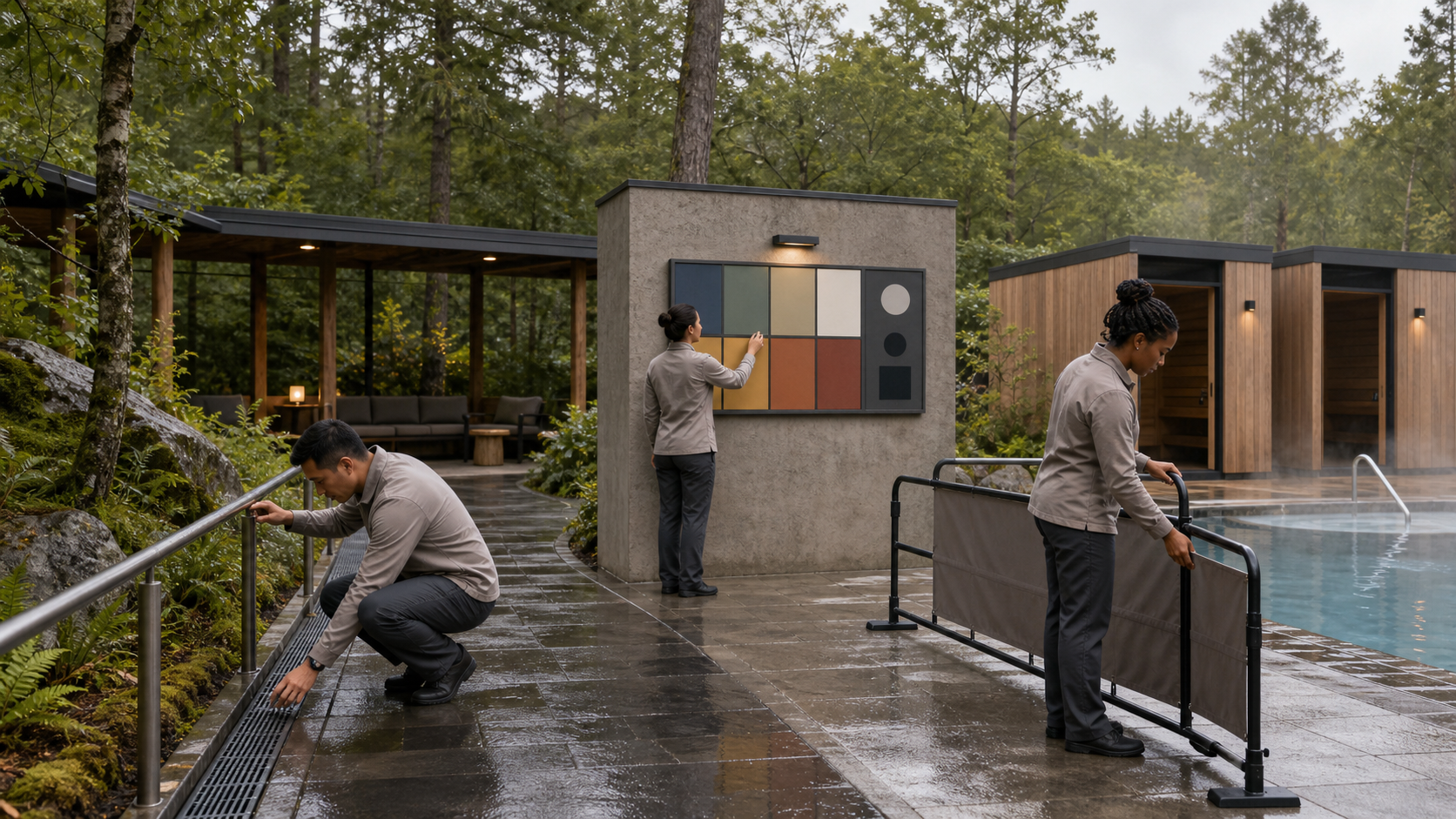
Reopening deserves its own checklist. A weather warning ending does not remove standing water, debris, surface damage or a plant-room fault. Inspect, correct, document and communicate before returning to the normal journey. Keep a fair rebooking and refund process so commercial pressure does not silently override a stop decision.
Treat every pool as a controlled system
The UK Health and Safety Executive’s swimming-pool safety guidance says operators must protect workers and users, assess the risks of their particular pool and decide what supervision is required. If constant poolside supervision is not required, it says trained staff must be on call and able to respond immediately. This is jurisdiction-specific guidance, but it illustrates why a tranquil appearance cannot decide the rescue model.
Write a pool safety operating procedure that reflects depth, temperature, features, visibility, bather load, guest profile, alcohol controls, transitions from heat or treatment, and the delay created by garden paths. Test sight lines from real staff positions. Planting, steam, low light, reflections and relaxation structures can obscure a person without appearing to block the pool in a design review.
Water quality is a separate control. HSE’s guidance on infectious agents in spa-pool systems explains that such systems have been linked with outbreaks and calls for controls across design, commissioning, operation, maintenance, water testing and inspection. It is not evidence that any named facility has a problem. It is evidence that attractive water must be managed as engineered public-use infrastructure.
Define sampling, dosing, circulation, cleaning, filter care, microbiological testing, plant alarms and escalation with competent technical advice. Record results and corrective action. A value written in a log is not enough if nobody checks trend, investigates deviation or confirms recovery. Weather can also introduce debris and increase demand; the operating plan should say when additional inspection or treatment is necessary.
The Journal’s earlier guide to commissioning heat, cold and flow is relevant where guests move between saunas, steam, cold water and rest. Sequence, guidance, exclusions, hydration, staff exposure and recovery space belong in one journey. The presence of heat and cold facilities does not establish a therapeutic result.
Make wet routes accessible, legible and dignified
Access is not solved by an accessible entrance if the usable experience ends at the changing room. Review gradients, crossfalls, turning space, thresholds, handrails, seating, transfer options, surface temperature, lighting, acoustics, shelter, assistance and emergency evacuation across the outdoor journey. Ask what remains available when a route closes because of rain, ice or maintenance.
The Equality and Human Rights Commission’s updated services Code of Practice explains that public and private service providers in Great Britain should not discriminate and may need to deliver services differently so disabled people can receive the same standard as far as possible. Other jurisdictions have different duties. Operators should obtain local advice and involve disabled people in testing, rather than assuming that one design feature meets every need.
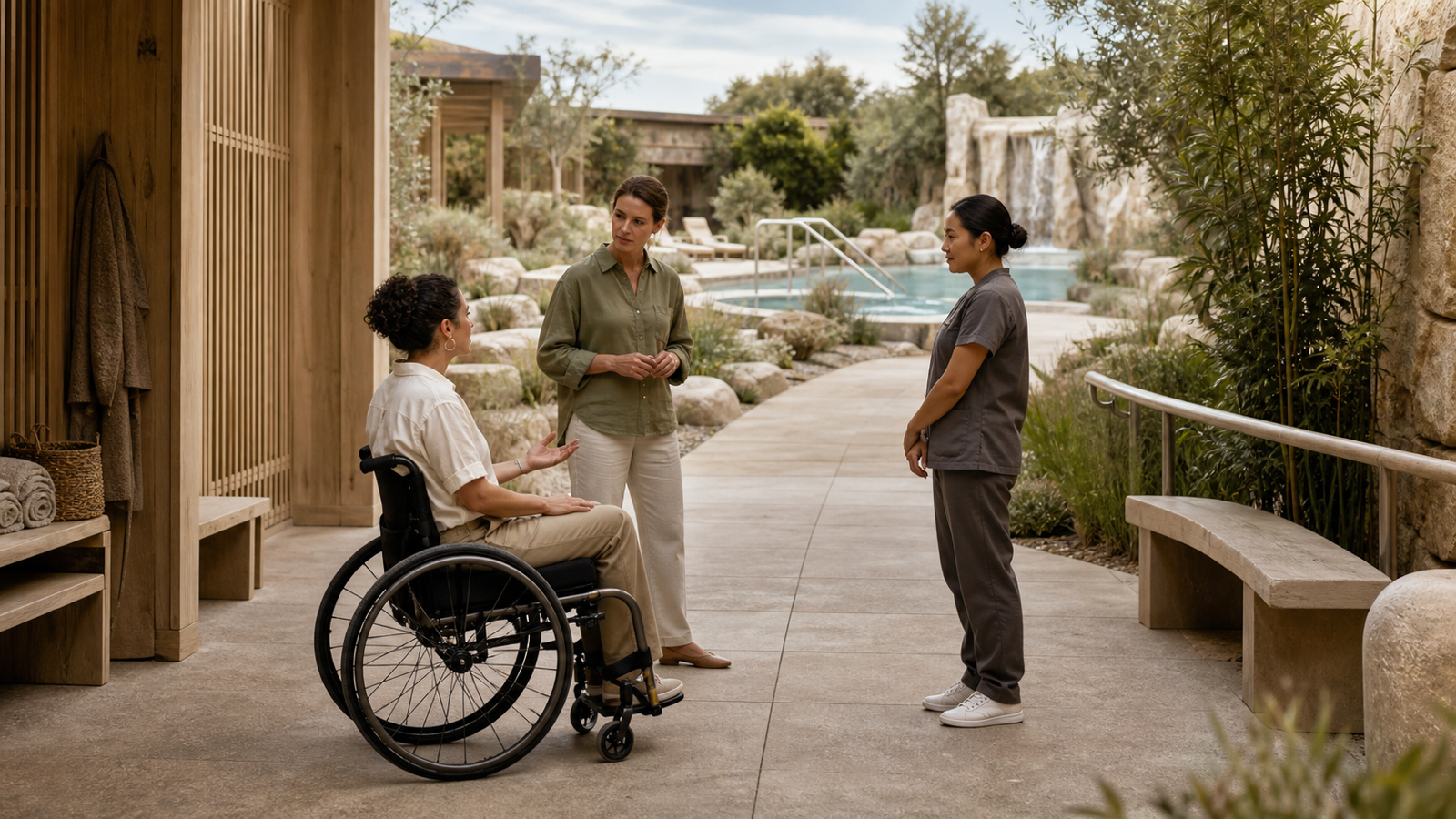
Publish useful pre-arrival information: route surfaces, distances, steps, transfer equipment, changing facilities, pool entry, quiet alternatives, temperature ranges where appropriate, assistance available and how to discuss adjustments. Do not advertise “fully accessible” as a blanket claim. Describe features and limits, then provide a human contact who can help a guest make an informed choice.
Active directory profiles such as Thermae Bath Spa and The Garden Spa by L’Occitane at The Bath Priory can help researchers compare different garden, thermal and hotel contexts. Their presence in the Spa Nomination Directory does not prove identical facilities, accessibility, inspection, nomination, judging, endorsement or award outcome.
Staff the transitions, not only the rooms
Outdoor zones create distributed work. Therapists, attendants, lifeguards or responders, technicians, cleaners, food teams and reception staff may each see only part of the journey. Define who owns the whole operating picture during each shift. That person needs authority to change capacity, isolate a feature, call technical support and stop service.
Briefings should cover forecast, planned maintenance, water status, staffing, group bookings, access arrangements, unusual events and open corrective actions. Use a clear handover between day and evening conditions. Test radios or other communication at the furthest garden points, including in steam, plant noise and poor weather. A response time assumed from a floor plan should be rehearsed.
Protect staff too. Repeated hot-cold transitions, wet manual handling, outdoor cleaning, chemical tasks, long walks and emotional pressure from disappointed guests all affect work. Rotation and breaks should follow the exposure and task, not a generic timetable. The Journal’s analysis of spa therapist wellbeing explains why training cannot compensate for unrealistic schedules, weak reporting or inadequate recovery.
Measure the nature promise without inventing outcomes
A woodland setting can be a meaningful design asset, but “nature-led” is not one measurable outcome. Separate operational questions. Is shade available when needed? Are views preserved without blocking supervision? Are planting and products selected with credible ecological advice? Are water, energy, chemical use, waste and maintenance recorded? Do lighting and noise controls fit the site and local ecology?
Measure service reliability as well: weather-related closures, route defects, water deviations, assistance requests, near misses, guest complaints, staff exposure and corrective-action time. Review data by season and severity. A low incident count can mean good control, low use or weak reporting; it needs context.
Guest feedback may describe calm, beauty or connection, but it does not prove a medical or psychological effect. Marketing should identify the experience offered and avoid converting preference into guaranteed benefit. Sustainability statements need boundaries, method, period and evidence. Opening coverage, supplier claims and attractive imagery are not independent verification.
What does this mean for spa and wellness professionals?
For owners and developers, the garden belongs in the operating model from concept stage. Budget for drainage, lighting, shelter, plant access, monitoring, rescue, accessible alternatives, staff communication and seasonal maintenance. Opening day is the start of evidence collection, not the end of commissioning.
For spa directors, connect weather, water, guest service and workforce decisions in one shift-level control process. Give a named duty lead stop authority and a documented route to technical, medical or emergency help as locally appropriate. Audit the transitions where responsibility changes hands.
For therapists and attendants, competence includes recognising when the planned sequence no longer fits the guest or conditions, staying within scope, escalating concerns and documenting what changed. For marketers, describe real features and choices without implying universal suitability, clinical benefit, verified sustainability or award recognition.
For awards researchers, judge evidence at the level claimed. A concept may be compelling; an operating file should show inspection, training, water control, access, incident learning and honest communication. Directory presence remains a discovery tool, not a result.
A 30-day outdoor spa operations review
Days 1–7: map and observe
Walk every guest and staff route in dry, wet, bright and low-light conditions. Map water, heat, changing, shelter, access, communications and emergency movement. Photograph defects for internal action, assign owners and confirm which records already exist. Do not use the review as evidence of public certification.
Days 8–15: define triggers
Create site-specific weather and water decision tables with competent input. Define inspection frequency, supervision, bather load, stop rules, reopening checks, guest communication and commercial remedies. Test whether the duty lead can obtain the information and authority required during a real shift.
Days 16–23: rehearse inclusion and response
Run scenarios involving a route closure, pool rescue, plant alarm, mobility adjustment, sensory need, lost communication and sudden capacity reduction. Include disabled participants or qualified access expertise. Record gaps without blaming the person who exposes them.
Days 24–30: correct and verify
Prioritise material safety, access and water findings. Verify corrections through observation or test, update controlled procedures, brief every relevant role and set seasonal review dates. Remove or qualify any public claim that exceeds the available evidence.
What remains unproven
The cited opening and booking sources do not prove Sakura Spa’s operating performance, safety record, accessibility, environmental impact, guest outcome or award status. This article does not assert that Gisborough Hall uses the proposed framework. It makes no finding about any supplier, practitioner or treatment.
The UK sources describe responsibilities and planning in particular jurisdictions; they are not universal law or a property certification. Every operator must confirm current local health, safety, pool, equality, employment, environmental and consumer obligations with competent advisers.
Frequently asked questions
Does an outdoor spa always need a lifeguard?
Not necessarily. The supervision and rescue model depends on local law and a suitable assessment of the pool, users, features and response time. An operator should document the decision, train the assigned people and rehearse response under real site conditions.
Can a weather app decide whether the garden stays open?
No. A forecast or alert is an input. The site also needs observed conditions, defined thresholds, authority, guest communication, alternative service and a reopening inspection. Local emergency guidance takes priority.
Does a nature-led design prove wellbeing or sustainability?
No. It describes an intent or experience. Specific outcome and environmental claims require appropriate methods, evidence and boundaries. Operators can start with observable service conditions and measured resource or maintenance data.
