

A spa can promise rest while running on a workforce with too little time to recover between guests. That contradiction is receiving fresh attention after a 2026 therapist survey described physical exhaustion, emotional fatigue and doubts about staying in the profession. The findings are important, but they need careful reading. The survey involved 159 people across spa, beauty, wellness and therapeutic settings, most of them self-employed or independent. It is an exploratory signal, not a representative estimate for every country, employer or spa therapist. Its strongest professional use is therefore not to declare a universal crisis. It is to ask whether operating conditions support the people expected to create calm, attentive and safe guest experiences.
Why spa therapist wellbeing is an operating question
Therapist wellbeing is often discussed through personal habits: sleep, exercise, resilience or self-care. Those may matter to individuals, but a spa also controls work design. Appointment density, room setup, equipment, transitions, breaks, late-running protocols, client conduct, role boundaries, manager support and schedule changes are operational decisions. When those decisions create repeated physical or emotional load, asking the individual to become more resilient leaves the source of pressure untouched.
The Spa Business report on therapist wellbeing, published on 12 July 2026, was the initial industry-news signal. It reported that one in three respondents had considered leaving because of concerns about their wellbeing. A separate Professional Beauty analysis published on 15 July provides further percentages and describes the research as an anonymous survey created by therapist and campaigner Hayley Snishko in association with education provider The Power of Touch. Both reports concern the same survey; they are corroborating coverage, not two independent samples.
What the survey shows—and what it cannot show
The public reporting says 159 professionals responded. Sixty per cent identified as self-employed or independent practitioners, 15 per cent as spa or senior spa therapists, 10 per cent as managers or leaders, 5 per cent as educators, and the remaining 10 per cent as specialists. More than three quarters had worked in the industry for over six years. This mix broadens the experience captured, but also limits claims about employed spa teams. An owner-operator choosing a daily caseload and a therapist working a hotel rota may face different demands, control and support.
Across the sample, 89.3 per cent said they had experienced physical exhaustion from work; 32.1 per cent said it occurred frequently or very frequently. Emotional fatigue had been experienced by 86.8 per cent, including 30.2 per cent frequently or very frequently. Burnout or overwhelm had been experienced by 72.3 per cent, with 27.7 per cent selecting the two highest-frequency options. These figures describe whether respondents had ever experienced a condition as well as how often. They should not be shortened into a claim that nine in ten therapists are continuously exhausted or that the survey diagnosed a clinical condition.
The findings also contain a strong positive signal. Professional Beauty reports that 99.4 per cent had felt fulfilled by their work and every respondent had experienced a meaningful connection with clients; 79.9 per cent and 82.4 per cent respectively selected frequently or very frequently. Those results suggest commitment and pressure can coexist. Retention work should protect what makes the role meaningful while reducing avoidable load, rather than assuming dissatisfied people simply need motivation.
Important methodological details are not available in the public material reviewed for this article. The coverage does not publish the recruitment channel, fieldwork dates, response rate, complete questionnaire or country distribution. The sample is small and appears self-selected. Perceptions about clients becoming more anxious, exhausted or emotionally overwhelmed are practitioner perceptions, not measurements taken from clients. No causal link can be drawn between a particular rota, management practice or training programme and the reported outcomes.
Move from a wellbeing benefit to a work-design review
International guidance supports looking first at the organisation of work. The World Health Organization guidelines on mental health at work cover organisational interventions, manager and worker training, individual interventions, return-to-work support and access to employment. WHO does not present a single wellness activity as a substitute for changing harmful conditions. For spa leaders, that means a meditation subscription or staff treatment allowance can be useful only alongside a review of workload, control, support and role clarity.
The UK Health and Safety Executive offers a practical diagnostic through its Management Standards for work-related stress. The six areas are demands, control, support, relationships, role and change. Legal duties vary by jurisdiction, so an international operator must follow the rules where each spa works. The framework is still a useful set of questions for any management team because it separates vague concern from conditions that can be observed and changed.
Demands: measure the whole appointment cycle
A treatment is not only the booked minutes with a guest. It includes reviewing information, welcoming and consulting, preparing equipment, delivering the service, helping the guest transition, resetting the room, handling notes where applicable, cleaning and moving to the next appointment. If a 60-minute service occupies a 60-minute slot, one or more of those tasks becomes unpaid, rushed or transferred to a colleague. Managers should time complete cycles by service type and room, then test the schedule on peak days rather than relying on an ideal average.
Physical load also varies. Repeating the same manual technique, moving equipment, reaching across a fixed-height table or working without a genuine pause may matter more than the number of guests alone. A credible review combines schedule data with therapist feedback and an ergonomic assessment appropriate to local occupational-safety requirements. It should not wait for injury or absence before equipment and technique are examined.
Control: give teams a safe way to influence the rota
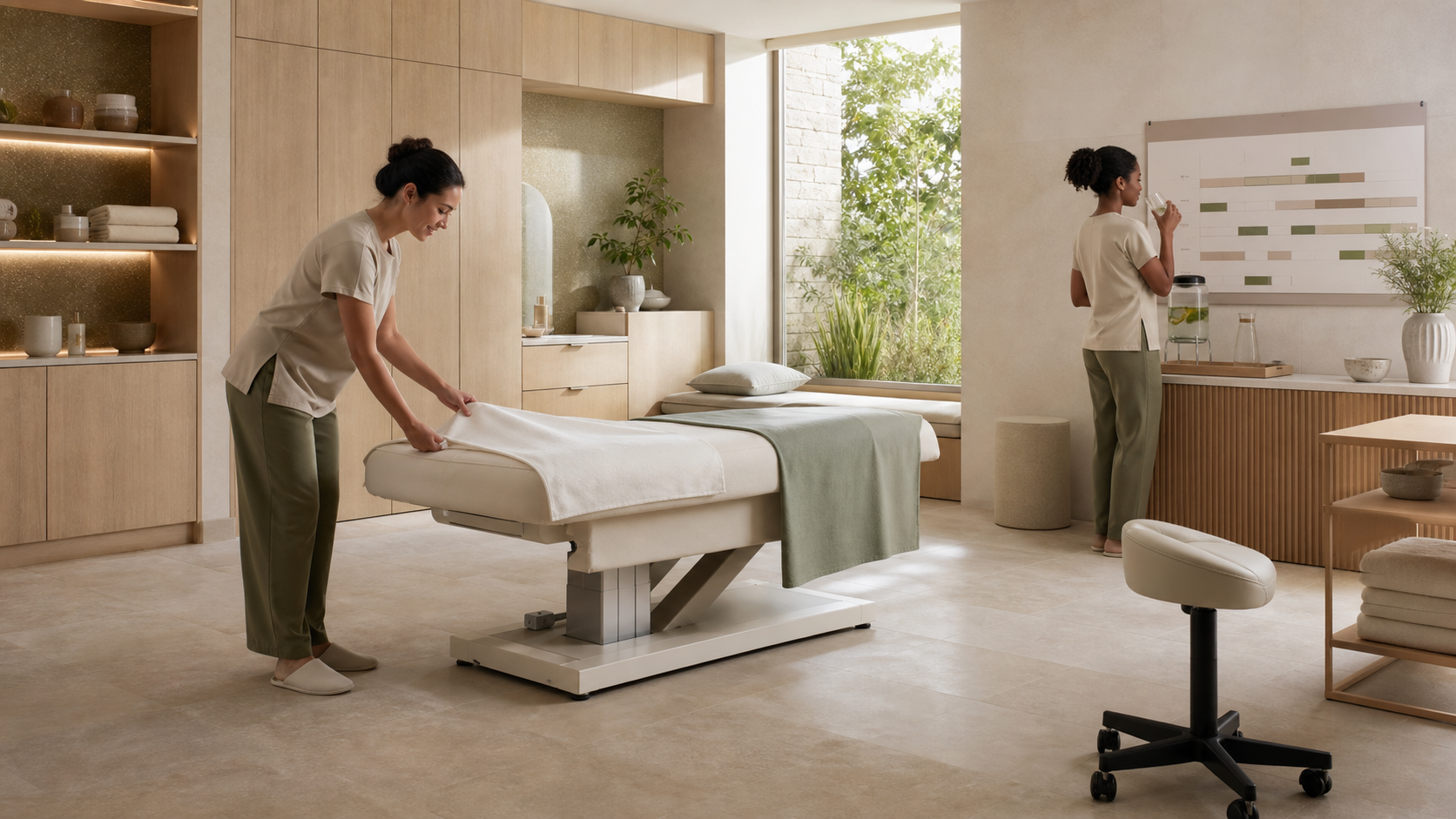
Control does not mean every employee chooses every booking. It means the people doing the work can raise a capacity problem, record a restriction, request rotation and understand how changes are decided. A manager needs a protocol for late arrivals, add-ons, double bookings, shortened resets and guests requesting a service that falls outside the assigned therapist’s competence. Without a protocol, commercial pressure is resolved informally at the treatment-room door.
Useful controls include limits for consecutive manual treatments, service rotation, protected meal periods, recovery buffers after high-load services and an escalation path that does not punish a therapist for flagging safety or scope. The right thresholds depend on the service, practitioner, law and evidence. This article cannot supply a universal maximum caseload.
Support and relationships: make difficult moments discussable
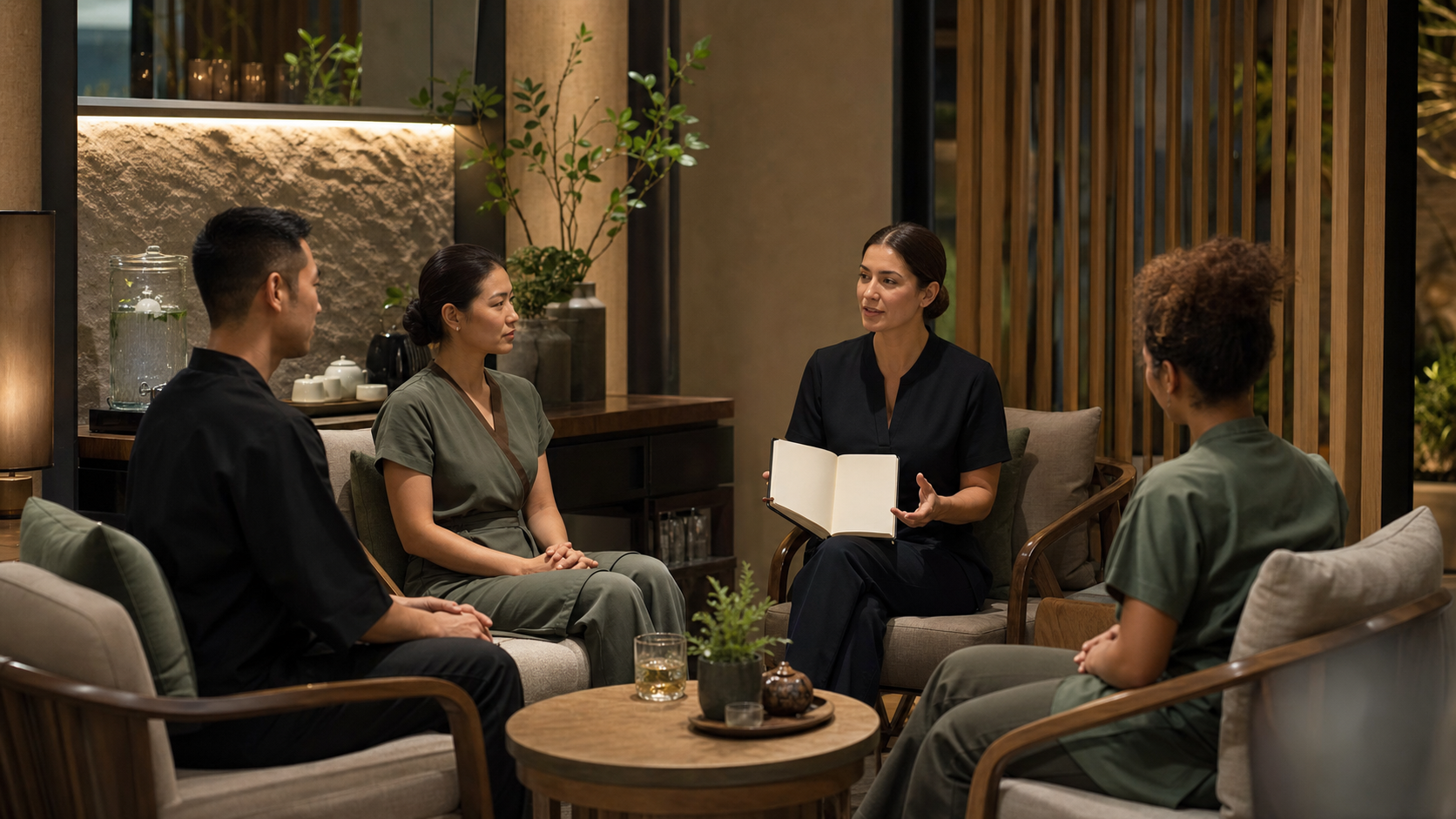
Spa work can include sustained attention, close physical proximity and conversations in which a guest shares personal concerns. Hospitality skill does not turn a therapist into a mental-health clinician. Teams need scripts for professional boundaries, access to a manager during an incident, a process for unacceptable client conduct and an appropriate referral route when a request falls outside scope. Training should clarify those limits rather than encourage staff to take responsibility for problems they are not qualified to manage.
Support also needs a routine. A brief check-in after an incident, an accessible way to report patterns and a scheduled one-to-one can reveal whether the same service, shift or policy is generating strain. Confidentiality matters: managers should collect only the information needed for a work decision and handle health information under applicable privacy and employment rules.
Role and change: define what the job is becoming
The survey reports that respondents wanted development in areas including trauma-aware care, menopause, nervous-system regulation and emotional resilience. Interest in a topic does not itself establish a qualification standard, evidence of benefit or permission to practise beyond a regulated scope. Spa employers should start with the guest situations staff actually encounter, then choose training that is evidence-informed, relevant to role and clear about referral.
Snishko’s primary C.A.R.E. programme page describes a forthcoming professional-development offer covering therapeutic relationships and communication, professional practice and boundaries, therapist wellbeing and sustainable practice, and leadership. It is authoritative for what its creator plans to offer, but it is not an independent evaluation of outcomes. An announced programme should not be reported as proven to improve retention or wellbeing before implementation and assessment.
The ISO 45003 overview provides broader management context. The standard gives guidance for managing psychosocial risk within an occupational health-and-safety system and applies across sectors and organisation sizes. Its existence does not certify any spa, and the full standard requires proper implementation. The relevant principle is that psychological health and safety can be managed through an ongoing system, not only through individual support after a problem appears.
Build an evidence file for therapist wellbeing
A staff survey is a starting point, not a finished programme. Before collecting new data, define who will see it, how confidentiality will be protected and what decisions the results can trigger. Small teams may need an external channel or aggregated reporting because identities can be obvious even without names. Do not ask employees to disclose diagnoses or personal history when workload, equipment, scheduling and support can be assessed directly.
Combine leading and lagging indicators. Leading indicators can include planned versus actual reset time, consecutive-treatment patterns, missed breaks, overtime, schedule changes, equipment faults, training completion and response time to reported concerns. Lagging indicators may include absence, turnover, vacancies, incidents, complaints and exit themes. Guest scores should not be used to dismiss staff evidence: a team can preserve service quality for a period by absorbing unsustainable pressure.
Measures also need context. A rise in reported concerns may mean conditions worsened, but it may also mean trust in the reporting process improved. Low incident numbers may mean controls work, or that the reporting route feels unsafe. Management should review patterns with employees, record actions, set owners and dates, and check whether the change altered the condition it targeted.
What does this mean for spa and wellness professionals?
For owners and general managers, therapist wellbeing belongs in operating reviews, not only human-resources communications. Ask whether service design includes all required tasks, whether commercial targets assume missed buffers, and whether managers have authority to protect a safe rota. Earlier Spa Awards Journal guidance on recruiting spa therapists explains the hiring side; retention depends on whether the promised role matches daily delivery.
For spa directors, test the system service by service. Observe full appointment cycles, review late-running decisions, rotate demanding work where appropriate and document the response to repeated issues. The Journal’s earlier article on employee motivation and retention offers historical context, but recognition is not evidence that current workload or support is adequate.
For therapists and practitioners, describe the work condition as specifically as possible: the service sequence, missing buffer, equipment problem, client-boundary issue or unclear instruction. That gives management something it can assess. Where a health concern exists, use qualified professional support and the processes available in the relevant jurisdiction; an editorial article cannot diagnose or provide individual treatment advice.
For educators and suppliers, avoid turning a workforce concern into an unsupported product promise. Training can improve knowledge or practice when it is relevant and evaluated, but it cannot compensate for an impossible schedule. Equipment can reduce certain demands only when it fits the service, room and user and is maintained correctly.
For awards researchers and directory users, workforce claims require evidence. A policy, benefit list or directory profile does not prove how a spa operates. Active directory pages for Chiva-Som International Health Resort and The Oriental Spa at Mandarin Oriental Bangkok help readers discover different established spa settings; their inclusion here is not an award result, endorsement or verification of employment practice.
A practical 30-day operating review
In week one, map complete appointment cycles and identify where reset, consultation or record time disappears. In week two, hold confidential team discussions around demands, control, support, relationships, role and change; compare those accounts with schedules, overtime and incidents. In week three, choose a small number of changes with named owners, such as a buffer for one high-load service, a clearer late-arrival rule, an equipment adjustment or a manager escalation route. In week four, check implementation with the people affected and record what needs a longer trial.
This is not a certification exercise. The purpose is to create a traceable loop: identify a condition, agree an action, observe the result and review it. A spa that cannot change everything at once can still stop treating uncertainty as proof that nothing is wrong.
What remains unproven
The 2026 survey does not establish an international prevalence rate for therapist burnout, identify causal factors or prove which intervention improves retention. Public reporting does not provide enough methodological detail to compare the figures directly with national workforce data or other spa surveys. The C.A.R.E. programme is announced, not independently evaluated. WHO, HSE and ISO guidance provide credible frameworks, but using a framework does not prove successful implementation.
The responsible conclusion is narrower and more useful. A current industry signal has identified experiences that management should be willing to examine. Spa leaders can respond without overstating the research: measure complete work, involve the people doing it, change controllable conditions, protect professional boundaries and verify whether action made a difference. Therapist wellbeing is personal, but it is not only personal. The operating system matters.
Frequently asked questions
Does the survey show that most spa therapists are burned out?
No. It reports experiences among 159 respondents from mixed spa, beauty, wellness and therapeutic backgrounds, most of whom were independent. The sample is not presented as representative of all spa therapists, countries or employers.
Is resilience training enough?
No single intervention is enough for every setting. Training may help, but organisational guidance also points to work design, management, support and risk controls. A spa should assess the conditions creating pressure rather than place the entire responsibility on the individual.
What should a spa measure first?
Start with complete appointment cycles, actual reset time, missed breaks, repeated schedule changes, consecutive high-load services, overtime, incident patterns and the accessibility of manager support. Discuss the findings with the team before setting targets.
Does directory presence or an award prove good employment practice?
No. Directory presence helps discovery, and a verified award concerns its stated criteria and period. Neither should be presented as proof of current workforce conditions unless that specific claim was independently assessed.
