
Business-event wellness starts with the whole delegate day
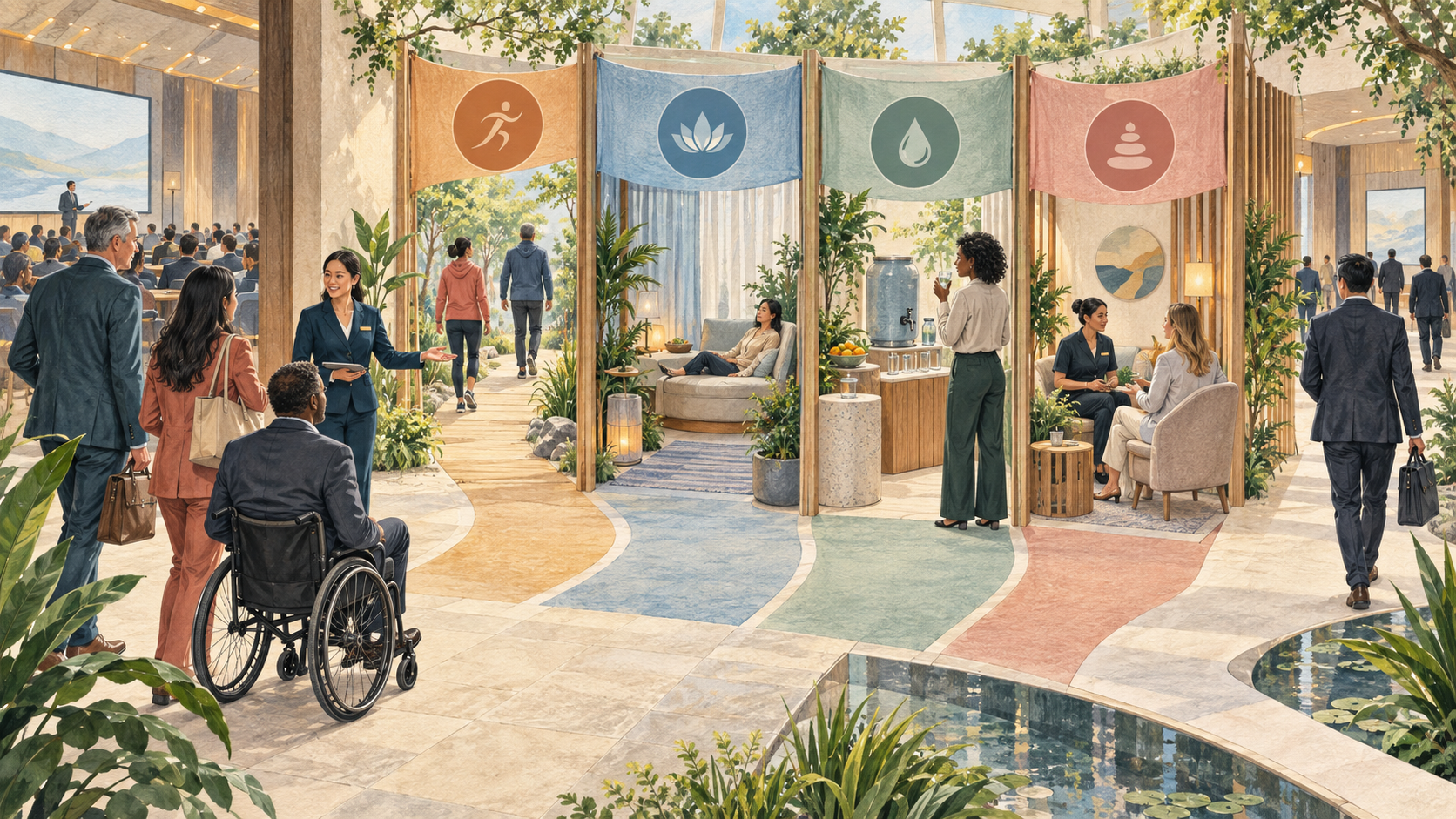
Business-event wellness is moving beyond a bowl of fruit beside registration or a spa discount added to the closing email. The more useful question is operational: how can an organiser, hotel and spa give delegates realistic ways to move, pause, hydrate, find quiet or book a service without turning participation into a promise of health, performance or recovery?
Two current signals bring that question into focus. At Gastech in Bangkok, running from 14 to 17 September 2026, the Tourism Authority of Thailand says it is presenting wellness, culture and responsible travel through an exhibition activation that includes Thai massage, tea, puppetry and Muay Thai demonstrations. Separately, Spa Business reported on 14 September that Hilton plans an integrated fitness and recovery concept for its still-unopened Signia Hilton Indianapolis, a meetings-focused hotel.
These are different propositions: one is a time-limited tourism showcase inside a large energy conference; the other is an announced hotel facility intended to serve travellers, local users and private groups. Neither proves a delegate outcome or an industry-wide trend. Together, however, they show why wellbeing is becoming part of the event journey rather than a standalone spa appointment.
What the current signals establish
The official Gastech site confirms the Bangkok dates and describes an exhibition and conference for the global energy industry. TAT’s own release describes its booth, the four experience types and a promotional intention to connect wellness, culture, low-carbon travel and future tourism. The source does not report participant outcomes, completed spa treatments, independent evaluation or booking conversion. A demonstration is evidence that an activity was presented, not that every delegate took part or benefited.
Hilton’s 25 August announcement for Signia Restore says the future concept will combine fitness, recovery zones, technology, a wellness concierge and retail. It also says private group buyouts are planned for executive retreats, leadership summits and incentive programmes. Hilton’s current property pages present Indianapolis as a convention hotel with extensive meeting space and direct convention-centre access. These are issuer statements about a planned offer. Until the property and services are operating, they are not evidence of commissioning, utilisation, safety performance, guest satisfaction or commercial results.
This article therefore uses both signals as planning prompts. It does not review Gastech, TAT, Hilton, Signia Restore, any device, practitioner or treatment. It makes no finding about award merit and does not imply first-hand attendance.
Define the service boundary before promotion
A business-event wellness programme needs a written boundary before it needs a slogan. Name who the programme is for, which activities are included, where they occur, when they are available and which team owns each stage. Separate a public demonstration from a bookable service; a self-directed break from an instructor-led session; a spa consultation from a treatment; a hotel amenity from an event inclusion; and general wellbeing support from healthcare.
The boundary should also state what the offer does not promise. “A place to pause between sessions” is different from “stress reduction”. “Optional gentle movement” is different from “preventing the effects of sitting”. “Access to recovery equipment” is not proof of accelerated recovery. Copy, booking flows, staff scripts and signage should preserve those distinctions in every language used by the event.
Map the delegate day, not just the facility
Start with the actual day: travel, arrival, security, registration, seated sessions, meals, exhibition walking, networking, evening functions and return to accommodation. Mark high-load transitions and the time genuinely available. A ten-minute pause located twelve minutes from the conference room is not accessible in practice. A spa appointment that collides with a keynote is not an integrated choice.
Build a route for each offer. Record entry point, capacity, expected duration, clothing or equipment needs, accessibility, supervision, cleaning, water, storage, privacy, exit and return to the programme. Then walk the route at the busiest plausible time. Check that a delegate can leave without explanation, join late where appropriate and return without losing essential information.
The US Centers for Disease Control and Prevention workplace activity-break guide offers a useful bounded reference for organisers. It recommends simple activities, adaptable seated or standing participation, permission to work within personal comfort and a gradual approach. It is guidance for workplace physical activity, not proof that a particular conference break will deliver a health outcome.

Keep participation specific, optional and reversible
Delegates may be employees, clients, suppliers, speakers, regulators or job candidates. That context can make an apparently casual invitation feel compulsory. Wellbeing activities should not become a loyalty test, networking gateway or condition for accessing event content. Invitations need a clear “no” route, an equivalent non-participation option and no disadvantage for declining.
Consent belongs to the specific activity. Agreeing to enter a wellness lounge does not authorise touch, photography, health questions, a product trial or marketing follow-up. A movement break does not authorise an instructor to correct someone physically. A spa information desk does not create consent for assessment or treatment. Staff should ask at each boundary and make stopping easy.
Quiet must be a real choice. Not every delegate wants music, scent, guided breathing, group conversation or technology. Provide low-sensory seating and an ordinary circulation route that does not pass through a demonstration. If a cultural practice is presented, name the practitioner’s role and the limited purpose of the demonstration; do not convert cultural access into a decorative claim of authenticity or therapeutic effect.
Separate three layers of the offer
Universal supports
Universal supports sit inside the event design: reasonable transition time, accessible water, seating variety, clear wayfinding, quieter areas and opportunities to change posture. They should be available without a health disclosure, product purchase or spa booking. The World Health Organization’s physical-activity and sedentary-behaviour guideline supports the broad principle that all movement counts and adults should limit sedentary time, but it does not prescribe a branded delegate programme.
Optional facilitated activities
Short movement, meditation, breathwork or cultural demonstrations need a named facilitator, a defined scope, capacity, adaptations, stop instruction and escalation route. Risk depends on the activity and population; it cannot be solved by a generic disclaimer. Do not diagnose delegates or ask them to disclose more than is necessary to decide whether the activity is suitable.
Bookable spa or recovery services
Hands-on treatments, thermal experiences and recovery technology belong in the spa’s service system, even when the event promotes or pays for access. Keep practitioner scope, contraindication checks, cleaning, maintenance, incident response, records, pricing and cancellation terms under the responsible operator. A group allocation should not compress the suitability process or turn a treatment into an unreviewed conference perk.
Build capacity without creating a wellbeing queue
Capacity is part of the promise. Count rooms, seats, equipment, practitioners, cleaning intervals and travel time against the number of delegates who could reasonably arrive. Publish whether an offer is drop-in, timed, allocated by the organiser or booked privately with the spa. If access is limited, use a fair method and avoid presenting a scarce appointment as a universal inclusion.
Protect staff capacity as carefully as guest capacity. Event demand often arrives in short peaks, while spa work requires preparation, reset and professional attention. Do not remove breaks, shorten cleaning or extend practitioner scope to absorb a queue. Create a visible “full” state, a waitlist rule and a safe fallback such as quiet seating or a later booking opportunity.
Design access before the invitation
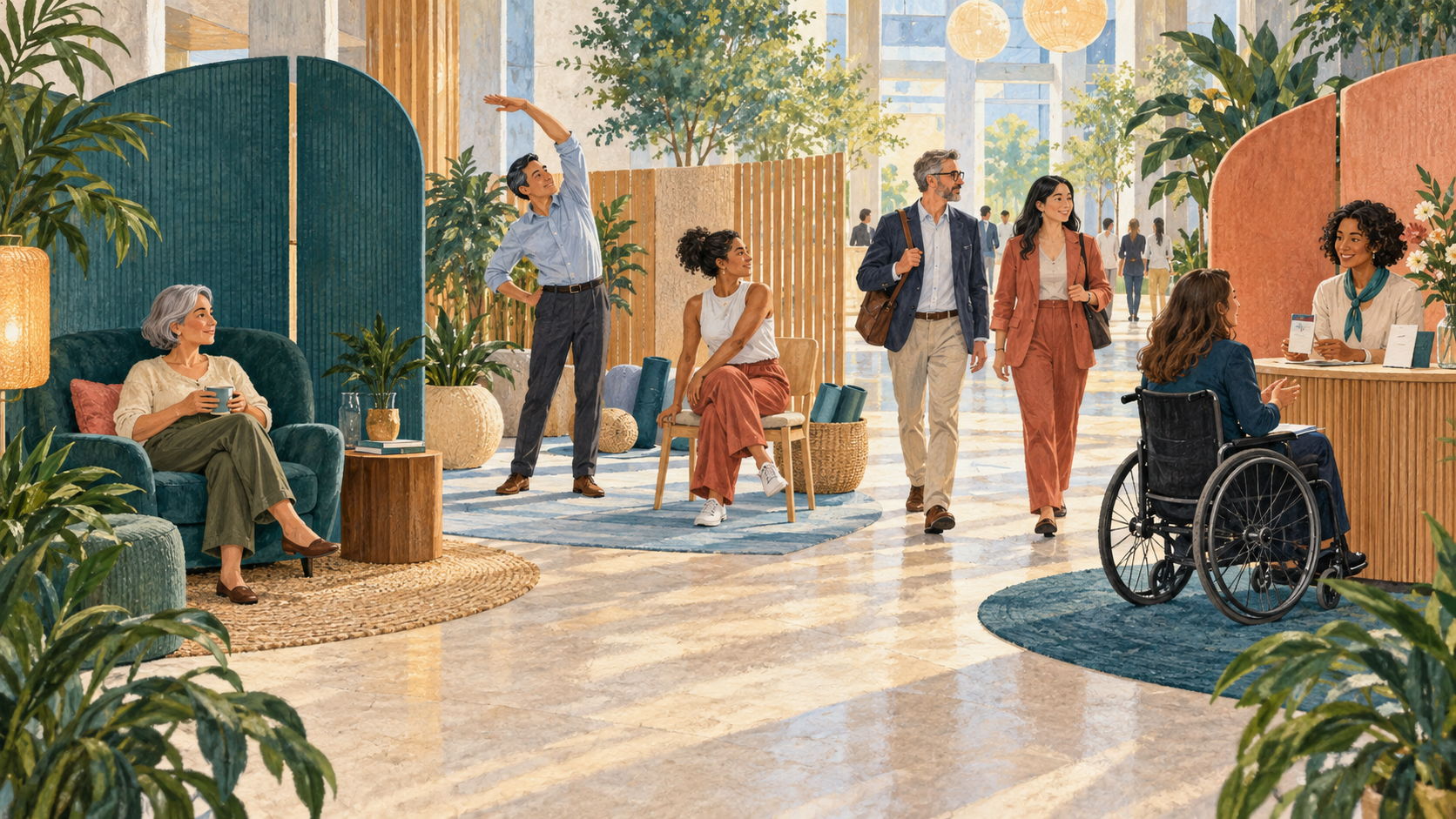
Access is more than step-free entry. Test the booking route, circulation width, seating, equipment transfer, changing space, lighting, sound, scent, captioning, interpretation, assistance policy and time needed between sessions. Offer seated and standing movement where the activity permits, but do not assume one version is suitable for everyone. Ask what adjustment is needed rather than asking for a diagnosis.
Publish practical information early enough for a delegate to choose. Include distance from the main programme, duration, physical contact, clothing, language, sensory conditions, cost, capacity and whether a companion or support person can attend. Put the same information in the booking confirmation and at the activity entrance.
Directory records can help readers discover different operating contexts, but they are not proof of event participation, access, inspection or award result. The Spa Awards directory pages for Urban Wellness Centre at Four Seasons Hotel Bangkok and The Oriental Spa at Mandarin Oriental Bangkok are included only as Bangkok spa starting points. This article does not say either venue is connected with Gastech, TAT’s booth or the Signia concept.
Keep claims at the level of the evidence
Event and spa marketing teams should maintain a claim register. For each phrase, record the exact claim, audience, market, source, date, owner, limitations and recheck point. Separate experience descriptions from outcome claims. “A guided ten-minute movement break” is observable. “Improves focus” requires matching evidence for the intervention, population and conditions. “Recovery technology” may name a service category; it does not establish a recovery result.
Future language needs equal discipline. Signia Restore is announced and promoted on official pages, but its Indianapolis debut remains prospective at the time of this review. TAT’s release describes what its live booth is presenting, not a completed evaluation of the four-day event. Use “plans”, “says”, “is presenting” and “is expected” where those are the supported states. Replace them only when a current operating or results source establishes the change.
Do not borrow authority from the venue. A convention-centre connection, luxury hotel, known spa brand or government tourism presence does not validate every claim made inside the programme. Each activity, product and result keeps its own evidence burden.
Minimise health and participation data
A delegate should not have to disclose a health history to enter a quiet room, refill water or choose a standard seat. Collect only the information needed for the specific service. Event organisers generally do not need spa consultation notes, treatment choices or suitability answers. The spa does not need access to the delegate’s employer, agenda or networking activity unless a clear operational reason and appropriate authority exist.
Map every data handoff: event platform to venue, organiser to spa, sponsor to organiser and device to vendor. State which fields move, why, for how long and who can act on them. Marketing permission must be separate from service administration. A wristband scan or room charge should not silently become consent for wellness profiling.
Measure the service before claiming an outcome
Begin with operational measures: sessions offered, places available, booking completion, queue length, no-show rate, accessibility requests met, cleaning intervals completed, staff breaks protected, incidents, complaints and return-to-programme time. These measures can show whether the offer functioned as designed. They do not establish health benefit.
Participation has several states: invitation, awareness, booking, arrival, start, completion and feedback. Keep them separate. A scan at a booth is not a completed activity; a booking is not attendance; satisfaction is not recovery. If outcomes are studied, define the question, method, comparison, consent and limits before collection, and use appropriate expertise.
The current ISO 20121:2024 overview describes a management-system approach to social, economic and environmental event impacts, stakeholder engagement and continual improvement. It is not a wellbeing certification and does not prove conformity by mention alone. It is useful here as a reminder to define scope, responsibilities, interested parties, operational controls, monitoring and corrective action around the whole event.
What does this mean for spa and wellness professionals?
For spa directors, business events can create legitimate discovery and demand, but only if the spa controls its professional boundary, capacity and records. For event organisers, the priority is a usable day: realistic transitions, accessible universal supports and optional activities that do not compete with core content. For hotels, the handover between event floor, guestroom, fitness area and spa must be commissioned rather than assumed.
For facilitators, state the activity, adaptation and stop route plainly. For marketers, describe what exists today and keep future facilities, participant numbers and benefits in their correct evidence state. For sponsors and technology suppliers, commercial visibility must not become a health claim or independent endorsement. For awards researchers, a well-staged activation is not evidence of service quality, outcome or recognition.
Two Journal guides extend the operating framework. Spa Community Events: Measure Access Beyond Attendance separates listing, arrival, participation and feedback. Spa Opening Readiness: Proof Before Promotion explains why plans and reservations do not replace completed commissioning. Neither guide proves any fact about the organisations discussed here.
A 30-day business-event wellness commissioning review
Days 1–7: map the day and the evidence
List every wellbeing touchpoint from arrival to departure. Record owner, source, current or future status, exact claim, capacity, route, cost and data flow. Remove any outcome statement without matching evidence. Flag activities that have no clear boundary between demonstration, instruction, consultation and treatment.
Days 8–14: walk every route
Test desktop and mobile booking, physical travel time, accessibility, signage, quiet alternatives and return to the programme. Rehearse declining, stopping, a full session, a late arrival and an assistance request. Confirm that staff can apply the process without asking for unnecessary health information.
Days 15–21: rehearse capacity and escalation
Run the busiest transition with realistic staffing and cleaning. Protect practitioner breaks. Test queue closure, incident coordination, equipment failure and communication across organiser, venue and spa. Keep clinical or treatment records with the responsible service, not the general event team.
Days 22–30: publish the bounded offer
Release accurate activity descriptions, access details, costs, limitations and booking rules. Train hosts to present participation as optional. Monitor operational measures during delivery, correct failures and schedule a post-event review. Publish outcomes only if the method supports them; otherwise report the service evidence without converting it into a wellbeing result.
What remains unproven
The reviewed sources establish that TAT described a wellness and culture activation at Gastech Bangkok, that Gastech lists a 14–17 September 2026 event, and that Hilton has announced Signia Restore for a meetings-focused Indianapolis property. WHO, CDC and ISO materials provide broader public-health and management context. They do not prove that a named delegate used an activity, that the programmes improved health or performance, that planned facilities have opened or passed commissioning, or that any device or service produced a result.
This article does not establish common practice, legal compliance in any jurisdiction, commercial success, cultural authority, a nomination, inspection or award. Its conclusion is procedural: business-event wellness becomes more credible when the whole delegate day is mapped, participation remains specific and reversible, spa services retain their professional controls, and operating evidence is reported without being inflated into a health outcome.

