
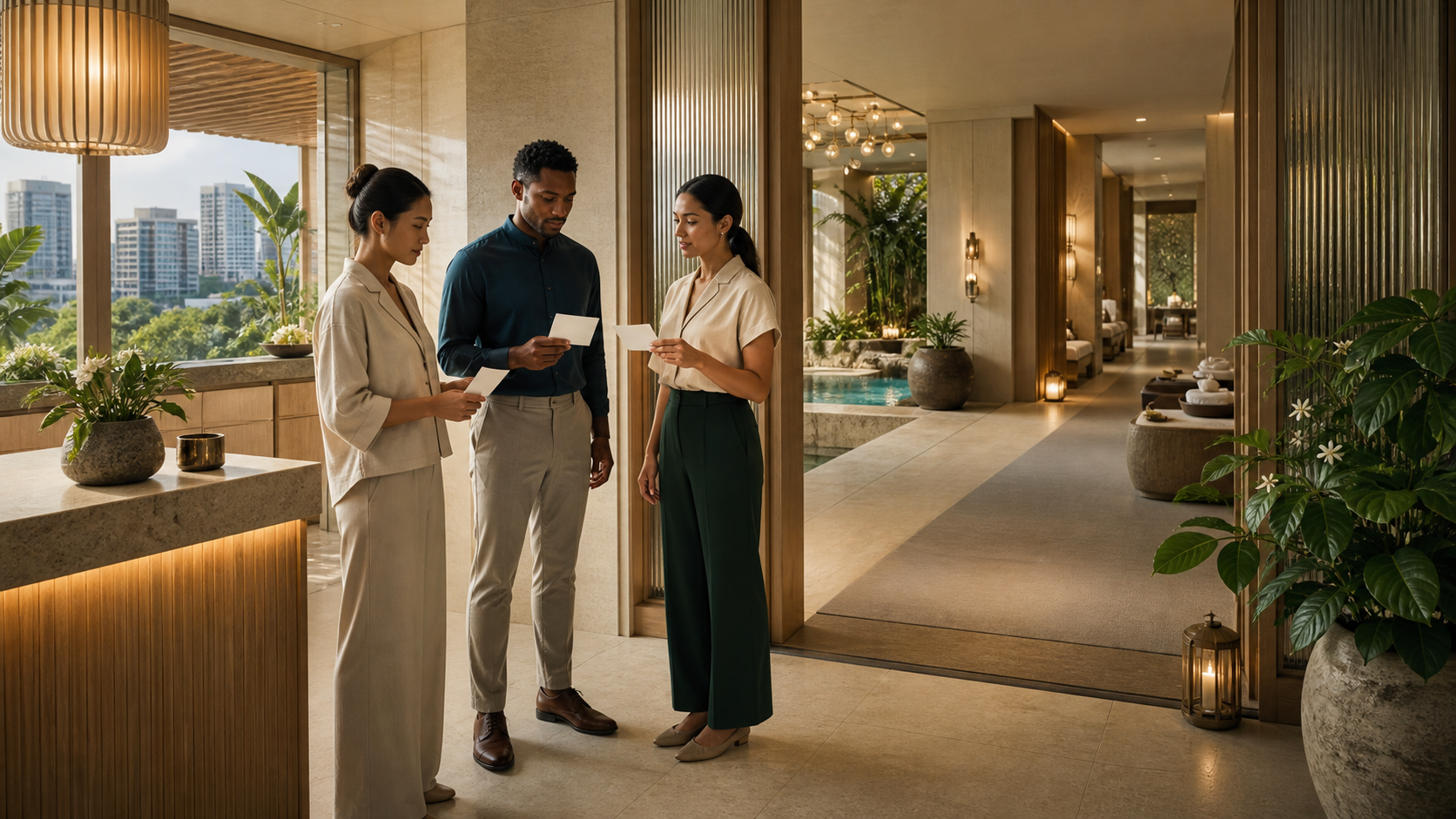
Spa opening readiness is not established by a ribbon, a reservation button or a finished-looking room. It is established when the services offered to guests have defined boundaries, trained owners, tested equipment, accurate public information and evidence that exceptions can be handled safely.
A current Bangkok opening makes that distinction visible. Asset World Corp and Fairmont announced the opening of Fairmont Bangkok Sukhumvit on 23 August 2026. Their release describes a 416-room hotel, a Fairmont Spa of more than 1,000 square metres, a fitness studio and family facilities. It also says dining and entertainment venues will be introduced progressively, with some concepts planned for later in 2026. Opening is therefore an established event, while the complete future offer remains phased.
The property is not being reviewed or rated here. No visit, booking, treatment, water test, staff interview, licence, commissioning record or certification file was examined. The opening is a timely industry signal for a broader question: what proof should any hotel spa hold before promotion becomes an operating promise?
What the Fairmont Bangkok opening establishes
The announcement establishes that the hotel has opened and identifies the facilities its owners present as part of the current destination. The Nation also reported the opening on 19 August, describing the hotel as a new luxury, MICE and wellness property. The current Fairmont hotel page publishes contact details, room availability and operating information, including a 24-hour fitness studio for in-house guests with staffed service hours.
Those records support current opening status. They do not establish treatment outcomes, thermal-system performance, staffing levels, guest satisfaction, sustainability certification, nomination or award merit. Nor does a general hotel opening prove that every venue, ritual, offer and distribution page began operating on the same day.
This is normal in a phased project, but it creates an information duty. Each public promise needs a state: available now, available on specified days, restricted to certain guests, bookable from a stated date, or still planned. “Open” is too broad when a guest is deciding whether a particular treatment, thermal facility, accessible route or membership benefit is usable.
Spa opening readiness begins with a service boundary
Build a dated opening register before launch. List every treatment, room, thermal feature, water body, changing area, retail product, class, membership, day pass and package. For each one, record whether it is designed, installed, commissioned, staffed, tested, bookable and actually released. Name the person who can change its status.
Define dependencies as carefully as the service itself. A massage requires a suitable room, verified equipment, linen flow, product control, therapist competence, consultation and cleaning time. A contrast circuit requires water and temperature controls, clear sequencing, supervision decisions, emergency response and guest communication. A family offer requires age rules, appropriate access, safeguarding and an accurate hand-off between hotel and spa teams.
The current Fairmont Spa page describes treatment suites, a hammam, sauna, ice bath, whirlpool and daily ritual. That is primary evidence of what the brand is inviting guests to consider at the time of access. It is not independent proof that every listed feature passed a specific test, and this article does not infer a failure. The professional lesson is to connect each invitation to an internal acceptance record.
Do not let a marketing deadline decide readiness. If one element remains unavailable, release the verified services and state the limit precisely. A smaller honest opening protects trust better than a complete-looking menu that staff must explain away after arrival.
Commission water and thermal systems before guest use
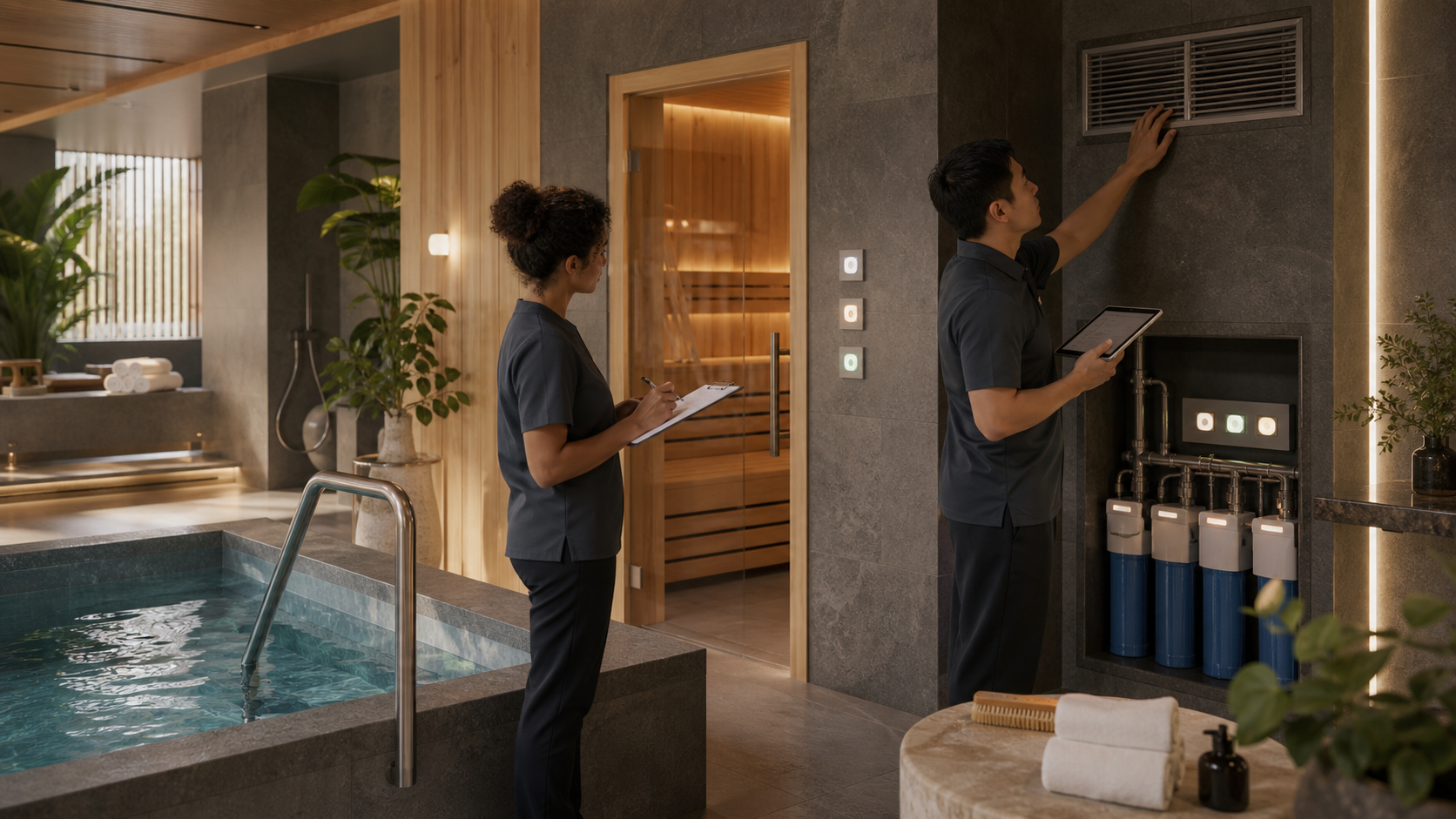
Water and heat require evidence beyond visual completion. Confirm that installation, circulation, filtration, disinfection, ventilation, temperature, drainage, cleaning, emergency controls and recordkeeping have been tested against the rules and professional standards applicable to the property. Establish acceptable ranges, sampling points, testing frequency, response thresholds and named authority to close a feature.
The World Health Organization’s recreational-water resources treat pools and spas as environments whose microbial, chemical and physical risks must be managed. WHO’s linked swimming-pool guidance discusses operation, monitoring and hazard control. It is international public-health context, not a substitute for current Thai requirements, a site design review or qualified local advice.
Run failures before guests do. Rehearse an out-of-range water result, a temperature deviation, a ventilation fault, a closed sauna, a delayed laboratory result, a guest who becomes unwell and a handover between engineering and spa reception. Record who stops access, who communicates, how a booking is changed and what evidence permits reopening.
Keep commissioning records linked to the actual asset and configuration. A supplier certificate, handover email or test from an earlier setup is not proof of current operation after settings, chemicals, software or equipment have changed. Trend results after opening; a pass on one day does not remove the need for ongoing control.
Turn the treatment menu into an operating control
A menu is a compact set of promises about duration, technique, products, suitability, price and expected experience. Convert each entry into a controlled service specification. Record the approved sequence, preparation, room and equipment, product batch process, therapist competence, consultation points, cleaning interval, escalation path and version date.
Separate atmosphere from health claims. Words such as restorative, balancing or revitalising may describe an intended experience, but they should not be converted into promises to diagnose, treat or prevent disease. Any specific outcome statement needs a defined evidence review, applicable advertising and professional boundaries, and clear approval. Staff should know what they may explain and when to refer a question.
Time the whole service, not only hands-on treatment. Include arrival, consultation, changing, room reset, product preparation, thermal access and departure. Then test the schedule with realistic occupancy and staff breaks. A sellable calendar slot is not proof that the experience can be delivered consistently without rushed consultation, shortened cleaning or hidden unpaid work.
The Journal’s spa franchise quality framework explains why a standard needs evidence, escalation and local verification rather than copy alone. The same discipline applies to a single opening: a brand manual becomes operational only when the team can reproduce the service and manage a deviation.
Rehearse access, privacy and handovers
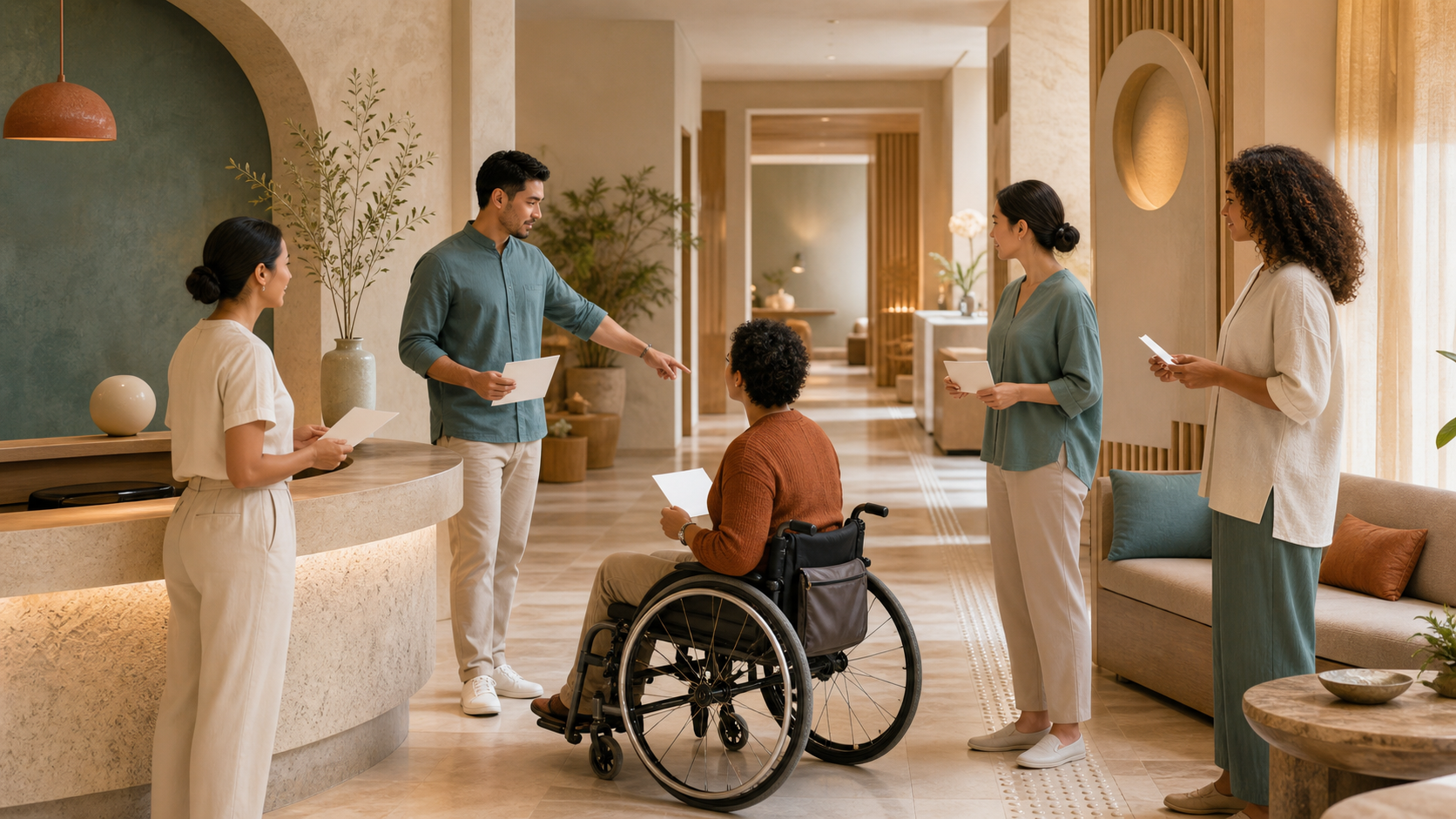
Opening evidence should include journeys made with people who use the service differently. Test reservation, arrival, lift and doorway access, changing, transfer points, seating, lighting, sound, treatment positioning, thermal entry, privacy, payment and emergency exit. Publish factual access information so a guest can make a decision before sharing personal details.
A room labelled accessible does not prove that the complete spa journey works. The current Fairmont page lists a mobility-access room, while the hotel and spa pages provide general facilities and contact information. This article does not assess those arrangements. For any operator, the control is to connect accommodation information with the route, equipment and assistance available inside the spa, then train staff to answer accurately.
Use rehearsal to expose ownership gaps. Who receives an access request from reservations? Who decides whether a treatment can be adapted without changing its safe scope? Where is the information recorded, who may see it and when is it deleted? Can the guest reach someone with authority before arrival? Do not rely on the guest repeating sensitive information at every desk.
Include privacy in the physical test. Check consultation acoustics, changing-room sightlines, treatment-room entry, device notifications, printed schedules and staff conversations. A beautiful reception can still disclose a name, treatment or access need if handovers are not designed.
Separate sustainability intent from verified status
The opening release says the hotel was designed to LEED Gold standards and lists measures including water recycling, energy systems, indoor-air-quality features, electric-vehicle charging and a heat-reduction façade. The wording matters: “designed to” describes an intended standard. It is not the same statement as a completed third-party certification.
The US Green Building Council explains that LEED certification requires prerequisites, credits, documentation, review and verification, after which a project receives a certification level. No public LEED project record for this hotel was verified during this review, so the article does not call it LEED-certified.
Spa teams should apply the same distinction internally. Record which environmental measures are design intentions, installed features, commissioned systems, operating procedures or measured results. Define the boundary: hotel, spa, specific equipment or purchasing category. Use consistent units and periods for energy, water, waste and indoor conditions, and retain the underlying evidence.
The Journal’s wellness beyond the spa suite analysis shows why certification scope and measured outcomes must remain distinct. At opening, communicate what is verified now and what will be measured after a stable operating period.
Synchronise every guest-facing channel
Opening information often changes faster than distribution systems. At the time of review, the current Fairmont page presents the property as open, while the ALL Accor listing still includes “Opening Second Half 2026” in its title and copy. That visible mismatch may be a publishing lag; it is not evidence that the hotel or spa is closed. It does illustrate why status needs one accountable source and a channel-by-channel correction log.
Audit the official site, booking engine, confirmation email, spa menu, maps, telephone script, loyalty app, agency feed and marketplace listings. Compare opening status, address, hours, age rules, access, inclusions, prices, cancellation terms and contact route. Record when each channel was checked and who owns correction.
Test from the guest’s position. Can a person identify whether the spa accepts non-residents, whether thermal access is included, what needs advance booking and which facilities are operating? If the answer requires an internal explanation, the published information is not yet complete.
Directory records such as The Oriental Spa at Mandarin Oriental Bangkok and Urban Wellness Centre at Four Seasons Hotel Bangkok are active discovery pages for further Bangkok spa research. Their presence does not prove a commercial relationship, current availability, nomination or award result, and this opening does not alter their status.
What does this mean for spa and wellness professionals?
For owners and general managers, define the opening boundary in writing. Authorise only the services that meet acceptance criteria, publish known limitations and give one leader power to pause an unsafe or inaccurate offer.
For spa directors, maintain a live readiness register covering people, rooms, equipment, water, products, schedules, access, information and exceptions. Review it daily during launch and retain evidence for every status change.
For therapists and reception teams, rehearse normal and difficult journeys before guests arrive. Confirm consultation, handover, cleaning, access requests, late arrivals, unavailable facilities, complaint ownership and emergency escalation. Training attendance is not enough; observe competent performance.
For engineering and hygiene teams, connect each system to defined limits, test methods, records, closure authority and reopening evidence. Make the spa team understand what the readings mean without asking them to perform work outside their competence.
For marketers and distribution teams, version every claim. Remove planned features from current inclusions, distinguish design intent from certification and correct stale channels. Do not turn a property opening, directory presence or brand reputation into a quality or award conclusion.
A 30-day opening evidence plan
Days 1–10: define and prove
Freeze the opening register, service specifications, applicable approvals, equipment list, water and thermal limits, staff competence records, access information and guest-facing copy. Trace each public promise to a named source and acceptance record.
Days 11–20: rehearse and correct
Run complete guest journeys across quiet and peak periods. Include maintenance faults, inaccessible routes, treatment changes, staff absence, privacy errors, water exceptions and channel mismatches. Record findings, owners, deadlines and retests.
Days 21–30: monitor real operation
Review cancellations, unavailable features, late starts, treatment changes, water and temperature exceptions, cleaning completion, access requests, complaints and staff overtime. Separate launch anecdotes from defined measures. Correct the service or the promise when they disagree.
What remains unproven
This review did not establish the opening date of every Fairmont Bangkok venue, the availability of every spa service, the property’s licences, water results, commissioning reports, staff competence, guest outcomes, environmental performance or LEED certification. It did not inspect the hotel, contact the companies or make a booking. Official and independent public pages were used only to establish the announced hotel opening and published offer at the time accessed.
No concern described here is presented as an observed failure by Fairmont, Accor, Asset World Corp or the property. The opening is a current signal used to build a general professional framework. Operators must identify current local law, authority requirements, manufacturer instructions and qualified advice for their own site.
Frequently asked questions
Does an open booking calendar prove that a spa is ready?
No. It proves that inventory is offered. Readiness also requires a defined service, trained people, tested systems, accurate information and a working exception path.
Can a spa open while part of a hotel remains phased?
Yes, if the available boundary is clear and the released spa services independently meet their requirements. Planned venues should not be presented as current inclusions.
Is “designed to LEED Gold standards” the same as LEED Gold certification?
No. Design intent and third-party certification are different claims. Use the exact verified status and retain the record that supports it.
