

What the tenth World Wellness Weekend currently establishes
Spa community events can look successful before anyone arrives. A venue page is published, a city appears on a map, bookings fill and social posts travel. Each signal is useful, but each answers a different question. None, on its own, shows who could find the activity, who reached the door, who was able to take part, what was delivered or whether a useful change followed.
That distinction matters as spas, hotels, fitness businesses and community organisations prepare for the tenth World Wellness Weekend, scheduled for 18–20 September 2026. When reviewed on 9 September, the initiative's official live map displayed 11,736 venues, 2,012 cities and 187 countries. The same page separately described an expectation of 15,000 venues across 190 countries. It also said participating venues commit to at least one free collective activity, while optional paid services or packages may sit alongside it.
A 4 September Spa Business report describes planned programmes involving guests, staff and local communities. Those sources establish an upcoming event, the organiser's current map and the announced participation model. They do not establish final venue totals, attendance, accessibility, safe delivery, sustained behaviour change, commercial conversion, community benefit, nomination or award merit. This article does not evaluate the initiative or any listed venue. It uses the current signal to build a practical evidence chain for spa community events.
Spa community events need separate evidence states
The first discipline is to stop using one large number for several different states. Create a simple event ledger with separate fields for: venue invited; venue registered; listing published; activity confirmed; places available; reservations accepted; people arrived; people started; people completed; people offered feedback; feedback received; follow-up delivered. Record the time, source and owner of every figure.
This prevents a changing map from becoming a false attendance report. A venue may register more than one activity. One city may include many venues. A reservation can be duplicated, cancelled or transferred. A walk-in can arrive without appearing in booking data. A participant can attend more than one session. Decide the unit before adding totals, and publish the denominator beside every rate. “Eighty per cent attended” is meaningless unless readers know whether the denominator is reservations, confirmed places or unique people.
Use status language that survives scrutiny. “Listed” means discoverable at a recorded time. “Confirmed” means the venue has reconfirmed activity, capacity, access details and responsible staff. “Delivered” means the activity occurred. “Participated” needs a defined threshold appropriate to the activity. “Reached” is a communications measure. “Benefited” is an outcome claim and needs a method, time window and evidence stronger than a sign-in sheet.
Design access before publishing the invitation
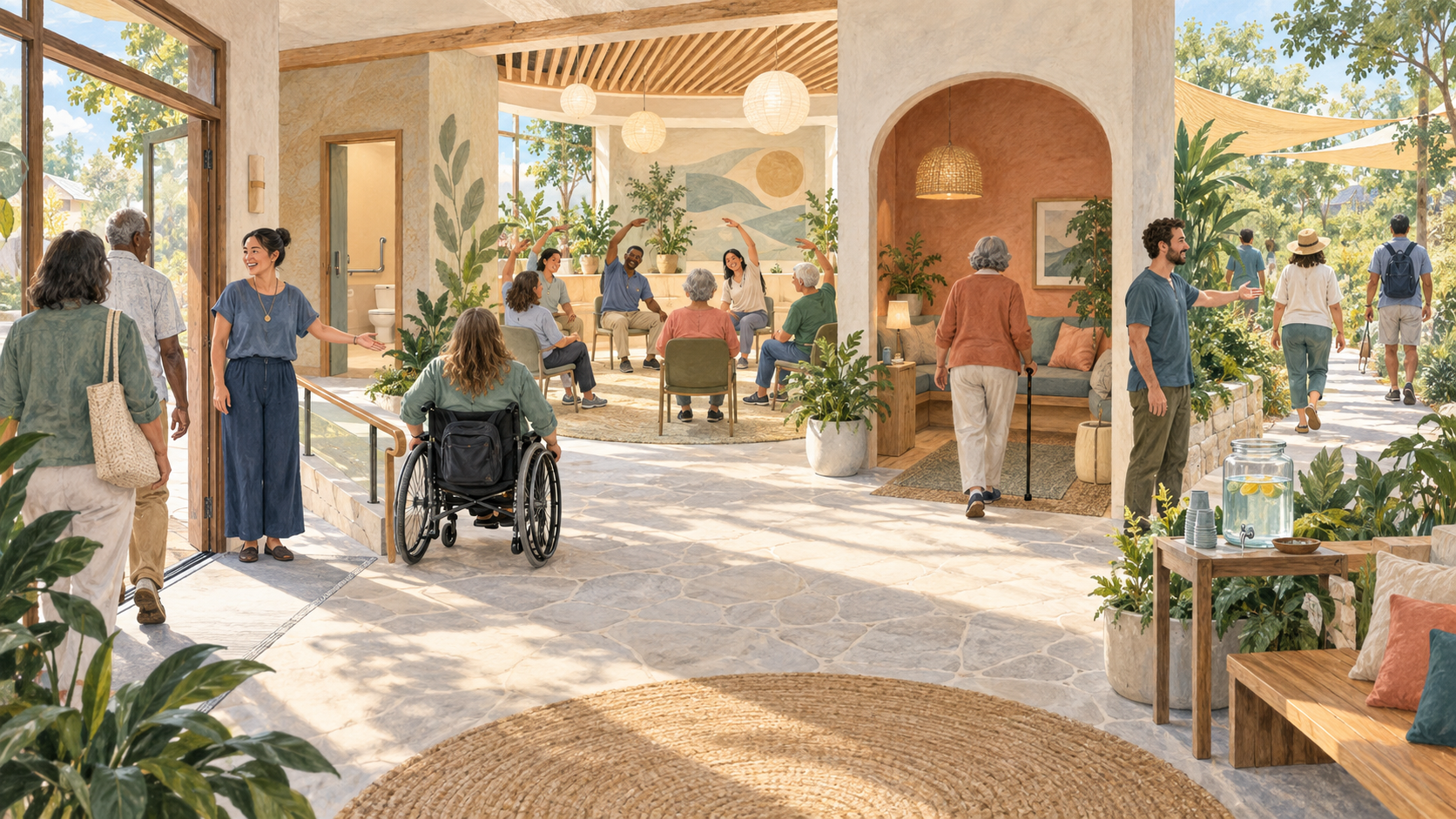
Free entry removes one possible barrier; it does not create universal access. A guest may still face an unreadable listing, unsuitable timing, inaccessible transport, steps, narrow circulation, an unavailable toilet, sensory overload, unclear clothing rules, language barriers, age restrictions or a booking channel they cannot use. Map the journey from discovering the activity to getting home, not only the minutes spent in the room.
The United Nations disability-inclusive communications guidelines advise event planners to ask about accessibility needs, provide information in different formats, evaluate entrances, toilets and emergency exits, arrange accessible seating and communication support, and invite feedback from people with disabilities. This is practical planning guidance, not a certificate for a spa. Its strongest lesson is to involve the people affected before the event rather than waiting for a complaint at the door.
Write an access card for every activity. State the address and arrival route, duration, pace, surfaces, temperature, sound and lighting, seating, changing requirements, water access, toilet provision, age or companion rules, cost boundary, capacity, facilitator language, what participants should bring and how to request an adjustment. Name a contact who can answer specific questions. If a barrier cannot be removed, describe it plainly and offer a meaningful alternative where possible.
Do not record “no accessibility requests” as proof of accessibility. People may not have found the invitation, trusted the process or known what support was available. Track barriers reported before, during and after the event, decisions made, adjustments provided and requests that could not be fulfilled. Review that record with community representatives, including disabled people's organisations where relevant and available.
Keep the free activity and the paid pathway distinct
The official event page allows optional paid offers around the required free activity. That can support a viable business relationship, but the boundary must be visible before a person books. State exactly what is free, its duration and capacity, and whether equipment, changing access or refreshments are included. Present any paid extension as optional. Do not make a person surrender marketing consent, purchase another service or join a membership to receive the promised free activity unless that condition was clearly part of the offer and is lawful.
Use separate counts for free participation and paid conversion. A conversion rate can help a commercial team, but it is not evidence that the event reached people who usually face barriers. Equally, low conversion does not show that a community activity lacked value. Decide in advance whether the primary objective is discovery, access, learning, relationship-building, staff development or sales. One event can serve several objectives, but each needs its own measure and owner.
Make service recovery work across both pathways. If the free class is full, cancelled or unsuitable, the remedy should not be a pressured upsell. Give staff approved alternatives: another free time, a waitlist with clear priority, a lower-demand format, accessible remote information where appropriate, or an honest apology and follow-up. Record unmet demand without turning it into delivered participation.
Control scope, safety and staff load at event scale
An introductory event is still an operated service. Define who is accountable for the venue, activity, equipment, first response, safeguarding, data and communications. Confirm local legal duties, professional scope, insurance, emergency arrangements and manufacturer instructions with competent advisers. A global campaign badge cannot replace property-level decisions.
Risk controls should match the activity. A talk, a gentle movement class, a pool session, a massage demonstration and a thermal experience do not share one suitability screen or supervision plan. Publish a plain description, offer a real choice to stop, and give facilitators observable stop and escalation rules. Do not use the relaxed tone of a celebration to soften exclusions or imply treatment outcomes.
The World Health Organization's report on health and well-being through sport events places risk assessment and preparedness alongside communication and activity promotion. It does not prescribe a spa protocol. It supports a transferable principle: participation goals and health-security controls belong in the same event plan.
Protect workers and volunteers too. Estimate preparation, delivery, cleaning, translation, access support and follow-up time. Set capacity from the safest constrained resource, not from the largest room. Brief everyone on roles, breaks, incident reporting, photography rules and the difference between answering a general question and giving individual health advice. If an essential competent person is absent, pause or adapt the activity rather than improvising.
Collect the minimum data needed to learn
Event evaluation does not require a detailed personal profile. Start with a purpose table: the question to answer, the minimum data needed, who can access it, how long it is retained and when it will be deleted. Keep booking, operational safety, optional feedback and marketing consent separate. A person should be able to decline a testimonial, photograph or newsletter without losing their place where local law and the service design allow.
Aggregate by default. Count unique arrivals without publishing names. If organisers need to understand whether intended groups were reached, choose proportionate categories, explain why they are collected and allow “prefer not to say”. Small groups can make individuals identifiable even after names are removed, so suppress or combine results where necessary. Seek qualified local privacy advice rather than copying another property's form.
Never infer a health result from registration, attendance, a smile, a social post or a same-day satisfaction score. The WHO's physical activity surveillance resources distinguish standardised population measurement from casual observation and describe dimensions such as frequency, duration and intensity. A spa event is not population surveillance. The useful comparison is methodological: define what was measured and do not promote a proxy into an outcome.
Measure access, participation and learning separately
Build a small dashboard with three layers. The access layer tracks whether listings were published, access cards were complete, questions were answered, requested adjustments were provided and known barriers were removed. The participation layer tracks capacity, reservations, arrivals, unique starters, completions, early exits and no-shows. The learning layer records participant feedback, facilitator observations, incidents, unmet needs, referral questions, follow-up and the changes approved for next time.
The European Observatory on Health Systems and Policies, hosted by WHO Europe, identifies representativeness, capacities, legal frameworks, sustainability and policy uptake as themes for monitoring social participation. A spa does not need to turn a community morning into a national study. It can still ask who shaped the event, whose perspective is missing, what the team learned and whether a decision changed.
Review negative space. Which neighbourhoods produced no enquiries? Which activity filled but had many no-shows? Which access questions arrived too late? Which people started but did not complete, and were they comfortable saying why? An empty category is not evidence of no demand. It is a prompt to test discovery, trust, timing, transport, cost, relevance and measurement design.
The current ISO 20121:2024 overview says the event-management standard applies to events of different types and sizes and addresses social, economic and environmental impacts, with added emphasis on inclusivity and legacy. Citing the overview does not claim certification or conformity. It reinforces a sound question: what remains after the event besides posts and a total?

What does this mean for spa and wellness professionals?
For owners and spa directors
Approve the objective, access standard, capacity, free-offer boundary, service scope and evidence ledger before approving campaign copy. Use the Journal's guidance on designing safety, calm and choice together to test zone-specific access, and its analysis of why interest is not a booking forecast to keep promotional demand separate from delivered participation.
For operations and community partners
Walk the route with people who understand the intended community. Test finding the listing, booking, transport, entry, toilets, seating, sound, light, instructions, stopping and exit. Active directory records such as Alba Thermal Springs & Spa, Fingal and AWAY Spa at W Barcelona can serve only as disclosed starting points for checking how spa identities and locations appear. Directory presence does not prove event participation, accessibility, partnership, nomination or award merit.
For marketing and awards researchers
Label every number by state and time. Keep organiser targets, live listings, venue confirmations, attendance and outcomes in separate sentences. Ask for the event ledger, access review and change log before using “inclusive”, “global”, “community impact” or similar claims. A badge or map entry shows participation in a campaign framework, not service quality or excellence.
A four-phase event evidence file
Before registration closes
Freeze the objective, units and denominators. Confirm the activity owner, capacity, access card, free inclusion, optional paid offer, data purposes and emergency route. Invite community and accessibility review while changes are still possible.
Before doors open
Reconfirm the listing, facilitator, room, equipment, water, toilets, signage, quiet option, adjustments and staff brief. Remove unavailable activities from every channel. Record the final offered capacity and the exact time of the snapshot.
During delivery
Count arrivals and participation consistently, protect choice and privacy, document adaptations and incidents, and keep sales activity visibly optional. Do not chase completion at the expense of dignity or safety.
After the event
Reconcile listings, reservations, arrivals, participation and feedback. Review barriers and missing voices, agree specific changes and publish only supported figures. Delete data on schedule. A later follow-up can explore continuity, but it must not retrofit a health outcome onto attendance.
What remains unproven
The reviewed sources do not establish how many World Wellness Weekend activities will ultimately operate, how many unique people will attend, which venues will meet a particular access standard, whether participants will change behaviour, or whether communities will receive lasting value. Counts on a live map can change after the recorded review time. Announced partner, venue and country reach is not a completed delivery report.
This article has not inspected any participating site, booking record, safeguarding plan, professional credential, incident file, accessibility audit, survey method or privacy assessment. The European Commission, WHO, UN and ISO materials are used within their published scopes; none endorses a spa, campaign listing or Spa Awards decision. The defensible conclusion is narrow: community wellness events become more credible when organisers keep access, participation, learning and outcomes as separate evidence states.
Questions before publishing an event result
Can we call the event inclusive because it was free?
No. Price is one access condition. Inclusion also depends on discovery, transport, communication, physical and sensory access, timing, suitability, staff practice, choice and whether affected people helped identify barriers.
Can registrations be reported as participants?
Only if every registration is reconciled to a defined participation record, which is uncommon. Report registrations and unique participants separately, with their denominators and snapshot times.
Does a positive feedback score prove a health benefit?
No. Same-day feedback can describe experience within its method. A health or behaviour outcome needs a suitable measure, comparison, time window and cautious interpretation. Do not let a celebration outrun its evidence.
