

Bathhouse benchmarks can reveal useful questions without supplying a ready-made investment answer. A new working analysis from the Global Wellness Institute describes a young, ambitious thermal-wellness sample: guided programming is common, multi-site expansion is widely expected and substantial capital is already involved. The same source is explicit that its 47 responses are directional, primarily from the United States and not representative of the wider industry.
That distinction matters. A percentage drawn from an evolving voluntary survey is a sector signal, not a demand forecast for a particular city, a guaranteed operating model or evidence that a larger facility will be profitable. Spa and wellness leaders can still use the findings, provided they preserve the data version, read every denominator, test assumptions locally and separate planned activity from delivered performance.
This guide turns the current research into a practical evidence file. It shows how to move from external signal to local question, from question to reversible test, and from test to a governed decision about access, programming, staffing, water management and expansion.
What the current bathhouse benchmarks establish
The Global Wellness Institute working analysis dated 6 October 2026 covers 47 distinct operator or developer responses, including 37 currently operating businesses. Thirty-five responses are from the United States. The document says 36 of 47 respondents offer or plan guided thermal programming, while 29 of 47 have or plan a large-format or event sauna. Among operating respondents, 25 of 37 report regular or occasional guided programming.
The same analysis places limits beside the headline numbers. Its results are self-reported and directional. Denominators vary by question, percentages are rounded and the financial ranges are confidential. The top revenue category is open-ended, so a precise average cannot be calculated. Expansion answers describe intentions rather than confirmed openings, and the brief states that facility size does not establish profitability or cause higher revenue.
The GWI media alert published on 7 October updates the public record and repeats the wider-industry limitation. It also notes that the survey remains open. That makes the release a working snapshot rather than a fixed final benchmark.
Spa Business reported an earlier survey snapshot on 24 September with 43 respondents. Its figures differ accordingly from the later 47-response analysis. The difference is not evidence that either publication is defective; it shows why an operator must record the source, date, respondent count and definition used when a number enters a board paper, supplier brief or development model.
Read a directional benchmark before applying it
Start with the population question: who answered, and whom do they not represent? The GWI brief describes an operator and developer sample with a strong US concentration. It includes operating and pre-opening businesses, and some findings mix what respondents currently have with what they plan. Those choices are useful for mapping emerging practice, but they do not produce a national adoption rate or a global probability of success.
Then reconstruct each fraction. “Sixty-two per cent expect multiple locations within three years” means 29 of 47 respondents stated that expectation. It does not mean 62 per cent of all bathhouse businesses will expand, that finance is secured or that another location will open. “Forty-four per cent report US$300,000 or more monthly gross revenue” applies to 15 of 34 operating respondents who disclosed a revenue range. Gross revenue is not profit, and it does not reveal occupancy, payroll, energy cost, debt service, maintenance or capital recovery.
Professional survey guidance provides a useful reading frame. The American Association for Public Opinion Research disclosure standards call for information about the sponsor, instrument, population, recruitment, collection mode and dates, sample size, weighting, processing, quality procedures and limitations. Spa operators are not being asked to audit a volunteer initiative as academic peer reviewers. They should simply avoid assigning more precision or reach than the disclosed method supports.
Create a citation card for every external benchmark used in a decision. Record the document title, publication date, access date, version, population, sample size, geography, denominator, response basis, unit, currency, time period and caveat. Preserve the original file. If the source later updates from 43 to 47 responses, keep both versions and note which one supported each decision.

Convert the signal into a site-specific business case
Use the research to form questions, not to fill missing cells with sector averages. If guided programming is prominent in the sample, ask whether the intended local audience values scheduled facilitation, at what times, at what price and with what access needs. If day passes are important to respondents, ask how a day-pass model would interact with peak capacity, quiet periods, memberships, treatment rooms, food and beverage, local competition and transport.
Define the decision before commissioning more analysis. It might be whether to test one weekly guided session, convert an existing room, add a new thermal circuit or acquire a second site. Name the baseline: continue the current offer, make the smallest safe change or stop. A benchmark cannot choose among options when the objective, constraints and alternatives are undefined.
The UK government’s 2026 Green Book is written for public appraisal, not private spa investment, but its uncertainty disciplines are transferable. It advises decision-makers to compare options, communicate incomplete evidence, test scenarios and adjust for optimism bias—the tendency to underestimate cost and duration while overestimating benefits. A commercial team can apply those principles without claiming government endorsement of its project.
Build three operating scenarios
Create a restrained case, a central case and a pressure case. Vary local attendance, price, repeat use, staffing hours, utilities, maintenance closure, cleaning time, insurance, financing and ramp-up. Do not let revenue move while every cost remains fixed. Include a delay scenario because the GWI sample itself reports that 15 of 31 operating respondents who supplied a development timeframe took two years or longer from concept to opening.
Identify the switching points. How low can attendance fall before an extra guided session no longer covers its avoidable cost? How much can construction or energy expense rise before the preferred option changes? What happens if a planned instructor is unavailable, a water circuit closes or a permitted capacity is lower than the concept assumed? A decision is stronger when leaders know what would reverse it.
Use local evidence in stages: anonymous demand research, observed utilisation, a temporary approved programme, waitlist behaviour, actual session contribution and repeat use. Deposits, signed agreements or paid pilots are stronger commercial signals than expressions of interest. None proves long-term demand by itself. Set a stop rule before enthusiasm and sunk cost make the experiment hard to end.
Separate capital intent from operating readiness
The working analysis reports that 14 of 47 respondents selected an opening investment of at least US$5 million, while 19 reported at least US$2 million. Four were unsure or declined. Because pre-opening responses are included, those figures are not all completed expenditure. They describe ranges within this sample, not a minimum budget, a quotation or a cost guide for another country.
Translate a concept into readiness gates. The commercial gate tests demand and access. The technical gate confirms structure, ventilation, drainage, water treatment, energy loads, fire and electrical requirements. The regulatory gate records approvals and responsible authorities. The people gate defines roles, qualifications, supervision and emergency competence. The operating gate proves cleaning, water testing, opening checks, incident response, maintenance and closure procedures under real capacity.
The World Health Organization recreational-water resource points operators to dedicated guidance for swimming pools and spas and emphasises that risks in recreational water can be assessed and managed. That source does not approve a design or replace local codes. It reinforces a basic boundary: popularity, revenue intention and attractive programming do not substitute for competent water and facility management.
Assign evidence to each gate. A rendering proves only a design intention. A supplier proposal proves only what was offered at that date. A permit application is not an approval. Equipment delivery is not commissioning. Staff attendance is not demonstrated competence. A soft opening is not stable performance. Keep these states distinct in internal reports and guest-facing communications.
Make guided thermal programming a controlled service
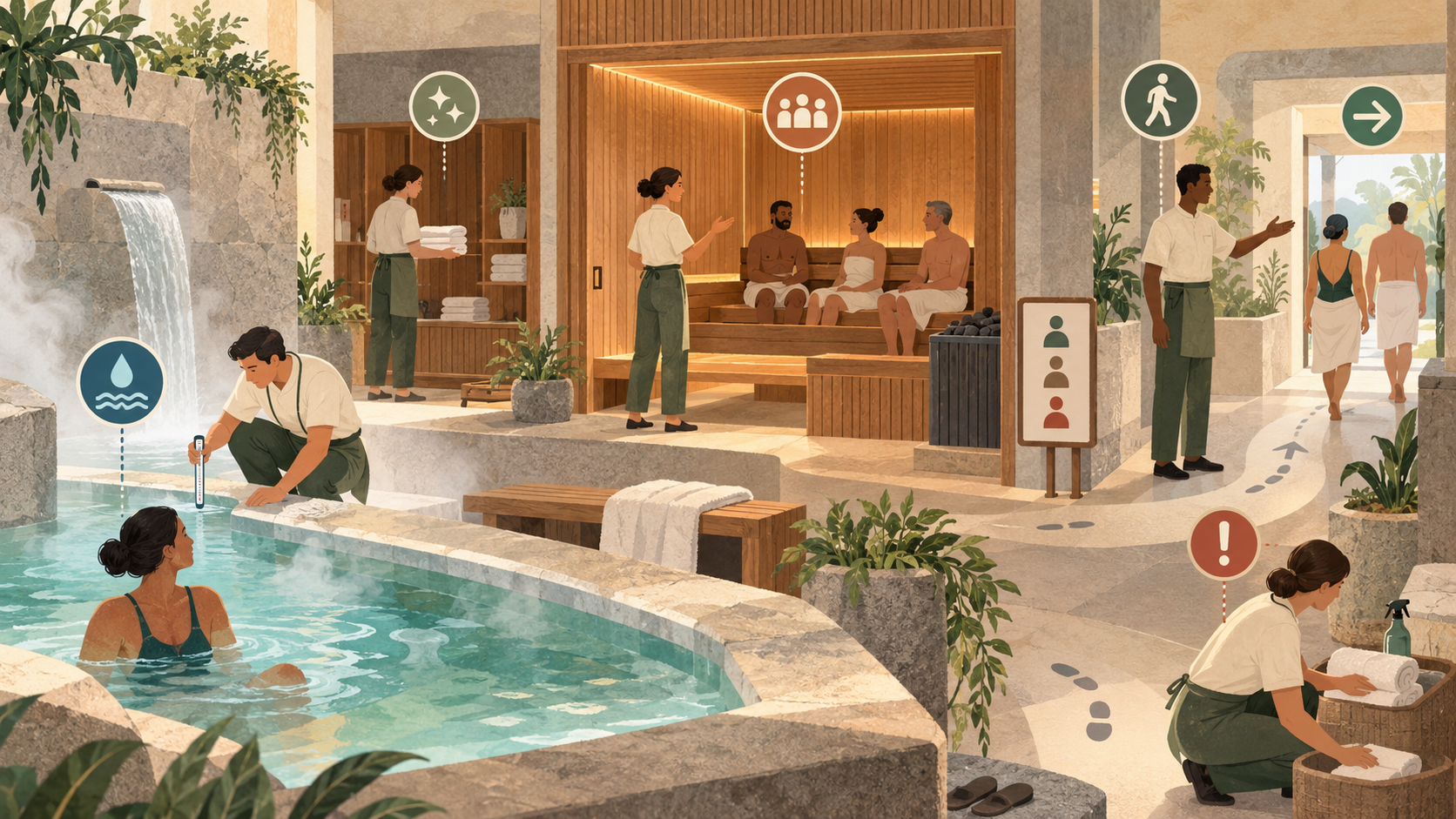
The survey’s programming figures are valuable because they show where participating operators are directing attention. They do not define one standard format. Among operating respondents with regular or occasional guided programming, the options selected include private groups, sound or music, sauna rituals, breathwork, guided contrast, social programming, meditation and recovery sessions. Multiple selections were allowed.
Define any programme as a service before promoting it. State the intended audience, duration, environmental conditions, capacity, facilitator role, guest preparation, accessibility, contraindication and stop process, cleaning reset, incident route and evidence of completion. Avoid implying that a fashionable label supplies a safe protocol. “Aufguss” and “sauna rituals” were grouped in one survey option, so the reported result cannot establish adoption of either one separately.
Match the promise to staff capability. The GWI brief says 25 of 47 respondents selected staffing and training as something prospective owners often underestimate. That is respondent perception, not a measured overrun, but it is a useful risk prompt. Build a competency matrix for opening, closing, water checks, heat exposure, guest communication, accessibility, facilitation, escalation and equipment isolation. Rehearse ordinary sessions and exception cases.
Measure the programme chain in order: session scheduled, qualified facilitator assigned, environment released for use, places offered, places booked, guests admitted, session delivered, incidents or early exits recorded, reset completed and feedback reviewed. Attendance is not a wellbeing outcome. A full session is not proof of safe delivery. Repeat booking is not evidence of a health benefit.
Test access models without extrapolating demand
In the 47-response snapshot, 23 respondents selected day pass or single visit as their most important access model, and 32 identified general admission or day-pass traffic as a future growth driver. Memberships and private events were each selected by 15 respondents as future growth drivers. These are useful option signals, not mutually exclusive market shares or proof that a particular mix will work.
Model access as a capacity allocation question. Day passes can support discovery but may concentrate demand. Memberships can improve frequency but create entitlement at peaks. Private events can bring revenue while displacing public access. Treatments, food and beverage and retail can broaden spend, but they add labour, stock, hygiene, licensing and service-recovery requirements. Use one timetable and one capacity ledger so each commercial promise competes for the same real resources.
Track conversion by state. An enquiry is not a booking; a booking is not attendance; attendance is not repeat use; repeat use is not satisfaction; satisfaction is not a health result. Record cancellations, turnaways, access complaints, quiet-period utilisation and displaced demand. Review results by time, channel and product without inventing precision from small groups.
Keep equity visible. A high-yield private booking may look efficient while reducing access for local day guests. A membership can reward regular use while excluding visitors who cannot commit. Operators should decide which audiences the model intends to serve, how capacity is reserved and how accessibility needs are handled. The financial model and the guest promise should describe the same operation.
What does this mean for spa and wellness professionals?
Owners and investors should treat the new bathhouse benchmarks as a question set for due diligence. Finance leaders should preserve denominators and run scenarios. Designers and engineers should convert concepts into code, water, energy and maintenance requirements. Spa directors should define access and service states. Training owners should verify competence. Marketing teams should separate plans, openings, attendance and outcomes.
The evidence chain complements the Journal’s guidance on sauna performance programming and cultural space and making public sauna commitments testable. Programming quality and public promises both depend on a facility that can deliver its declared service under normal and exceptional conditions.
Directory records for Peninsula Hot Springs, Mornington Peninsula and Thermae Bath Spa can help teams form comparison questions about thermal positioning, access and guest information. They are discovery records only. Directory presence does not verify a benchmark, current programme, financial result, inspection, nomination or award. Confirm current services directly with each property.
A 30-day local-proof sprint
In week one, freeze the external source file and build citation cards for every number used. Define the local decision, baseline and three options. In week two, collect demand, capacity, regulatory, technical, staffing and cost evidence for the actual site. In week three, run approved scenario and switching analysis, assign readiness gates and design a small reversible test. In week four, review the test against pre-agreed continuation and stop rules.
The control file should contain the source versions, assumptions register, local demand method, capacity map, cost ranges, regulatory advice, technical dependencies, competency matrix, water-management responsibilities, scenario model, risk register, pilot plan and decision record. Version every material change. If a survey update, permit condition, supplier scope or operating assumption changes, reopen the affected decision.
What remains unproven
The current GWI analysis describes 47 respondents and explicitly does not represent the wider industry. It does not size the global bathhouse market, establish national benchmarks, prove causation between facility size and revenue, convert gross revenue into profit or confirm that stated expansion intentions will become openings. Its programming choices do not establish the safety, quality or outcome of a particular session.
Spa Business offers useful earlier coverage, but its 43-response snapshot should not be combined silently with the later 47-response brief. AAPOR standards provide a disclosure lens, not an assessment of this survey. The Green Book supplies transferable appraisal disciplines within a public-sector purpose, not a private investment approval. WHO guidance frames recreational-water risk management, not compliance for every jurisdiction or certification of any listed property.
The defensible conclusion is practical. Read the benchmark as a dated, bounded signal. Preserve its version and denominator. Convert it into local questions, test those questions with reversible evidence, model uncertainty, pass each readiness gate and communicate only the state that has actually been reached. Growth can be explored without being presumed, and a compelling bathhouse concept can earn confidence through proof rather than projection.
