
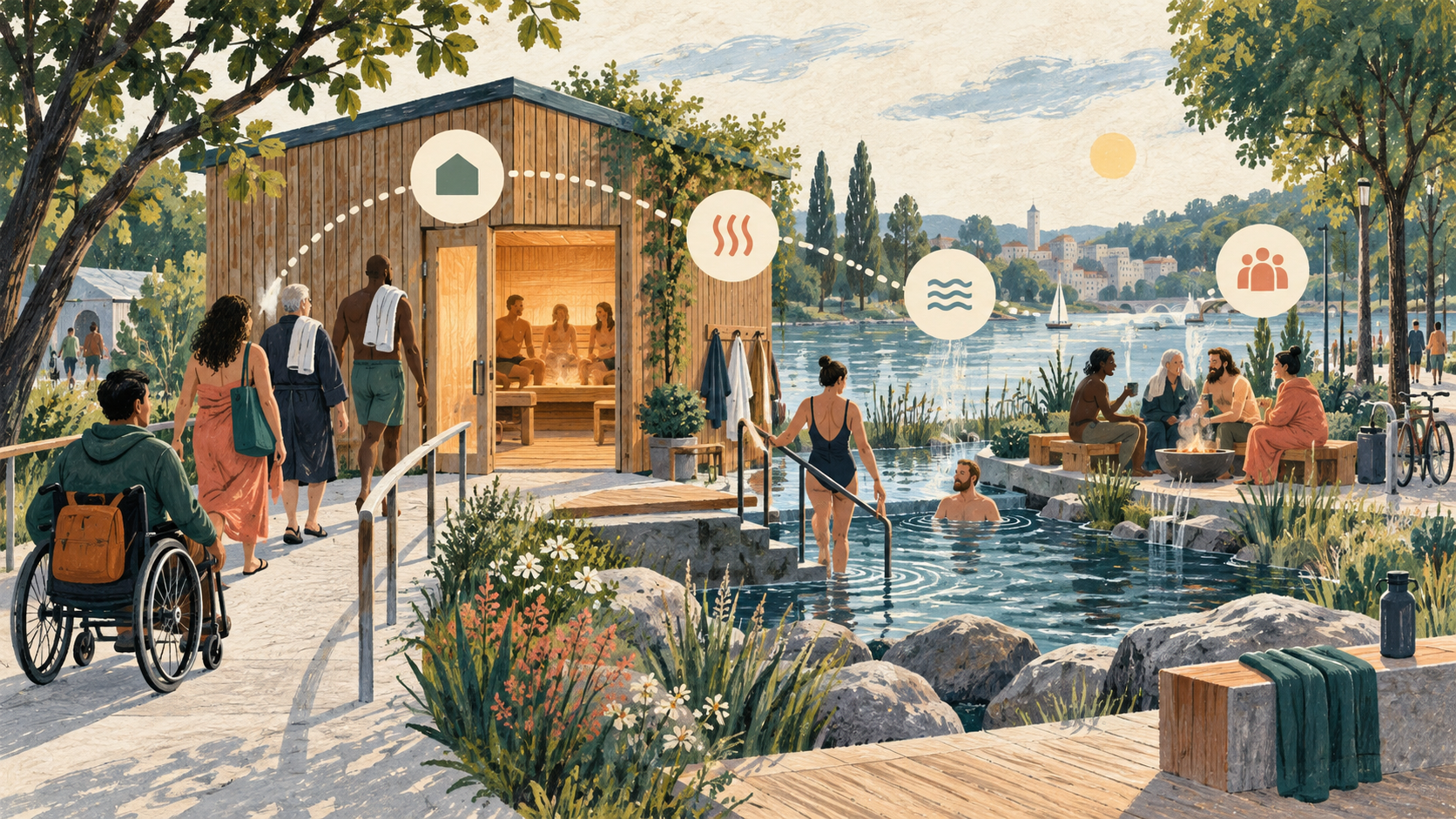
A public sauna charter changes the operating question
A public commitment can clarify values. It cannot, by itself, prove that a sauna is affordable, accessible, culturally respectful, safely operated or environmentally responsible. That distinction is the useful starting point for the new Public Sauna-Bathing Charter. The framework asks operators, communities, governments, funders and researchers to treat public sauna as a common good. For spa and bathing professionals, the practical task is to translate each principle into a decision, an owner, evidence and a review date.
The official Charter is version 1.0, dated 19 August 2026. A 23 September Spa Business report marked its public launch in Oslo ahead of the XIX International Sauna Congress. The timing gives the international spa sector a current signal, but not a new licence, audit or technical standard. A public sauna charter becomes credible only when people can see what changed in the real service.
What the current sources establish
The Charter sets out ten principles under four themes: practice, keeping, tending and stewardship. They cover access, shared civic space, respect for traditions, public good, sense of place, community accountability, safety and care, environmental reciprocity, circulating wellbeing, and recognition of public sauna as social infrastructure. It defines a public sauna by access rather than ownership: public sessions should be available to individuals on clear terms without requiring an overnight stay, membership or another purchase.
That definition allows municipal, non-profit, cooperative, commercial and hybrid models. It does not require free entry or ask operators to run at a loss. Instead, access is meant to influence operating and investment choices. The Charter invites applicants to select the principles relevant to their role and state how they will put them into practice. Its own description is explicit about the boundary: it is a shared set of principles and a guide, not certification, a technical rulebook, a replacement for regulation or one model imposed across cultures.
The International Sauna Congress is scheduled for 24–26 September 2026 in Oslo and is organised by the Norwegian Sauna Society and the International Sauna Association. The congress context explains why the launch is timely; it does not endorse any individual sauna or convert the Charter into congress accreditation. Similarly, the trade report’s account of sector growth is an industry signal, not evidence that every mapped site meets the Charter’s principles.
The public sauna charter needs five visible evidence states
A clear implementation file can separate five states. The first is principle published: the Charter contains a public expectation. The second is commitment declared: an organisation explains which principles it supports and what it intends to do. The third is control implemented: the service has policies, staff, maintenance, access information and responsibilities in place. The fourth is delivery verified: records show that the control worked during real public sessions. The fifth is result evaluated: the operator has measured the defined access, community, safety or environmental result using a stated method.
These states are related but not interchangeable. Signing can document intent and create accountability. It does not certify a building, approve equipment, confirm legal compliance or establish a health benefit. A well-designed safety system does not prove affordability. A low entry price does not prove that the complete route is accessible. Community consultation does not transfer ownership of a bathing tradition. Each public claim needs the evidence state that actually supports it.
Create a Charter register with one row per commitment. Record the principle, local interpretation, affected service, accountable person, baseline, action, evidence location, due date, review group and public wording. Add a field for the applicable law, code or technical standard, because values and compliance belong beside each other without being confused. Where evidence is pending, use future language. Where a change has been completed, say what is available now and how it was checked.

Make access a bookable public route
“Access for all” needs more than an inclusive headline. Begin with the commercial rule: which sessions can a person book without a hotel room, club membership, group hire or bundled product? Publish the price, duration, capacity, cancellation terms, minimum age, assistance options and what is included. Track how many public places are released, when they sell out and whether lower-priced sessions are available at usable times rather than only at inconvenient edges of the schedule.
Then test the physical and information route from discovery to departure. It includes transport, entrance, reception, changing, toilets, heat room, cooling area, water access, rest space and emergency exit. ISO 21902:2021 describes accessible tourism as equal access and enjoyment for the widest range of people of all ages and abilities, covering policy, infrastructure, products and services across the tourism supply chain. The standard’s abstract is an international reference, not evidence that a particular sauna complies with it.
Invite people with different mobility, sensory, cognitive and communication needs to test the journey. Record what they could complete independently, where assistance was required, what information was missing and who owns each correction. Avoid a single “accessible” badge. Publish specific facts such as step-free entry, door clearances, seating, transfer support, sensory conditions, lighting, assistance booking and any limitation affecting the heat or cooling experience.
Access is also social. Review dress rules, gender arrangements, privacy choices, language, first-visit orientation, behaviour standards and the response to harassment. A safer-space policy needs a reporting route, trained decision maker and proportionate consequences. If a session is designed for a particular community, explain its purpose while keeping the overall public programme transparent.
Treat living culture as a relationship, not a theme
Sauna is not a generic room type detached from people and place. UNESCO’s record of sauna culture in Finland describes a living practice found in homes and public places, transmitted through families, clubs and universities, with varied forms and no hierarchy among them. The inscription concerns Finnish sauna culture; it does not make every heat experience Finnish, give a commercial operator ownership of the tradition or authorise the use of protected community knowledge.
The Charter also names other sweat-bathing traditions while insisting on cultural distinction. Operators should therefore document whose tradition is being described, who advised the service, what terminology is appropriate, which elements may be adapted and how benefit returns to knowledge holders. Avoid combining sauna, banya, hammam, temazcal, jjimjilbang or Indigenous sweat-lodge references into an invented universal ritual. Similar heat does not erase different histories, meanings, protocols or permissions.
A cultural stewardship file should include contributor agreements, approved public descriptions, pronunciation guidance, staff training, benefit arrangements and review dates. If a ceremony, story, plant, symbol or instruction is private or restricted, absence from the guest programme can be evidence of responsible practice. A marketing team should not turn cultural consultation into a broad endorsement. Credit the people and scope accurately, and create a way for them to correct the representation later.
Put safety systems beside the values
The Charter’s “Tended With Care” principle refers to evidence-informed best practice, maintenance, safer-space operation and protection from harm. The Charter itself leaves technical detail to local requirements and expertise. Every operator therefore needs a separate compliance map for the jurisdiction, building, heat source, electrical installation, water systems, fire controls, occupancy, staff duties and any food, alcohol or therapeutic services.
Finland’s Safety and Chemicals Agency, Tukes, says its 2025 Consumer Services Act applies to leisure services including swimming pools, spas and bathing areas. Its general Safety in Consumer Services guidance places responsibility on the provider to identify hazards, plan proportionate controls, document safety management, maintain staff competence and revise documentation when facilities, equipment or operating methods change. That is Finnish guidance, not a universal sauna code. Its operating logic is nevertheless useful: the safety file must match the service as delivered, not an idealised brochure description.
Build the risk review around the whole sequence. Include booking information, contraindication or suitability advice within the operator’s competence, orientation, heat exposure, slips, burns, fainting, overcrowding, door and exit operation, water and electrical interaction, cold immersion, outdoor access, cleaning, staff observation, first aid and emergency escalation. Define stop rules for the service as well as for the guest. A timetable that leaves the room too crowded to supervise should trigger a capacity decision, not a disclaimer.
Log maintenance, temperature checks, incidents, near misses, complaints and changes. Assign responsibilities across landlord, operator, heater supplier, maintenance contractor and event host. A Charter statement should link to these working controls without pretending that a voluntary commitment replaces inspection or permission.
Make public good visible in the operating model
“Public good before private gain” is not a ban on profit. It asks what the commercial model protects when demand, land costs or investor expectations rise. Operators can make that answer testable through public-session allocation, concession pricing, community partnerships, local procurement, staff conditions, transparent private-hire limits and a policy for reinvesting part of the value created.
Start with capacity. Separate public sessions, memberships, private hire, hotel-only access, events and maintenance closures in the schedule. Report the share of usable capacity available to individuals on clear public terms. If premium products displace public access, record the decision and its mitigation. If a subsidised session depends on a funder, state the period covered rather than implying permanent affordability.
Community accountability also needs a route for influence. Publish how local residents, bathers and staff can raise issues, how decisions are made and when responses will appear. Consultation attendance is not the result; show the proposal, the feedback, the decision and the reason. Track who is missing from the conversation. An online survey available only to existing customers will not reveal barriers faced by people who cannot enter or afford the service.
Bound environmental and wellbeing claims
The Charter’s environmental principle can guide design and operation, but phrases such as regenerative, low-impact or climate-positive need their own method. Define the boundary: building work, fuel, electricity, water, laundry, products, waste, guest travel or the whole operation. Record the baseline, meter, period, allocation method and any estimate. A wood-fired sauna is not automatically low-carbon; an electric sauna is not automatically high-carbon. Load, energy source, heat retention, operating schedule, materials and maintenance all matter.
Likewise, social connection and personal wellbeing are plausible reasons people value shared bathing, but they should not become unqualified medical promises. Begin with service measures: places offered, first-time orientation completed, repeat attendance, complaints resolved, access barriers removed and community decisions implemented. If research measures psychological or health outcomes, define consent, method, comparator, timing, privacy and limitations. A testimonial or full booking calendar can support service learning but does not establish a general health effect.
What does this mean for spa and wellness professionals?
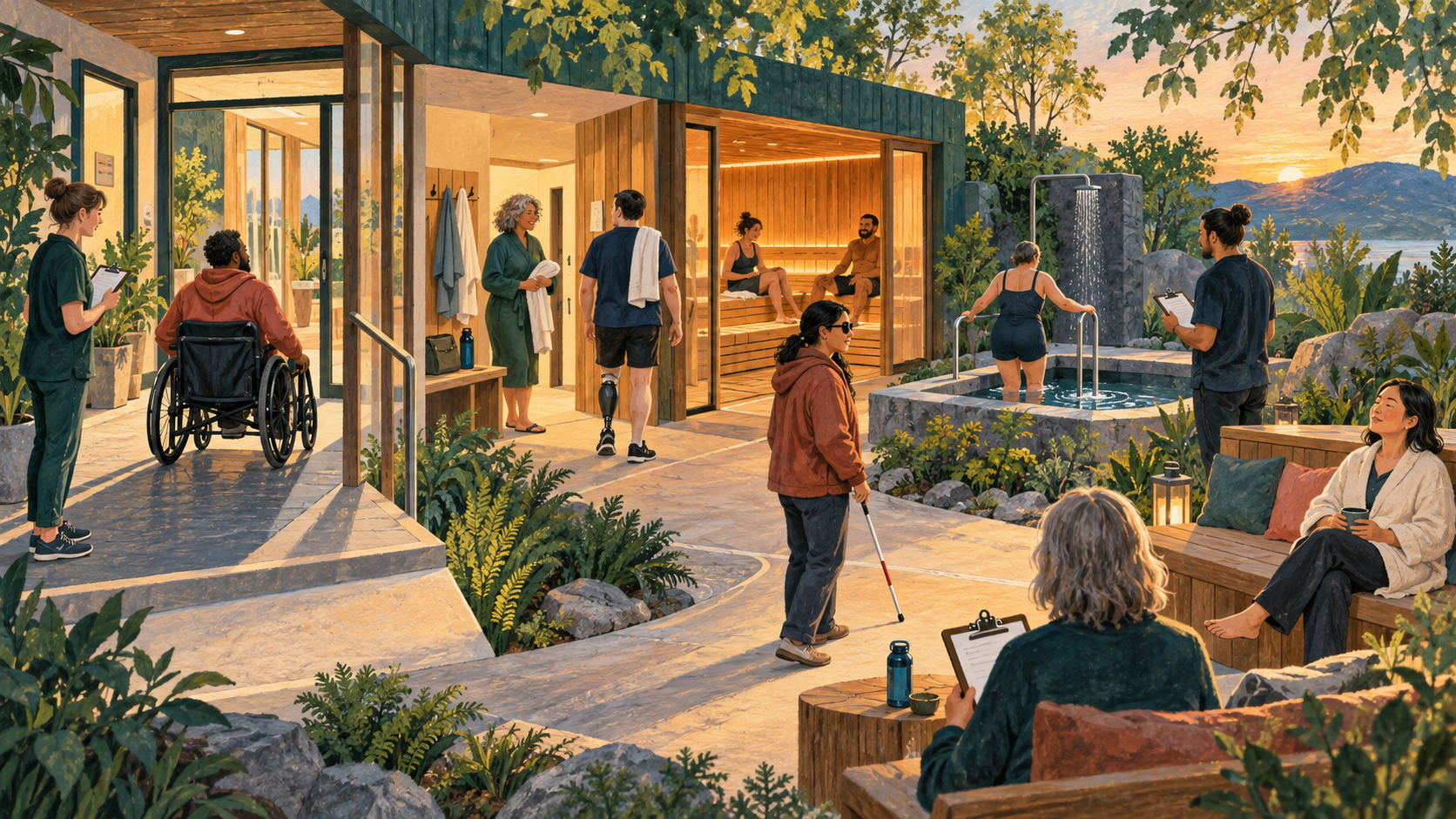
For operators, the immediate priority is a commitment-to-control review. Choose only the principles that the service can actively govern. For each, name the operational change and proof. Keep the Charter statement beside the legal and technical compliance file, not in place of it. Train front-line staff on public access, cultural language, stop rules, incident reporting and the limits of claims.
For hotel and resort spas, decide whether any sauna access is genuinely public under the Charter’s definition. A facility available only with an overnight stay, club membership or treatment purchase should not be described as public merely because many guests use it. Related Spa Awards Journal guidance on sauna culture and operating standards and making room for culture in sauna programming provides adjacent frameworks. Neither article certifies a Charter signatory or a current sauna operation.
For researchers and travellers, directory records such as Fontane Therme and Sky Lagoon Spa Reykjavik are separate discovery references. Directory presence does not establish that either venue has signed the Charter, met all ten principles, passed a current safety inspection, received a nomination or won an award. Any such status requires its own current source.
A 30-day public sauna charter review
Days 1–7: map the current service
List each public, member, hotel, event and private-hire session. Map prices, capacity, booking conditions, physical routes, staff roles, equipment, contractors and emergency arrangements. Collect every public use of “accessible”, “community”, “traditional”, “safe”, “sustainable”, “regenerative” and “wellbeing”. Record the evidence state behind each claim.
Days 8–15: choose bounded commitments
Read the ten principles with staff, bathers and relevant community or cultural contributors. Select commitments that match the organisation’s role and authority. Define one owner, baseline, action and review measure for each. Keep aspirations in future tense until the control is live.
Days 16–23: test the route
Run sessions with different users and conditions. Test booking, arrival, changing, heat, cooling, rest, communication and exit. Reconcile the experience with safety documentation, maintenance records and access information. Correct failures before promoting the commitment. Record why any unresolved limitation remains and when it will be reviewed.
Days 24–30: publish accountable language
Explain what was changed, what remains limited and where people can raise concerns. Link each public statement to the right evidence without disclosing personal or sensitive data. Set a review after seasonal changes, new equipment, staffing changes, pricing changes or an incident. A commitment should become more precise as evidence develops, not broader.
What remains unproven
The reviewed sources establish that version 1.0 of the Charter exists, that it contains ten voluntary principles, and that its public launch was reported in Oslo ahead of the 2026 International Sauna Congress. They do not establish that every applicant has implemented a commitment, that signatories are certified or audited, that a public sauna complies with local law, or that participation produces health, community or environmental outcomes.
The Charter can still be valuable. Its strongest use is as a visible promise register that prompts operators and communities to ask better questions. The proof must come from the service: a door people can actually use, sessions they can actually book, traditions represented with permission, risks actively controlled, impacts measured within a stated boundary and decisions open to review.

