
Wellness guest rooms are often sold through a list of features: adaptive lighting, air treatment, blackout controls, movement equipment, sound options or a digital guide. A newly published hospitality study points to a less glamorous condition for success. The value of an unfamiliar room may depend first on whether the arrival works, the guest understands the choices and help is easy to reach. Equipment alone is not the experience.
The September 2026 paper in Cornell Hospitality Quarterly examined matched reservation and survey records from one major destination hotel during the 2014–2015 launch of a wellness-centric room. Its authors describe check-in efficiency as a gatekeeper that helped guests understand the innovation and reduced technology anxiety. That is a useful operating signal, not a universal formula. The data come from one property, one launch period and one specific offer; the abstract does not prove that a feature improves health, that every guest wants instruction or that the same sequence will work in every market.
For spa and hotel leaders, the practical question is therefore not “Which wellness hardware can fit in a room?” It is “What must the service do so that a guest can understand, choose, use, stop and evaluate the room without friction?” Answering that question turns a specification into an accountable hospitality product.
Wellness guest rooms have an adoption window
The new service-innovation study calls the post-implementation period an “innovation window”: the moment when a radical value proposition enters established hotel routines. In the case studied, the room was not simply another amenity. Guests had to recognise what was different, understand how to use it and decide whether it was worth the price and attention.
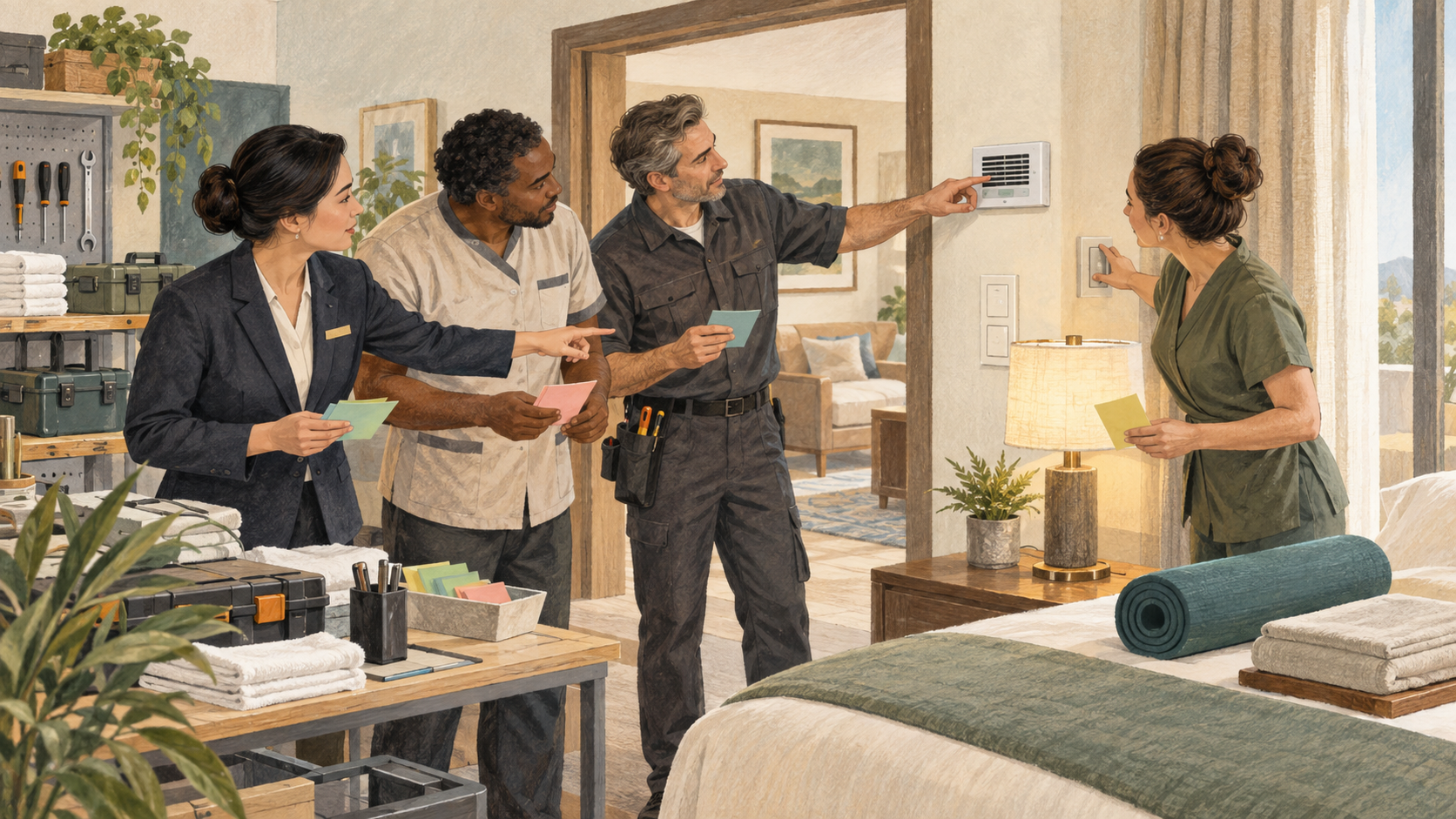
That window begins before the door opens. A guest may have booked for location, sleep, work or convenience rather than for a wellness programme. The reservation description creates an expectation; the pre-arrival message can either clarify the offer or overload the guest; reception decides whether the difference becomes understandable; housekeeping and engineering determine whether the promised settings actually work. A late repair, an unexplained control or a mandatory tutorial can undo the proposition before any reflective survey is completed.
This changes the launch question. Installation is a project milestone, but adoption is an operating state. A room should not be described as successfully launched merely because its devices are connected, its photographs are live and its booking code is available. Leaders need evidence that the complete service can be delivered repeatedly across shifts, room states, languages, access needs and foreseeable failures.
What the research establishes—and what it does not
The study separates three kinds of value. Extrinsic value concerns process efficiency; intrinsic value concerns the emotional quality of the experience; systemic value concerns economic considerations. Its reported hierarchy matters because it suggests that higher-order experience may remain inaccessible when the basic operating interaction fails. In plain language, a guest who cannot enter smoothly or understand the room may never reach the calm, control or enjoyment the concept was designed to support.
Separate research offers useful comparison without turning the finding into a law. A 2026 analysis of 220 publicly available hotel-review observations in the United Arab Emirates found positive relationships among smart-technology intensity, expressed sentiment and ratings, while explicitly treating reviews as observational rather than controlled causal evidence. The authors emphasise that technology is most useful when it reduces friction and complements responsive human service. A 2025 study of contactless technology in hotels in southern Thailand likewise reported context-sensitive associations and warned that purposive sampling, a cross-sectional design and regional conditions limit generalisation.
Together, these studies support a disciplined hypothesis: technology can contribute to satisfaction when it is useful, reliable and human-supported. They do not establish that adding technology causes wellbeing, guarantees repeat visits or creates an award-worthy room. They also do not show that one interface, staffing model or training script works across cultures. The correct response is a measured service trial with declared assumptions, not a sweeping promise.
Treat arrival as part of the wellness product
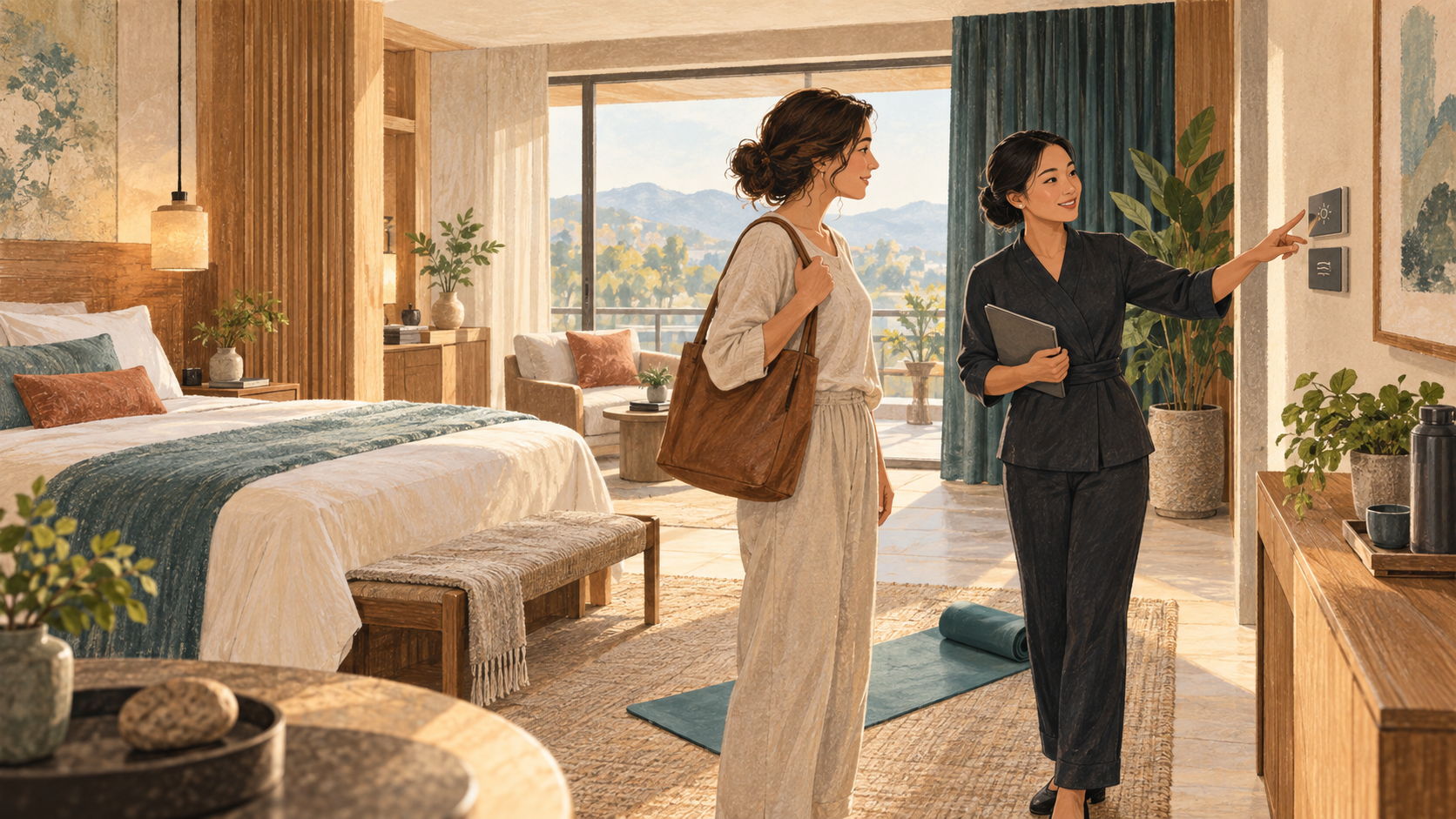
Arrival should make the room legible without turning reception into a sales demonstration. A concise introduction can cover four points: what is different, which features are optional, how to make a simple adjustment and how to request human help. The guest should also be able to decline the explanation and find the same information later.
A useful arrival standard can be tested. Can a guest reach the room without a special queue? Can the host describe the offer in under a minute? Can the guest choose a physical control instead of an app? Is there a plain-language quick start that does not require an account? Can a colleague demonstrate the room when the specialist is off duty? Is the explanation available in the languages actually supported by the property?
This is human-centred design applied to service. The US National Institute of Standards and Technology's human-centred design guidance says interactive design should begin with an explicit understanding of users, tasks and environments, involve users throughout development, and be refined through evaluation. Its listed principles include suitability for the task, conformity with expectations, suitability for learning, controllability, error tolerance and individualisation. Those principles translate well to a room: the guest should be able to understand a control, reverse a choice and recover from an error without feeling trapped or judged.
Give every feature a human fallback
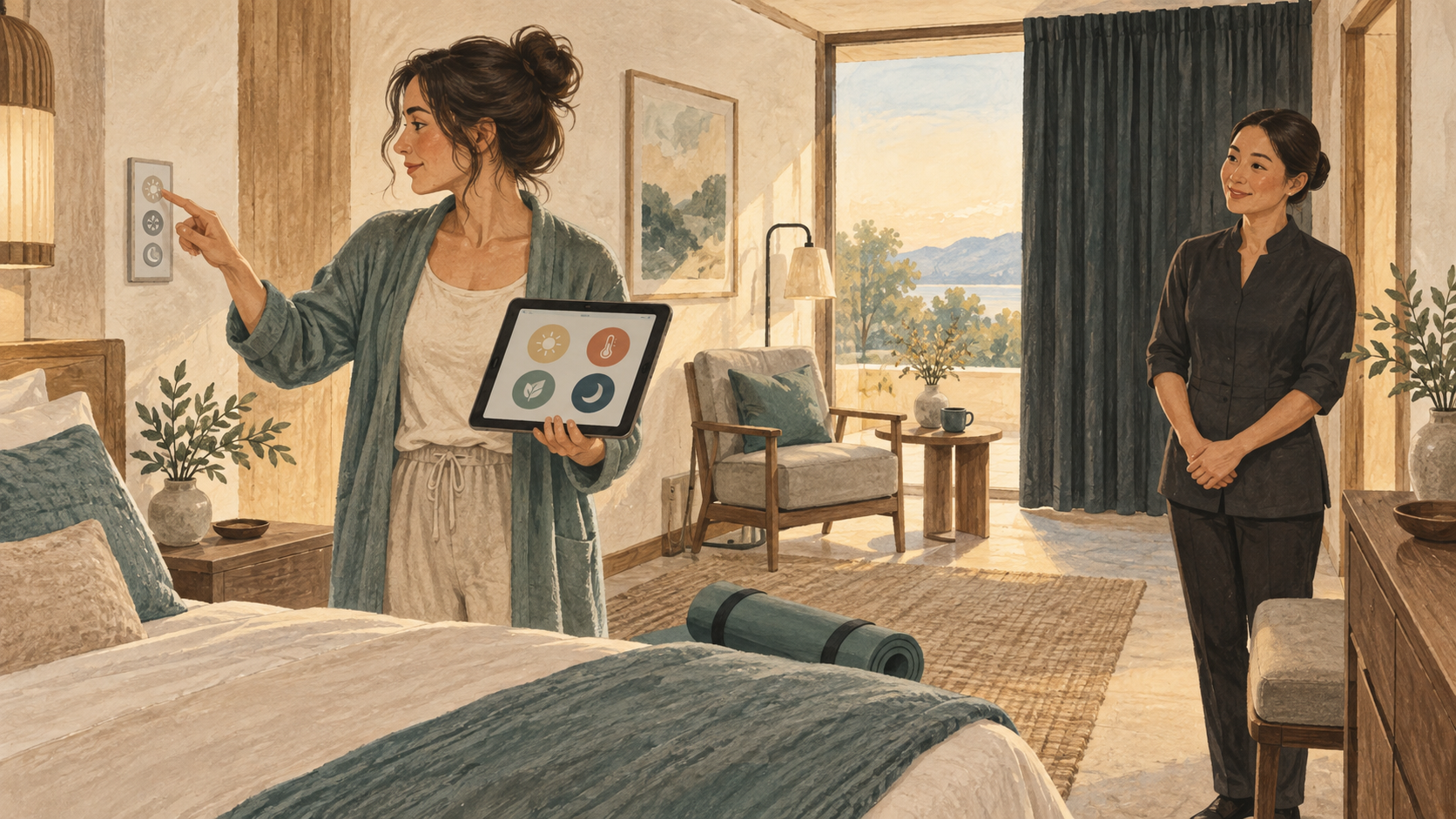
Wellness guest rooms often combine physical and digital layers. A curtain may have a wall switch and a tablet control. A lighting sequence may depend on a network service. A sound programme may be selected through a screen. The design should assume that a guest may prefer not to use the screen, may not see or hear it well, may not understand its icons, or may simply want a normal lamp and a quiet room.
For every feature, write a fallback before launch. State what the guest can do manually, who can help, what happens when the network is unavailable, how the room returns to a neutral state and how a preference is cleared after departure. A fallback is not an admission that the concept has failed. It is part of hospitality: control remains with the guest even when the novelty is declined.
Service recovery also needs a boundary. If a feature cannot be restored promptly, the team should know whether to reset it, disable it, move the guest, offer an ordinary room or adjust the charge. The choice and authority should not be invented at midnight by the person answering the telephone. A pre-agreed decision tree protects both the guest and the colleague.
Measure three layers of value separately
A single satisfaction score cannot show where a wellness-room service succeeds or fails. The three-layer structure from the 2026 study offers a practical measurement sequence, provided the hotel labels its own metrics rather than pretending to reproduce the research.
1. Functional delivery
Start with facts the operation can observe: room ready on time, controls working, settings reset, explanation offered, explanation declined, help request answered, fault resolved and feature taken out of service. Measure the journey by shift and room, not only as a monthly average. A high overall score can conceal a recurring night-shift failure or one room with unstable controls.
2. Experienced value
Ask whether the guest understood the offer, felt in control and found it useful. Keep questions neutral. “Which features did you choose?” is more informative than “How much did our wellness technology improve your sleep?” The latter embeds a health outcome and may encourage the guest to report what the brand appears to want. Open comments can reveal language, sensory and access issues that preset scales miss.
3. Economic value
Only after delivery and experience are visible should leaders examine rate premium, upgrade acceptance, service cost, maintenance, recovery compensation and repeat selection. Separate selection from use. A guest may pay for the category but ignore most features; another may receive an upgrade and value one simple control. Neither case justifies attributing revenue to every component.
This layered view also prevents an attractive average from becoming a false success claim. A higher room rate can coexist with poor usability. Positive comments can coexist with heavy labour costs. Smooth operations can coexist with weak demand. The decision to refine, scale or stop should use the three records together.
Build a 30-day adoption control loop
The first month should be treated as controlled learning, not as proof of a finished concept.
- Days 1–3: prove the neutral room. Confirm that every feature starts in a safe, ordinary and understandable state. Test the room with the network unavailable and with a colleague who did not help design it.
- Days 4–7: observe arrival. Record where the explanation slows, which questions recur, which guests decline and whether the host can offer a no-pressure alternative.
- Days 8–14: compare shifts and rooms. Review faults, response times, reset accuracy and recovery decisions. Fix operating variance before changing the marketing.
- Days 15–21: interview for understanding. Use short voluntary questions about clarity, control and usefulness. Include guests who ignored the features; non-use is evidence, not missing enthusiasm.
- Days 22–30: decide feature by feature. Keep, simplify, retrain, repair, reprice or remove. Document the evidence and owner for each decision.
Small numbers should remain small numbers. Early comments can reveal failure modes, but they are not population estimates. Ratings may also be shaped by the property, trip purpose, room category, service recovery and guest expectations. A launch review should therefore distinguish signals requiring action from conclusions requiring a larger or longer evaluation.
Keep health claims outside the satisfaction score
A guest can like a lighting scene, air setting or movement prompt. That preference does not establish a clinical or physiological outcome. Satisfaction, sentiment, feature use and health benefit are different evidence states.
The US Federal Trade Commission's health-products guidance, while jurisdiction-specific, offers a useful communication discipline: objective health and safety claims should be truthful, not misleading and supported before publication, including claims conveyed by implication or imagery. For an international hotel group, the applicable legal review will vary by market, but the editorial lesson travels well. Do not convert a pleasant stay, a testimonial, a device specification or a research abstract into a promise about sleep, immunity, recovery, stress or disease.
Marketing and operations should share a claim register. Each statement needs an owner, exact wording, evidence scope, approval date and review trigger. If the evidence covers a component but not the installed room, say so. If the research concerns satisfaction rather than health, keep the claim at satisfaction. If the evidence is exploratory, describe it as exploratory.
What does this mean for spa and wellness professionals?
First, wellness expertise should enter the room-design process before the final equipment list. The team can identify where a ritual needs consent, where a choice may feel prescriptive, where a sensory feature needs an off position and where marketing language crosses from hospitality into a health claim.
Second, the room must join the property's readiness system. The Journal's guide to spa opening readiness is relevant because training, maintenance, recovery and evidence ownership matter before promotion, even when the service sits upstairs rather than inside the spa. If room controls collect preferences or usage data, the separate framework for privacy before personalisation helps keep optional service and data capture distinct.
Third, directory discovery must remain separate from evidence. Readers can explore international hotel-spa records such as Cielo Spa at Four Seasons Hotel Buenos Aires and Mandarin Oriental, Munich, but those listings do not prove that either property uses the room model discussed here, participated in the research, achieved a health result, entered a nomination or received an award.
Finally, judges, editors and owners should ask for the adoption file, not only the room photograph. Useful evidence includes a current service map, training record, fault log, neutral-state checklist, accessible fallback, claim register, guest-choice data and a dated decision record. The test is whether the room works as a service when novelty meets normal operations.
What remains unproven
The current study is a valuable prompt because it connects operational competence with the guest's ability to access higher-order experience. It does not identify a universal set of wellness-room features, prove medical benefit, establish the ideal amount of staff contact or show that technology should replace ordinary room controls. The two comparison studies also reflect specific samples, regions and methods.
The defensible conclusion is narrower and more useful: unfamiliar wellness features need a service that teaches without pressuring, offers fallback without penalty and measures delivery before making claims. A room earns the right to scale when guests can understand it, colleagues can support it and leaders can explain what the evidence does—and does not—show.
