
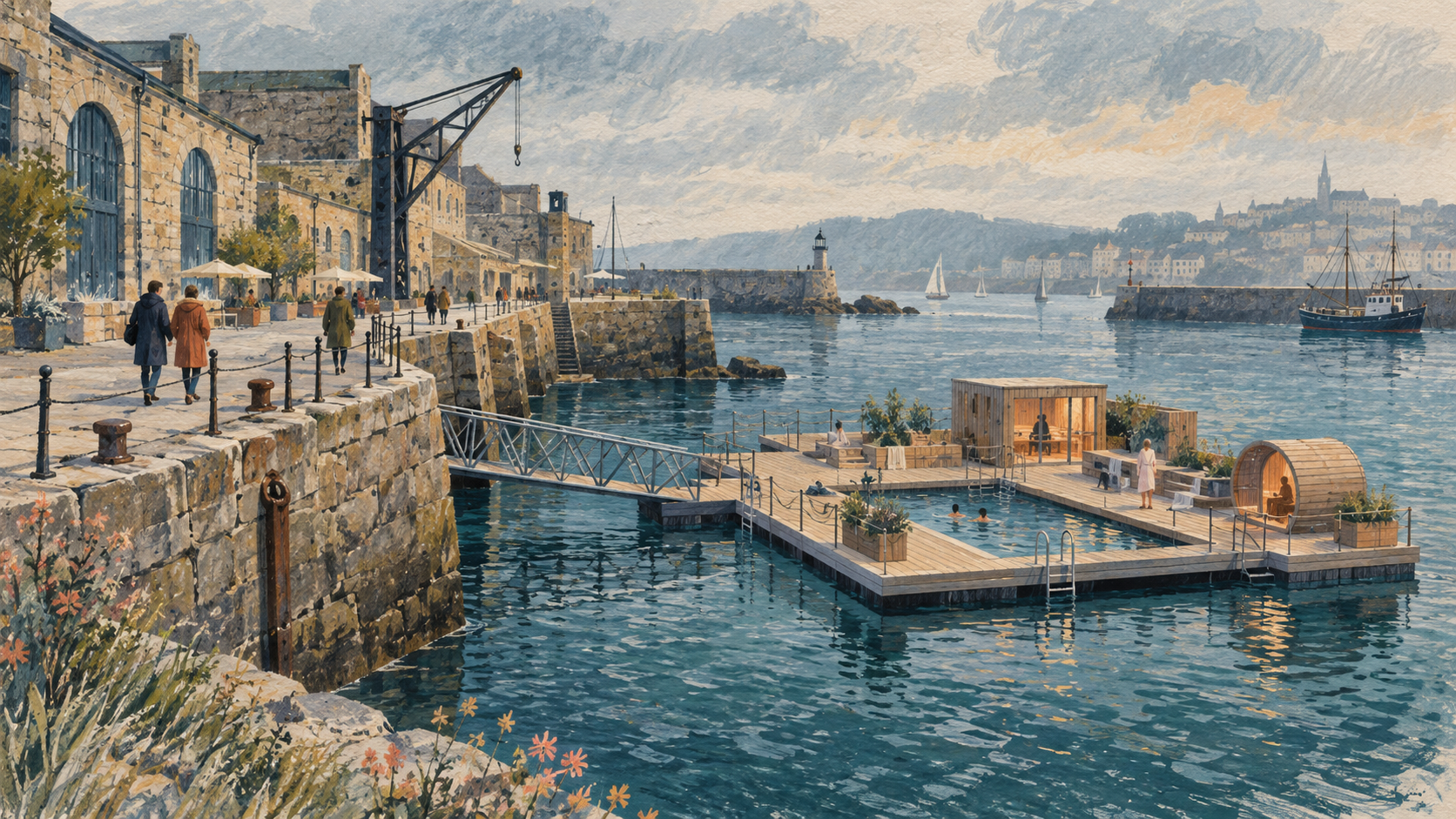
Waterfront bathing begins with approvals and operating decisions
A waterfront bathing project at a disused dock can make a compelling setting for saunas and public life. It can also make a concept feel finished long before a pool is commissioned. The proposed Allas Pool Cardiff offers a useful current example. The developer describes a year-round complex at the Mount Stuart Graving Docks, while its consultation website explicitly says the planning and listed-building-consent applications are still to be submitted. That is a meaningful difference for anyone writing about, financing or benchmarking a wellness destination. A consultation is evidence of a proposal and an invitation to comment; it is not permission to build, proof of safe operation or evidence of an open facility. Nordic Urban's September announcement and the project consultation site establish that boundary.
The wider industry lesson is to make every promise traceable to its present state. A public walkway, a heated pool, a sauna and a heritage structure are different systems with different permissions, owners and failure modes. They should not collapse into a single attractive rendering. This article uses the Cardiff proposal as a bounded signal and develops a practical commissioning framework for other waterfront bathing projects. It does not assess the proposed design, predict the planning decision or suggest that the Cardiff facilities already exist.
What the Cardiff sources actually establish
On 15 September 2026, Nordic Urban said it intended to submit a planning application to Cardiff Council in October. It described a proposed £17 million, 2,000-square-metre development with a 25-metre heated outdoor pool, hot and cold pools, four saunas, changing and relaxation facilities, food and drink, and terraces. The announcement says construction is expected to take around two years once planning permission is granted. Those are the developer's plans and estimate, not an approved budget, construction programme or opening date. Concept architect OOPEAA separately describes the design intent and the pre-application consultation, which it says closes on 13 October. OOPEAA's project statement is evidence of the design team's stated approach, not a site inspection.
The consultation site describes a phased wellbeing hub and says Nordic Urban intends to seek both full planning permission and listed building consent after the consultation. It expressly distinguishes the developer's consultation from the statutory consultation Cardiff Council would conduct following submission. This matters because even an accurately reported forthcoming application may change after feedback. A separate screening-opinion request associated with the docks is visible in planning listings, but a screening request should not be described as full project consent. The sensible editorial wording today is “proposed”, “planned” and “subject to consent”.
There is a real heritage asset behind the proposal. Cadw's official listing identifies Mount Stuart Graving Dock No. 2 as Grade II, designated in 1992, and part of a group of three docks important to Cardiff's port and shipping history. That listing confirms significance; it does not approve any particular intervention. The developer and architect say their concept retains the dock walls, steps and structures. Whether the eventual application and works satisfy the relevant consent process remains a question for the appropriate decision makers.
Keep five evidence states visible
For a spa or bathhouse developer, the first control is an evidence register that separates five states: concept, submitted application, consented design, commissioned facility and operating service. Each state needs a dated source and an accountable owner. A concept image belongs in the first state. A decision notice belongs in the third. Water-test records, rescue arrangements and staff competence belong near the fifth. A marketing page should draw from the state actually reached rather than the state the team hopes to reach next.
This is especially important for mixed-use destinations. A site may secure one approval while a pool element remains under review, or open a café while bathing has not started. A phasing matrix should say which entrance, route, amenity and service is available on each date. It should also identify who can change the public description when programme dates slip. The plan can be ambitious without creating a false impression that all elements are already approved or accessible.
For each public statement, record the wording, source, date checked, status, owner and next verification event. “Public terrace proposed” and “public terrace open” are separate entries. A funder, partner or journalist should be able to see what supported a claim at the time.
Design heritage access as an operating condition
Keeping an old wall intact is only one part of heritage stewardship. A public waterside path needs usable entrances, clear wayfinding, safe edges, appropriate lighting, maintenance access and a plan for periods when the bathing operation is closed. If a restaurant or terrace is promised without an admission charge, the operator should specify the actual accessible route, opening hours, conditions and any event closures before making that promise live. The Cardiff design team's public-access aspiration is valuable as a question to test, not evidence that the final route has been delivered.
Heritage also affects how repairs and routine cleaning are organised. A new deck, handrail or plant connection may meet an old structure in ways that were not obvious in a concept drawing. A commissioning file should show which historic features are protected, how contractors may work around them, what can be inspected without damage and who approves any change. The Grade II designation in the Cadw record makes that a concrete project issue at Cardiff, though it does not prescribe one universal design solution.
For guests, heritage interpretation should be accurate and proportionate. A programme may explain the dock's industrial history, but it should not invent a therapeutic tradition for the site or imply that the place itself delivers a health outcome. The public route and interpretation can be worthwhile on their own terms. A good operating model protects both the material structure and the visitor's ability to understand it.

Commission water, heat and rescue separately
A bathing destination is not ready because its deck looks finished. The water system, temperature control, emergency response and guest route need their own acceptance criteria. The UK Health and Safety Executive's pool guidance says operators must assess risks to workers and users and decide appropriate controls for the particular pool. It does not provide a universal lifeguard number. It also distinguishes maintained public pools from open water that is not maintained as a swimming facility. A waterfront project must establish which water experiences it will actually offer and the controls appropriate to each one.
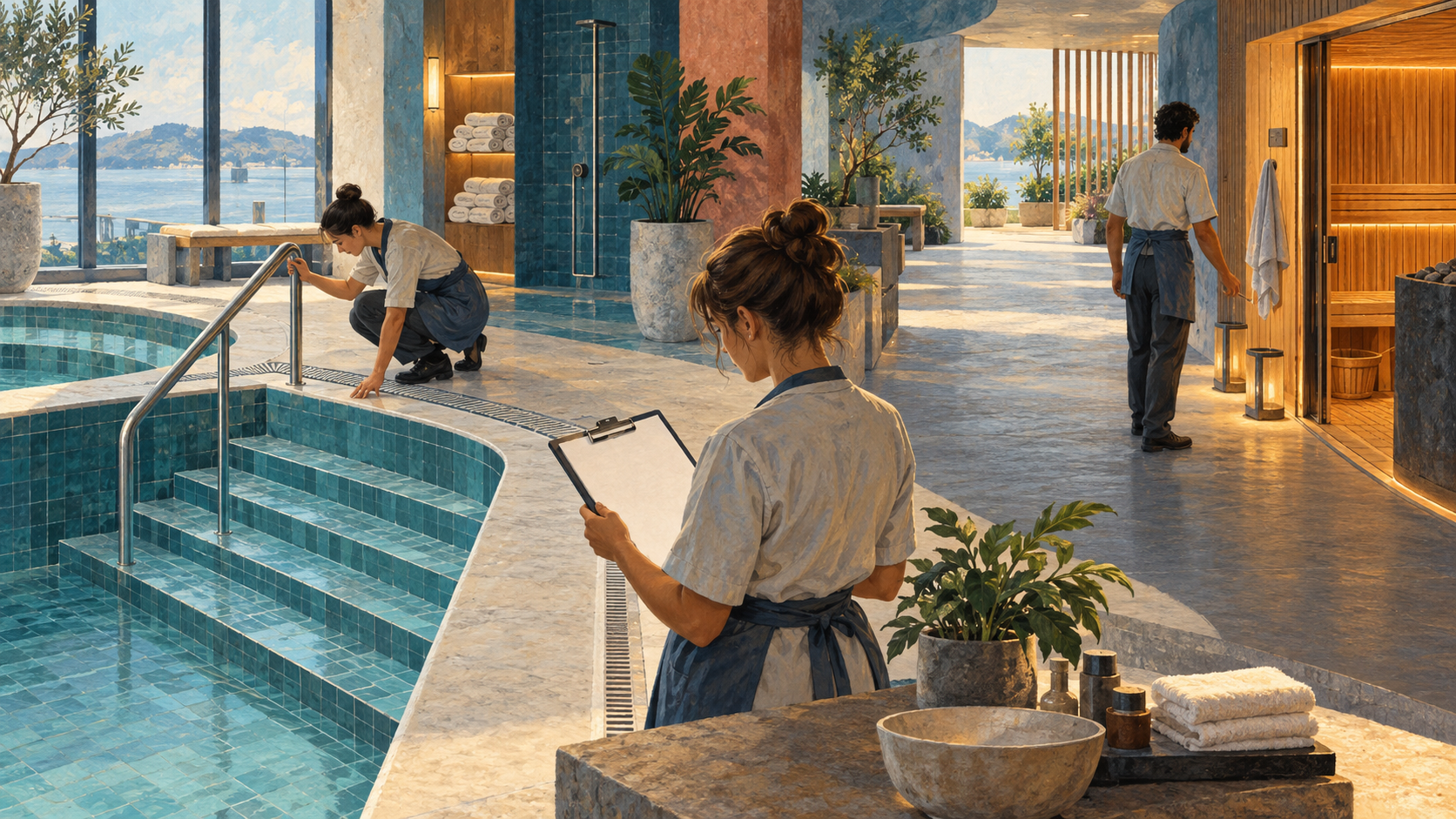
Before sale, the operating team should map each pool and sauna to an owner, a maintenance regime, a capacity, a supervision decision, an emergency procedure and a closure trigger. A heated outdoor pool has different questions from a cold plunge or a natural-water dip. The route between hot and cold areas also matters: wet surfaces, exposed weather, footwear, privacy, accessible alternatives and staff sightlines can change the risk even when individual rooms meet their own specifications. These are proposed audit questions, not findings about Allas Pool Cardiff.
The HSE says the need for constant poolside supervision and the number of lifeguards are determined through risk assessment, and that staff able to respond to emergencies must be competent. Its guidance also points to the Pool Water Treatment Advisory Group for water-quality practice. That means a staffing plan should follow the final facility, expected users and rescue analysis, not be copied from a comparable venue's brochure. Records should show training, exercises, incidents and revisions. A beautiful waterfront view cannot substitute for tested response time or a clear handoff to emergency services.
Water-quality evidence should travel with the operating claim. A project team can discuss filtration or heating technology at concept stage, but the later operational file needs commissioning results, monitoring responsibilities, corrective-action thresholds and a record of what happens when readings leave the accepted range. If part of the offer uses untreated natural water, that must be described and managed as the actual experience, not blurred with a maintained pool. Public copy should distinguish the two in language a guest can understand.
Make the free public route measurable
Nordic Urban says the terraces and a waterside walk are intended to remain open without an admission charge. That is an important proposed civic benefit. It should eventually be tested against an access plan: can someone reach the route without buying a bathing ticket, passing through a sales desk or crossing a wet changing zone? Is it open when a private event takes place? What happens during maintenance, poor weather or an emergency closure? Does the route remain understandable and usable for people with different mobility needs?
A simple site walk can expose contradictions between the commercial and civic promises. Ask an independent reviewer to arrive as a non-paying visitor, find the entrance, reach the viewpoint, use the facilities promised to the public and leave without staff intervention. Repeat the journey at the intended evening hours and during a simulated partial closure. Record barriers and repair them before advertising a permanently open public realm. This is a method for future acceptance testing; no such test is claimed for Cardiff.
The same principle applies to spa-directory and awards language. Being near an award-listed business, appearing in a directory or sharing an operator's brand does not prove accessibility, consent, safety performance or award status. A directory record is a discovery aid. Project claims require their own evidence from the project itself.
Plan the handoff between concept and operation
Many teams can contribute to a waterfront bathhouse: developer, architect, heritage specialist, pool engineer, landscape team, food operator, sauna operator, public-realm manager and emergency responders. Their responsibilities overlap at thresholds such as the water edge, the ticket boundary and the historic wall. A handoff matrix should identify the party that designs each element, the party that accepts it, the party that maintains it and the person who can close it. “Everyone is responsible” is not a useful control when a handrail, drain or evacuation route fails.
The proposed Cardiff scheme names concept and delivery practices in the developer's announcement. That establishes stated project roles at this stage. It says nothing about a final operating contract, inspections or staff roster. For any project, the design-to-operations handoff should include as-built information, approved alterations, equipment manuals, water-system drawings, cleaning restrictions, access routes, training records and a defects process. Commissioning is complete only when the future operator can use and maintain the asset safely within the granted permissions.
Write benefits and projections with the right verbs
A developer can reasonably explain why it expects public access, cultural programming and year-round bathing to make a place more useful. Those expectations should be attributed and framed as plans. Claims about visitor volumes, local spending, employment or health outcomes need separate methods and evidence. Even a strong precedent elsewhere is not a forecast for Cardiff. The project's £17 million figure is an announced development value; it should not become a verified final cost in editorial copy.
Sauna and bathing can be described as experiences without promising treatment or cure. A guest may seek relaxation or social connection, but an operator should not turn that motive into a guaranteed clinical effect. If a health claim is planned, define the exact service, population and evidence before publishing it. The safest early-stage copy says what has been proposed, who proposed it, what approvals are pending and what a visitor can currently do. It keeps images labeled as illustrations or renderings and never presents an imagined guest journey as a first-hand review.
What does this mean for spa and wellness professionals?
For developers, the Cardiff signal suggests a practical rule: match each public promise to an evidence state. Keep the approved application, heritage consent, as-built plan, water commissioning file and operating procedures distinct. If the project changes, update every public surface that describes the affected amenity. For spa operators, start staffing and training design early enough to influence layout, but avoid announcing operational capacity until the final water and rescue assessment is complete.
For editors and researchers, use the operator's dated release for the proposal, the consultation site for the current process, the Cadw listing for the historic asset and the HSE guidance for general pool-operating duties. Those sources answer different questions. None proves the completed performance of a future Cardiff venue. Spa Awards has separately examined heritage as an operating duty and how sauna standards develop; these are related reading, not endorsements of this project.
Readers looking for current UK spa experiences can use directory entries such as Thermae Bath Spa and The Gainsborough Bath Spa as separate discovery records. They are in Bath, not Cardiff, and the directory entries are not evidence about Allas Pool Cardiff, its consent, its eventual services, its nomination or any award result. That distinction should be explicit whenever a new project is discussed alongside active venues.
A commissioning checklist before the first ticket
At application and consent
Record the exact proposal submitted, the public-access commitment, the heritage interventions and every condition attached to a decision. Compare the final permission with marketing copy and with the operating plan. If the application is not yet submitted, call it a proposal. If consent is conditional, name the conditions that must be discharged before the relevant work or use. Do not treat a pre-application consultation as a planning decision.
Before practical completion
Walk the guest, worker and non-paying public routes. Test edge protection, weather response, accessible alternatives, plant isolation and emergency access against the final layout. Verify that the heritage-protection method is usable by maintenance teams. Check which spaces can open independently and which must stay closed together. Make each contractor hand over a record that the operator can understand and keep current.
Before sale and opening
Accept the water systems, pool supervision decision, sauna procedures, rescue plan, water testing, staff competence and closure rules. Run realistic drills. Reconcile the booking page, map, signs, directory copy and press materials with what is actually open. If one element is delayed, say so plainly. Recheck public access without a ticket. Only then should a planned guest experience be described as an operating one.
What remains unproven
As of this review, the official sources establish a Cardiff proposal, a live pre-application consultation, the developer's intended submission timetable and the dock's listed status. They do not establish granted planning or listed building consent, completed construction, commissioned pools, tested water systems, active sauna services, actual opening hours, realised public access, visitation, health outcomes or award merit. The project may evolve through consultation and formal review. The transferable lesson is the discipline of updating the evidence as it does, one claim and one operating system at a time.

