

Sauna standards are becoming an industry question, not simply a room specification. A current Spa Business report describes the launch of the Australian Sauna Association as a national body for education, advocacy, collaboration and shared standards. The development is timely for spas, bathhouses, health clubs and mobile operators, but an association’s existence does not itself certify a venue, settle local regulation or prove a health outcome.
The useful question is what a national body can change when growth is faster than shared operating language. It can convene operators, define terms, compare recurring problems, publish voluntary guidance and create a route from cultural knowledge to safer practice. It cannot replace building, fire, electrical, public-health, workplace, accessibility, consumer or professional obligations. Those remain attached to the specific place, service and claim.
For international spa leaders, Australia offers a practical case study. The task is to build a standards system that keeps five layers separate but connected: culture, facility design, daily operation, people and evidence. That distinction allows the sector to grow without turning “authentic”, “community-led” or “wellness” into untestable promises.
What the Australian Sauna Association announcement establishes
The trade report, dated 28 July 2026, says the Australian Sauna Association has been established to support authentic, accessible and community-led sauna culture across health clubs, spas, bathhouses and social-wellness businesses. It reports plans for education, advocacy, collaboration and shared standards, as well as an inaugural gathering called The Big Sweat on 22–23 August. These are current organisational aims and an announced event, not evidence that national operating standards have already been adopted.
The association’s own website describes it as a volunteer-led, not-for-profit national peak body working across bathing, building, operation, education and research. It also says it is Australia’s national member body of the International Sauna Association. That statement is primary evidence of the Australian body’s position; it is not an independent audit of its programmes, membership reach or future influence.
Australia’s official ABN Lookup confirms that Australian Sauna Association Incorporated is a registered entity and that its current name has been recorded since March 2025. This adds a useful boundary to the launch story: the current publicity marks a new phase of visibility and activity, rather than proving that every aspect of the organisation began in July 2026.
The distinction matters. A launch can create a forum and a mandate to develop resources. A standard exists only when its scope, drafting process, evidence basis, responsibilities, version, review cycle and relationship to law are explicit. Accreditation goes further again and requires defined criteria, competent assessment, conflicts controls, decisions, appeals and surveillance. None should be inferred from directory presence, membership or event attendance.
Sauna standards must begin with scope
“Sauna” can refer to a hot room, a bathing sequence, a cultural practice, a facilitated ritual, a hospitality amenity or a commercial venue. Infrared cabins, electric stone heaters, wood-fired rooms, smoke saunas, steam rooms and contrast circuits have different equipment, air, fire, water and staffing questions. A standard that treats them as interchangeable will either become vague or create false confidence.
The International Sauna Association says its work includes a definition recorded in Aachen in 1999 and the promotion and collection of research across history, folklore, medicine and technology. That breadth is valuable because it stops a technical checklist from pretending to describe the whole practice. It also shows why every document needs a declared boundary: a cultural definition is not a building approval, and a scientific archive is not a property-specific safety decision.
A useful national framework would begin with a taxonomy. It should identify the heat source, temperature and humidity operating range, whether water is applied to stones, room capacity, session model, level of facilitation, cooling route, water features, age policy, clothing convention, cleaning system and emergency response. Operators can then map each service to the rules and evidence that actually apply.
Map voluntary guidance to legal duties
Association guidance is most useful when it acts as a compliance map rather than a substitute regulator. For each sauna format, operators need to identify the relevant national, state or territory and local requirements, plus manufacturer instructions, insurer conditions and competent professional advice. A mobile wood-fired sauna on public land has a different approval path from an electric cabin inside a hotel, even if both offer communal heat.
The map should cover planning and land access; structural and fire safety; heater, electrical and ventilation requirements; safe entry and exit; slips and falls; accessible routes and communication; cleaning and infection controls; food and alcohol service where relevant; child and vulnerable-person safeguards; workplace exposure; incident reporting; and consumer claims. The responsible person, evidence location and review date should be named for each duty.
Cold plunges and spa pools deserve their own line. They are not made safe by being paired with a sauna. Current NSW Health guidance for public swimming and spa pools sets out notification, disinfection, monitoring and recordkeeping requirements for facilities within its scope, and recommends risk-management plans. It also distinguishes natural pools and defines when public-health powers still apply. Operators in other jurisdictions need the equivalent local check; copying one state’s settings is not compliance elsewhere.
The Journal’s guide to commissioning heat, cold and flow provides a compatible operating principle: test the route and control system, not only the rooms. A sauna standard should make dependencies visible, including what happens when a heater, ventilation fan, water-treatment system, door, alarm, timer or staffing assumption fails.
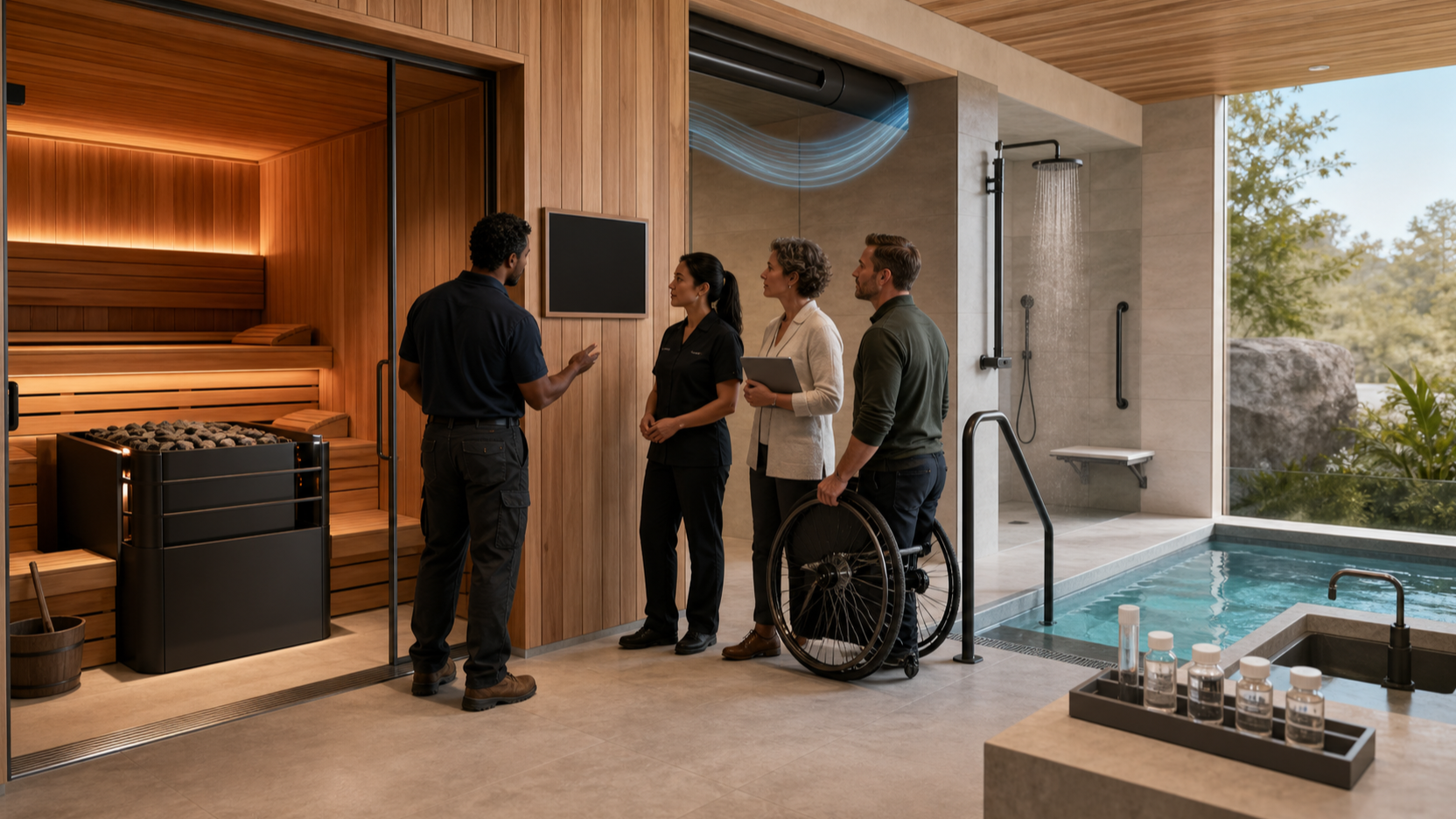
Design heat, cooling and water as one operating journey
Guests do not experience isolated specifications. They move through arrival, changing, orientation, heat, cooling, hydration, rest, optional water immersion and departure. Capacity decisions in one zone affect every other zone. A hot room that holds 20 people can still create an unsafe or unpleasant system if only six can cool down, the drinking-water point is inaccessible, wet routes cross dry circulation or the attendant cannot see a developing queue.
Start with intended use and foreseeable variation. Record the guest groups the service is designed for, the information provided before booking, the choices available on arrival and the conditions that trigger staff intervention. Do not turn a time-and-temperature table into a universal prescription. Individual suitability differs, and a hospitality team should not improvise medical clearance. The operating design should favour clear opt-outs, gentle entry, accessible cooling, observable routes and escalation to appropriate professional advice.
Commission the complete sequence under realistic load. Measure room and surface conditions where relevant, confirm ventilation performance, test controls and alarms, inspect door operation, trace cleaning and water records, observe towel and footwear behaviour, and simulate an incident without relying on one experienced employee. Include opening, shift-change and closing checks. Repeat tests after material maintenance or a change in capacity, ritual, equipment or plunge operation.
Facilitated sessions add another layer. An attendant, Saunameister or Aufguss practitioner changes airflow, sensory intensity, pacing and group behaviour. The programme needs a defined role, competency boundary, maximum load, communication method, stop authority and recovery time. Ceremony can enrich culture, but it should not obscure the underlying engineering or guest choice.
Protect workers, not only guests
A guest may leave the heat after one short session. An attendant may enter repeatedly, prepare rooms, clean hot surfaces, carry wet textiles, manage fires or equipment, guide groups and respond to incidents across a shift. Guest limits therefore cannot be reused as a workforce risk assessment.
Safe Work Australia’s heat-risk guide directs employers to identify, assess and control heat exposure and to respond when a worker shows signs of heat-related illness. Its accompanying guidance stresses that temperature alone is insufficient: humidity, air flow, task intensity, duration and individual acclimatisation matter. A spa should translate those principles into task-level controls, not simply tell workers to hydrate.
Map exposure by role and shift. Reduce unnecessary time in the hot environment; use engineering controls before administrative rules; build cooler recovery areas and realistic breaks into staffing; rotate tasks only when rotation actually reduces risk; provide training and first-aid arrangements; and include contractors, cleaners and maintenance staff. Review incidents, symptoms, near misses and overtime together. A successful guest programme is not successful if it transfers unmanaged heat load to the team.
Treat culture as living knowledge, not a styling package
UNESCO inscribed sauna culture in Finland on the Representative List of the Intangible Cultural Heritage of Humanity in 2020. Its record describes a practice transmitted through families, clubs and universities, centred on löyly and expressed through multiple forms without a hierarchy among them. The listing concerns Finnish living heritage; it does not certify commercial venues in Australia or elsewhere.
For operators, the lesson is that authenticity cannot be reduced to pale timber, a imported word or a high temperature. Cultural claims should identify whose tradition is being described, who contributed knowledge, what has been adapted, how practitioners are credited and how local guest expectations are handled. A new Australian culture can be informed by Finnish, Baltic, Nordic, Indigenous and other bathing knowledge without falsely merging them or presenting one group as decoration.
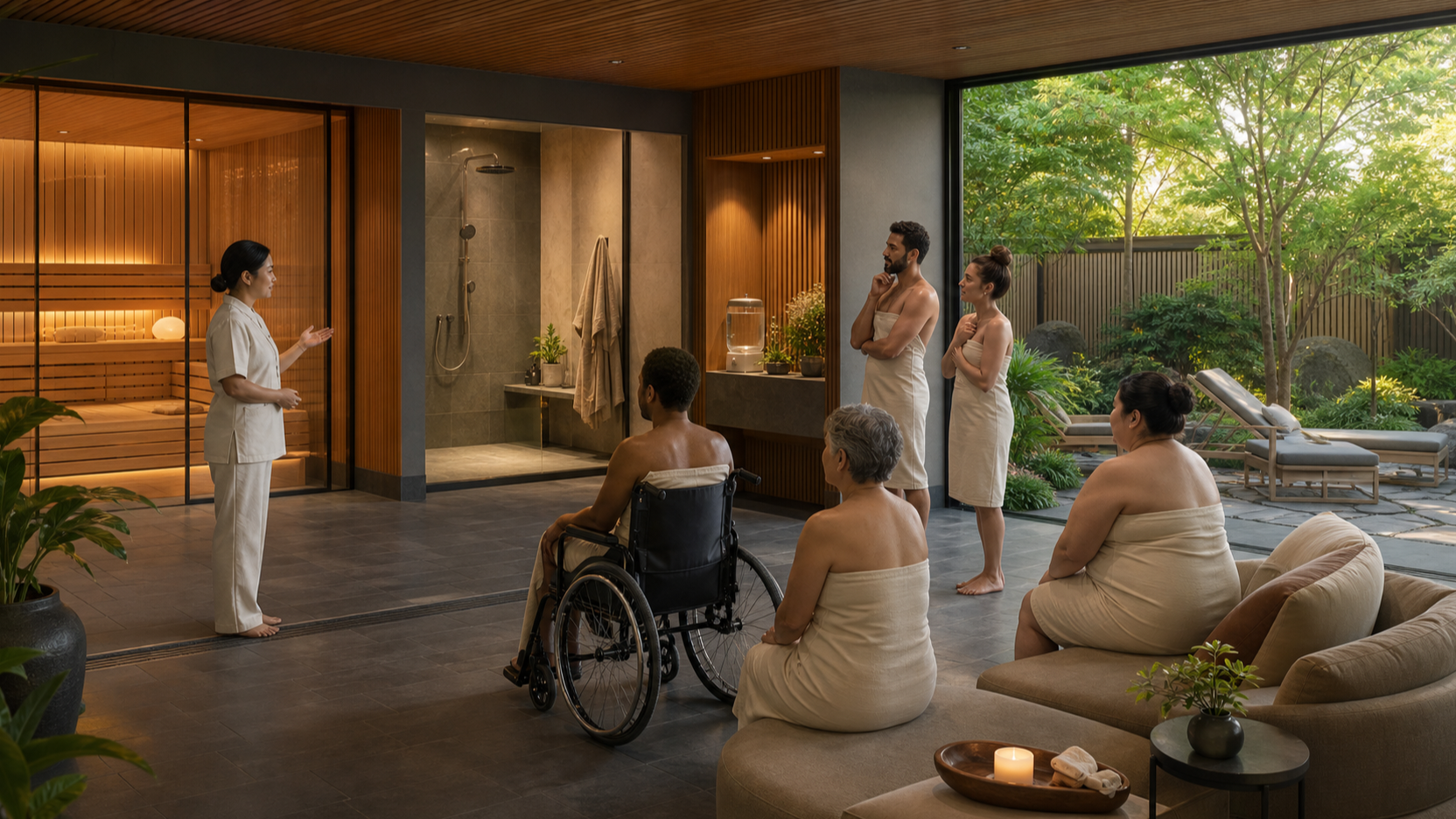
Standards should also make inclusion practical. Clothing expectations, gendered sessions, family access, privacy, body diversity, disability access, sensory load, communication and beginner orientation all affect who can participate. The objective is not one universal etiquette. It is a transparent offer with choices, boundaries and respectful enforcement so guests know what they are booking.
Build an evidence and claims register
A national association can help the sector improve its language by separating four kinds of statement: facility facts, cultural interpretation, guest-experience descriptions and health or performance claims. Each needs a source, owner, scope and review date. A new heater, training course, membership badge or association relationship does not substantiate all four.
Australia’s consumer guidance on false or misleading claims states that information about products and services must be accurate, truthful and based on reasonable grounds. It covers benefits, qualities, performance, testimonials and future claims, and warns that silence about important details can also mislead. For sauna marketing, that means planned facilities, projected benefits and limited evidence must be labelled honestly.
Create a claims register before rewriting promotional copy. Record the exact wording, channel, intended audience, evidence, population or setting studied, exclusions, expiry or review date and approver. Remove language such as “detox”, “risk-free”, “guaranteed recovery” or broad disease claims unless a qualified legal and evidence review supports the precise use. Do not convert association membership, cultural recognition or a research citation into an endorsement.
What does this mean for spa and wellness professionals?
For spa owners and investors, ask whether the sauna concept has a full compliance and operating map before treating it as a revenue feature. Budget for ventilation testing, competent installation, accessible circulation, water management, training, maintenance and workforce recovery, not only the cabin.
For spa directors and bathhouse operators, define the guest journey, intended use, capacity and intervention points. Keep pre-arrival information, orientation, signage, staff scripts and incident response aligned. Test the system under realistic load and after change.
For facilities, design and safety leaders, connect heat, air, fire, electrical, water, drainage, cleaning and emergency controls. Record which requirement applies, who verified it and when it must be reviewed. Voluntary guidance should make this file easier to build, not replace it.
For practitioners and attendants, work within a stated role and stop authority. Ritual skill does not remove the need for engineered controls, guest consent, breaks and task-level heat-risk management.
For associations, publish scope, methods, conflicts, version history and the limits of each document. Separate membership, education, standards, accreditation and certification. Invite regulators, workers, disability and cultural contributors into the process rather than relying only on suppliers and founders.
For marketers, editors and awards researchers, keep announced plans, entity registration, association membership, operational implementation and measured results in separate columns. The Journal’s responsible retreat principles offer a useful parallel: transparent scope, qualified roles, guest choice and accountable relationships matter more than a broad wellness label.
A 90-day sauna standards review
Days 1–30: define and map. Inventory every sauna and connected cooling or water feature. Record format, heat source, capacity, intended use, facilitation, guest groups, staffing, cleaning, emergency arrangements and current claims. Map each item to applicable approvals, legal duties, manufacturer instructions, insurance conditions and competent advice. Mark unknowns rather than filling them with assumptions.
Days 31–60: test the journey. Commission one representative session from booking to departure at normal and peak load. Verify ventilation, controls, doors, observation, cooling, hydration, accessibility, water records and staff exposure. Run an incident scenario and inspect whether the team can stop the session, assist a guest, contact help and preserve an accurate record.
Days 61–90: correct and publish boundaries. Close high-risk gaps, assign funded actions for the remainder and rewrite claims to match current evidence. Publish the service format, key guest choices and material limitations in plain language. Set review triggers for incidents, equipment changes, capacity increases, new rituals and updated guidance.
Readers can use the active directory page for Peninsula Hot Springs as a market-context reference. The link does not establish its current sauna specification, compliance, association membership, Spa Awards nomination, judging, result or endorsement. Those questions require current property-level evidence.
What remains unproven
The reviewed sources do not prove how many Australian spas or health clubs operate saunas, how consistently they meet current obligations, or whether the new association’s planned standards will be adopted. They do not establish that an association, event or shared charter causes safer facilities, better staff outcomes, commercial growth or health benefits.
The credible opportunity is narrower and more useful: a national forum can make definitions, evidence gaps and recurring operating problems visible. Progress should then be measured through published guidance, participation, corrected practice, incident learning and transparent review, not through launch language alone.
Frequently asked questions
Does association membership certify a sauna?
Not unless a clearly defined certification scheme says so and the specific venue has passed it. Membership, directory presence, training and event attendance are different states.
Can one sauna standard apply internationally?
A common framework can help, but legal duties, climate, building types, culture and service models differ. Operators must map voluntary guidance to the rules and evidence in their own jurisdiction.
Does traditional design remove modern compliance duties?
No. Tradition can guide cultural practice and design intent, but it does not replace applicable fire, electrical, structural, workplace, public-health, accessibility or consumer obligations.
Is a cold plunge covered by the sauna operating procedure?
It should be connected to the overall guest journey, but it also needs its own scope review for water quality, circulation, cleaning, access, supervision, suitability communication and incident response.
