
What the Zambia retreat announcement establishes
Traditional medicine retreats bring together hospitality, learning, living knowledge, plants and health-related language. That combination can create a valuable educational experience, but it also creates boundaries that a polished itinerary cannot settle. The central operating question is not how much knowledge a guest can consume in a week. It is who controls what may be shared, gathered, prepared, recorded and carried beyond the programme.
A current organiser page advertises a seven-day African Medicine Retreat in northern Zambia from 1 to 7 December 2026. It describes plant walks, medicine-making, farming, cooking, village visits, game drives and accommodation, with local knowledge holders involved in teaching. Spa Business reported the same dates and broad itinerary on 2 September, including the announced plan for participants to prepare several herbal remedies each day.
Those sources establish that a paid future programme is being offered and how its organisers currently describe it. They do not establish that the retreat has taken place, that every advertised activity will occur, that any remedy is safe or effective, that a particular regulatory category applies, that knowledge or plant access has been authorised for every later use, or that the programme has achieved a health, conservation, commercial or award result. This article does not audit the retreat. It uses the announcement as a timely signal for a wider professional question.
The World Health Organization's Global Traditional Medicine Strategy 2025–2034 provides a useful high-level direction: strengthen evidence, support safety and appropriate regulation, integrate services responsibly, and optimise cross-sector value while respecting rights, culture, biodiversity and community participation. A spa or retreat cannot meet that direction with ambience and attribution alone. It needs an operating architecture.
Traditional medicine retreats need a permission architecture
A conventional activity schedule answers when and where. A permission architecture answers who has authority at each step. Before a programme is sold, map the knowledge holder, community, land manager, plant custodian, facilitator, accommodation operator, health practitioner where relevant, photographer, researcher, marketer and guest. Give each role a written decision boundary.
The map should distinguish at least five permissions: access to a place; observation of a plant or practice; participation in an activity; recording or reproducing knowledge; and later use, including teaching, product development, research or marketing. Permission for one is not permission for all. A guest invited to observe a demonstration has not automatically received a licence to publish the method, train others or commercialise a formulation.
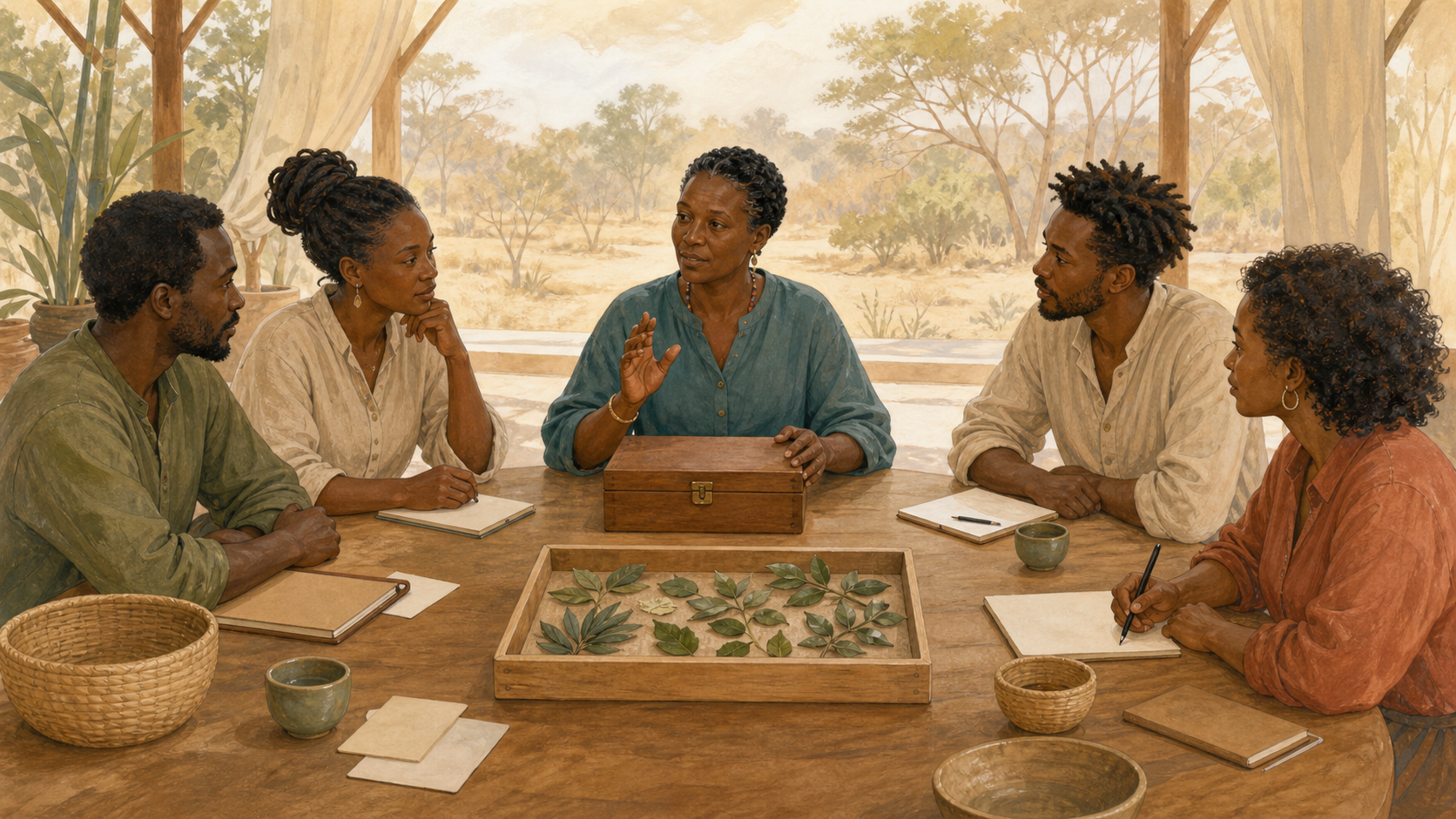
Put the people who hold the knowledge at the centre of this map. They should be able to define what stays closed, what may be taught, how it should be attributed, who may record it, and when permission can be withdrawn. A host's contract with a tour operator cannot substitute for consent from the relevant knowledge holder or community. Likewise, a participant waiver cannot grant rights that the organiser never held.
Use a disclosure ladder
For each session, classify material before guests arrive: public knowledge; knowledge that may be shared only in person; material that may be recorded for private learning; material approved for publication; and restricted knowledge that will not enter the programme. The categories must come from the knowledge holders, not from a marketing team trying to maximise content.
Record the decision, date, decision-maker, permitted audience, attribution, storage period and later-use conditions. If a guide improvises or a guest asks a new question, the safe default is pause, not assumed permission. A respectful programme makes “not for sharing” easy to understand without pressuring anyone to explain why.
Separate education, hospitality and regulated practice
The same programme can contain several different activities. A guided walk may be environmental education. Preparing a non-consumed demonstration may be a practical class. Serving food is hospitality. Giving a named person an individual assessment, recommending a substance for a condition, dispensing a product or applying a preparation may enter a different professional and regulatory space.
Zambia's Health Professions Council published TCAM regulation and integration guidelines in February 2026. The document addresses practitioner registration, approved scope, facility standards, consent, referral, records, products and advertising. It states that practitioners should work within training and approved scope, and that exaggerated or unverifiable claims should not be made. Whether a specific retreat activity falls within this framework is a question for the competent Zambian authorities and qualified local advice, not for an editorial article.
Define the verb, not just the session name
Write down what the guest will actually do: observe, identify, smell, touch, harvest, grind, mix, taste, ingest, apply, take away or receive as an individual recommendation. Risk and governance change with the verb. “Herbal workshop” is too vague for an operating plan because it can describe anything from looking at dried leaves to administering a preparation.
Then define who supervises, what competency has been verified, what materials are excluded, what hygiene controls apply, and what happens if a participant feels unwell. Keep education outcomes separate from health outcomes. A participant may learn to describe a process without demonstrating that the process is safe for unsupervised use or effective for a condition.
Create an escalation route
Guests need a plain explanation of what the programme is and is not. The team needs a current route for urgent care, adverse reactions, uncertainty about a participant's suitability, and requests outside facilitator scope. Health information should be collected only when necessary, protected, and visible only to the people who need it. A remote setting increases the importance of rehearsed communication and transport; it does not expand anyone's competence.
Put knowledge holders in control of the syllabus
Traditional knowledge is not an interchangeable amenity. A responsible syllabus begins with the holders' own learning objectives and restrictions. What do they want guests to understand about land, history, practice and responsibility? Which parts can be taught safely in a short programme? Which details lose meaning or create risk when separated from language, lineage or long-term supervision?
Control must continue through editing and promotion. Knowledge holders should review session descriptions, captions, translations and any explanation of origin. Their names should not be used as a universal authenticity seal. If several communities or practitioners hold different views, the programme should not flatten them into a single “ancient wisdom” narrative.
Compensation should recognise preparation, teaching, review, travel and the value created for the commercial programme. Benefit is wider than a speaking fee: it may include employment, equipment, training chosen by the community, shared revenue, conservation support, access to materials, or the right to reuse programme documentation. The arrangement should be negotiated, written and reviewable rather than inferred from goodwill.
The Convention on Biological Diversity records Zambia as a party to the Nagoya Protocol since 2016. Article 7 of the Protocol addresses access to traditional knowledge associated with genetic resources, subject to domestic law, through prior informed consent or approval and involvement plus mutually agreed terms. This does not mean every retreat conversation or plant walk automatically triggers the same process. It means operators should obtain competent advice before knowledge or biological material moves into research, product development, reproduction or another use.
Control each plant from observation to disposal
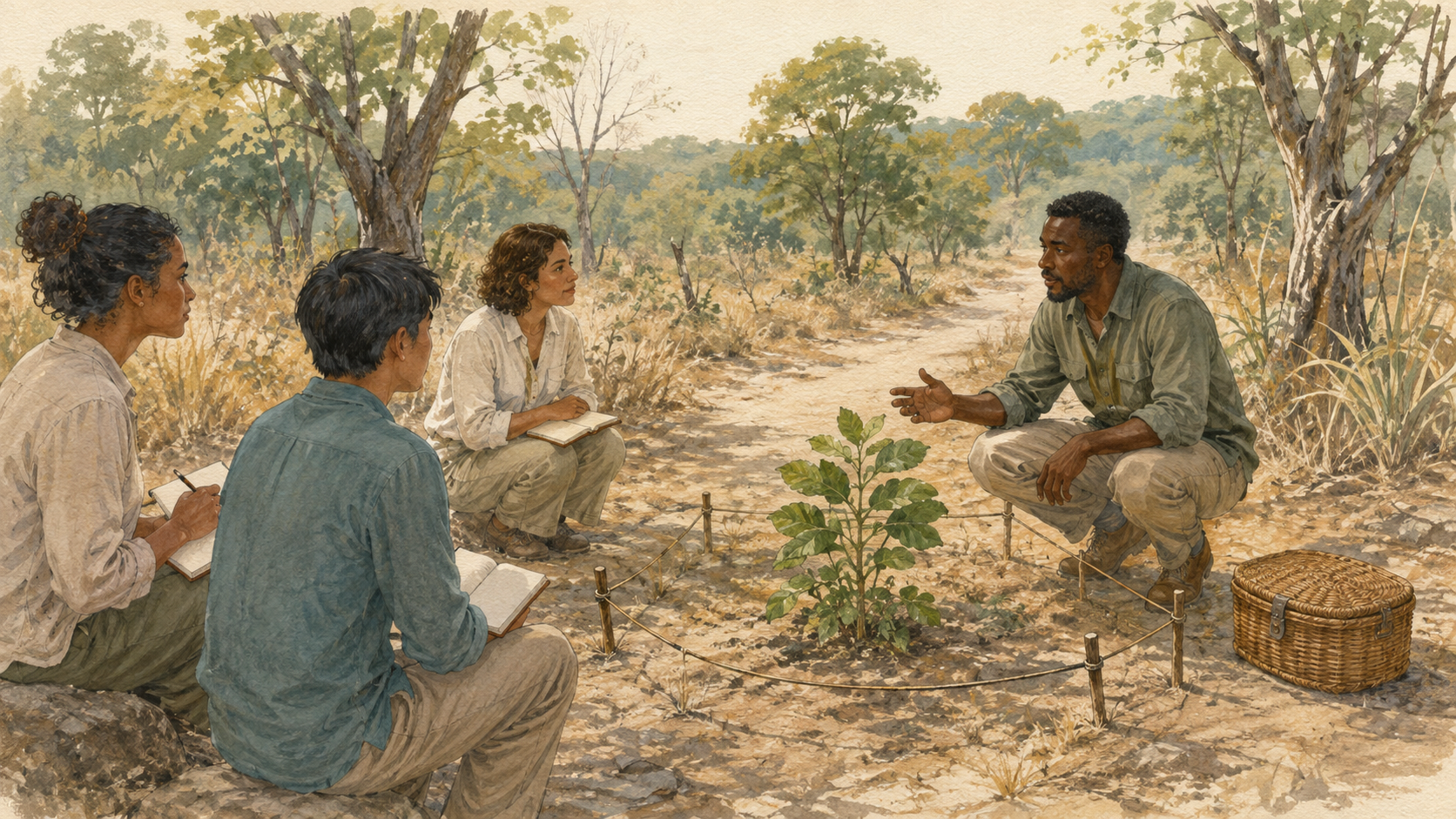
A plant walk should start with an approved route and an observation-first rule. Identify who controls the land, who can authorise collection, which species and plant parts may be touched, what quantity is permitted, and which locations are closed. Avoid turning a visually abundant landscape into evidence that harvesting is sustainable.
The WHO guidelines on good agricultural and collection practices for medicinal plants provide a structured reference for identification, collection, personnel, processing, packaging, documentation and quality assurance. They are not a retreat certification and do not replace Zambian law or knowledge-holder protocols. They do show why a generic basket and an enthusiastic group are not enough.
For every material used, record the agreed local and scientific identification where appropriate, collector, location at a suitably protected level of precision, date, plant part, amount, permission, handling, intended activity and final disposition. Prevent substitution and cross-contact. Separate display materials from anything intended for consumption or application. Do not let guests carry away unlabelled preparations or plant material without a verified legal and safety basis.
Harvesting is only one possible teaching method. Observation, photography where permitted, drawing, cultivated demonstration plots and pre-approved dried materials can reduce pressure and make boundaries clearer. The best choice should be set with land managers and knowledge holders, not assumed from a global checklist.
Make consent specific and repeatable
Consent is not one signature at booking. A guest may agree to attend but decline to taste, apply, discuss personal health, appear in photographs or visit a community. A knowledge holder may agree to teach but decline recording or publication. A community may welcome a visit under conditions that differ from the organiser's standard media release.
Build decision points into the journey: before purchase, before health-related information is collected, before each hands-on activity, before photography or recording, and before any later publication. Explain foreseeable risks and limitations in plain language. Provide a meaningful non-participation option without humiliation or loss of the entire programme.
If the programme collects questionnaires, samples or outcome data to produce generalisable findings, it may move beyond service evaluation into research. Zambia's National Health Research Authority publishes guidelines for research in traditional, complementary and alternative medicine that address ethical and scientific evaluation and the interests of knowledge holders. Operators should determine the correct route before collecting data, not describe ordinary feedback as research after the fact.
Keep marketing inside the evidence boundary
Marketing should describe the programme that has been authorised, not promise transformation from association with tradition. State dates, location, accommodation, accessibility, facilitator roles, activities and exclusions accurately. Distinguish a course, cultural exchange, wellness activity and healthcare service. If delivery is future, use future tense.
Avoid cure, detoxification, immunity, hormone, pain, trauma or disease claims unless the precise claim, product, practitioner and context have the evidence and lawful basis required. Tradition is evidence of history and living practice; it is not automatically clinical proof for a marketed outcome. Scientific language should not be added merely to modernise a cultural practice.
Photography needs the same permission architecture as teaching. Do not stage a guest as receiving a treatment that the programme does not provide. Do not show restricted plants, identifiable knowledge records or community members outside their agreed context. Captions should identify an illustration as an illustration and an announced programme as announced.
The Journal's guide to responsible retreat principles provides a broader framework for truthful scope, participant choice and local accountability. Its analysis of spa biodiversity programmes adds a useful reminder: encounter and storytelling do not prove conservation benefit.
What does this mean for spa and wellness professionals?
For owners and retreat directors
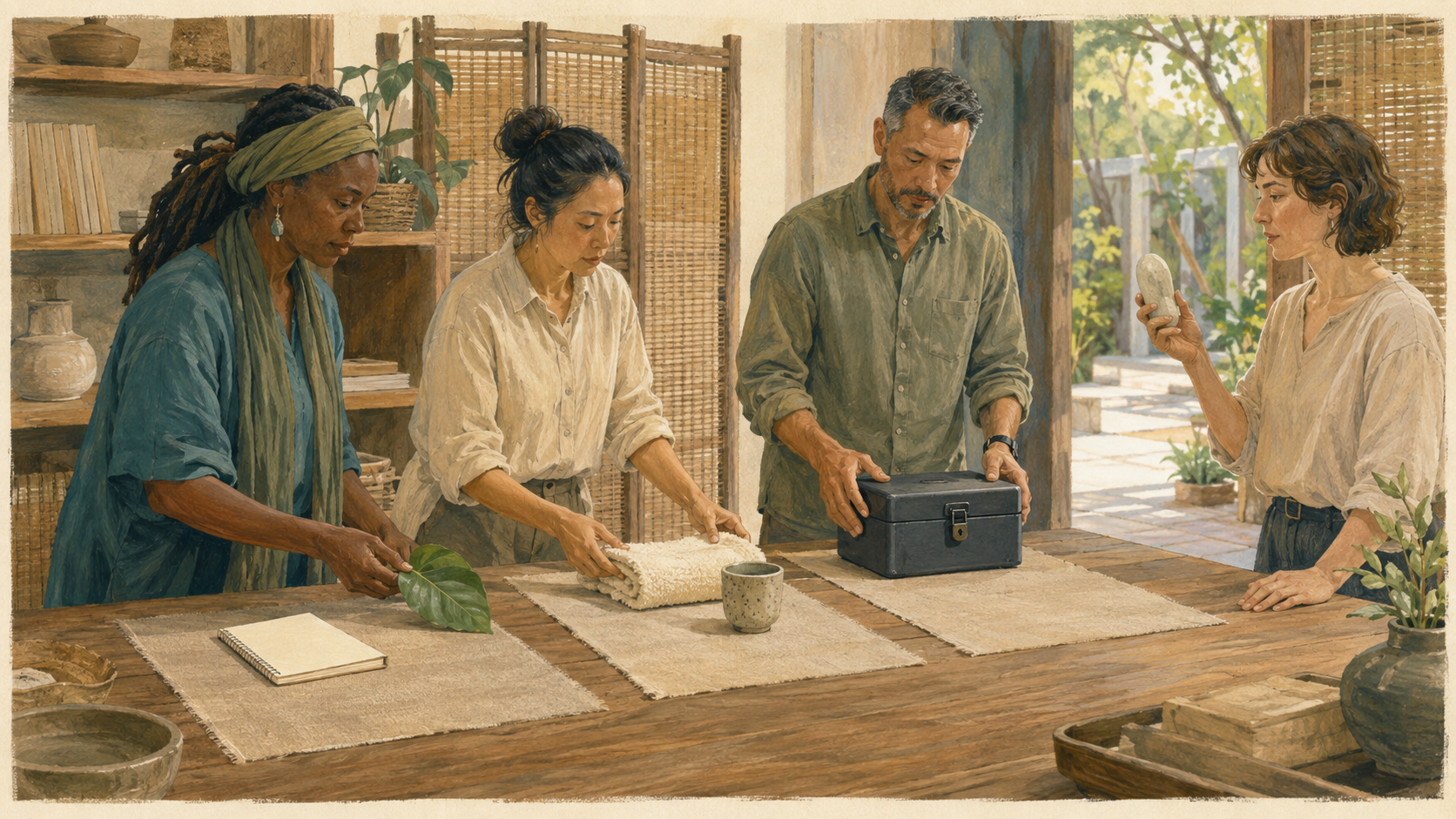
Make knowledge governance a release gate. Do not sell until authority, roles, land access, activity verbs, plant controls, guest choices, emergency routes, compensation and media permissions are documented. Budget for the work of knowledge holders before allocating spend to campaign imagery.
For programme and practitioner teams
Stay within verified competence and define handovers. Use a session-level checklist that shows what may be observed, handled, prepared, consumed, applied, recorded or taken away. Stop when an identity, interaction, permission or participant risk is uncertain.
For marketing and awards researchers
Keep announced plans separate from delivery and results. Directory entries for COMO Shambhala Estate and Chiva-Som International Health Resort are disclosed starting points for comparing how established destination spas present programmes. They are not evidence about traditional knowledge rights, the Zambia retreat, nominations or awards.
A 30-day pre-launch review
In week one, map every person, place, plant, practice and piece of content. Record who holds authority and which decisions require local regulatory or legal advice. Remove any session that has no accountable owner.
In week two, rewrite the itinerary using precise verbs. Build the plant register, hygiene controls, contraindication and escalation process, guest choice points, accessibility information and data map. Rehearse the difference between general education and an individual health recommendation.
In week three, ask knowledge holders to review the syllabus, compensation, attribution, recording rules, later-use terms and marketing. Test whether a guest can decline each optional element without pressure. Confirm the land and material permissions against the final programme.
In week four, run a tabletop rehearsal. Introduce an unidentified plant, a guest asking for a cure, an influencer filming a restricted explanation, an adverse reaction, a facilitator absence and a request to take material abroad. A publish decision requires a documented response for each scenario. This is an editorial operating framework, not legal, medical or regulatory advice.
What remains unproven
The reviewed sources do not establish that the announced December retreat has been delivered, that each activity or teacher is confirmed, or that any participant has received a benefit. This article has not verified practitioner registration, plant identities, land permissions, community agreements, access-and-benefit-sharing requirements, facility approvals, travel arrangements or the applicability of a particular rule to a particular activity.
The WHO, HPCZ, NHRA and biodiversity sources are used as labelled governance references. They do not certify the organiser, facilitators, venue, programme, plants or Spa Awards directory entries. Presence in a directory is not a nomination or result. A compelling story, cultural connection, payment page or future itinerary is not evidence of safety, efficacy, consent, sustainability, delivery or award merit.
The defensible conclusion is narrower and more useful: traditional medicine retreats should expand knowledge-holder control as commercial interest grows. Permission, scope, plant custody, guest choice and evidence must remain visible from the first itinerary draft to the last published image.
Questions before a traditional medicine retreat goes on sale
Can a participant take a remedy home?
Only when the operator has verified the identity, preparation, packaging, safety, practitioner authority, destination rules and specific permission for that material. A class fee or general waiver is not enough.
Does naming a local teacher prove community consent?
No. Individual participation, community authority, land access, knowledge rights and media permission are different questions. Ask the relevant holders and document the agreed scope without making a person stand in for every community.
Can guest feedback prove that a traditional practice works?
Feedback can describe a participant's experience within its limits. It does not establish clinical safety or efficacy, community benefit, conservation impact or general results. If the team intends to make research claims, determine the required ethical, scientific and regulatory pathway first.
