

Spa biodiversity programmes can turn a resort stay into a closer encounter with place, but they also move the spa beyond the treatment room. Trails, wildlife viewing, marine activities, cultural interpretation, guest choice and conservation work become part of one designed experience. That creates an opportunity for learning and stewardship, together with duties that cannot be met by evocative language alone.
A current announcement makes the issue concrete. On 5 August 2026, Spa Business reported that Gaya Island Resort had introduced a three-day wellness and wildlife package. The operator's original 16 July announcement is more precise: the inaugural event is planned for 17–19 September 2027 and is expected to combine guided nature sessions, wildlife and marine encounters, coral planting, a regional scent activity, a spa treatment and sunrise movement.
Those records establish an announced programme and open bookings. They do not establish that the event has taken place, that a participant has restored habitat, that wildlife has benefited, that a cultural practice has been endorsed by a community, or that a wellbeing outcome has occurred. No visit, treatment, interview, wildlife encounter or test was conducted for this article. The useful professional question is therefore prospective: what governance and evidence should be in place before a spa sells biodiversity as part of the guest journey?
What the Gaya announcement establishes
The operator describes four planned pillars: wildlife and marine encounters, a scent workshop, Bornean-inspired spa practice and morning yoga. It says guests are expected to take part in coral planting and guided activities, and it presents those activities as a route to active stewardship. The release also identifies the resort's conservation director and Spa Village team as programme curators.
The location has a formal conservation context. The official Sabah Parks record says Tunku Abdul Rahman Park was gazetted in 1974, covers 50 square kilometres across five islands, reefs and sea, and has the protection of fauna, flora and marine ecosystems as its main objective. It lists trails and visitor activities, but it does not certify a commercial itinerary, validate a spa claim or assign an ecological result to a future event.
This distinction should shape every use of the case. The 2027 dates are plans. The itinerary is operator-controlled information. Descriptions of restoration, transformation or positive impact are claims until a suitable baseline, method, authority and result are documented. A protected setting is not automatic proof that an activity helps the protected area.
Spa biodiversity programmes need a governance boundary
Start by defining where spa responsibility begins and ends. The guest may experience one seamless weekend, but the work can involve a hotel, spa, protected-area authority, conservation team, boat operator, guide, therapist, community knowledge holder and external supplier. Each party needs a named role, competent lead, approval route, stop authority and incident process.
The Convention on Biological Diversity's Guidelines on Biodiversity and Tourism Development organise the task around baseline information, goals, legislation, impact assessment, mitigation, monitoring, reporting and adaptive management. They are voluntary international guidance, not a permit or property certification. Their value is the sequence: understand the ecological and social conditions before choosing the activity, then monitor whether the operating limits work.
Translate that sequence into a programme register. For every trail, viewing session, boat movement, planting task or ingredient story, record the site owner, legal or park requirements, ecological purpose, evidence source, competent adviser, maximum group, timing, route, accessibility, weather limit, staff ratio, guest instructions, incident trigger and monitoring measure. If a permit, community agreement or specialist decision is not confirmed, remove that element from sale rather than treating approval as an opening-week task.
Keep commercial and conservation decisions visible to one another. A late group, popular photo point or premium private session can alter pressure on a site. The booking system should therefore carry capacity and closure rules supplied by the relevant operational and conservation leads. Revenue targets must not silently expand a route that was assessed for a smaller use.
Design wildlife encounters around distance and choice
Wildlife viewing should be built around the animal's space, not the guest's desired photograph. The voluntary GSTC Hotel Criteria call for visits to natural sites to follow appropriate guidance and for free-roaming wildlife interactions to be non-invasive, responsibly managed and monitored. They also point operators towards local conservation bodies and expert advice. Meeting a criterion is not the same as GSTC certification, and neither the announcement nor this article makes a certification claim.
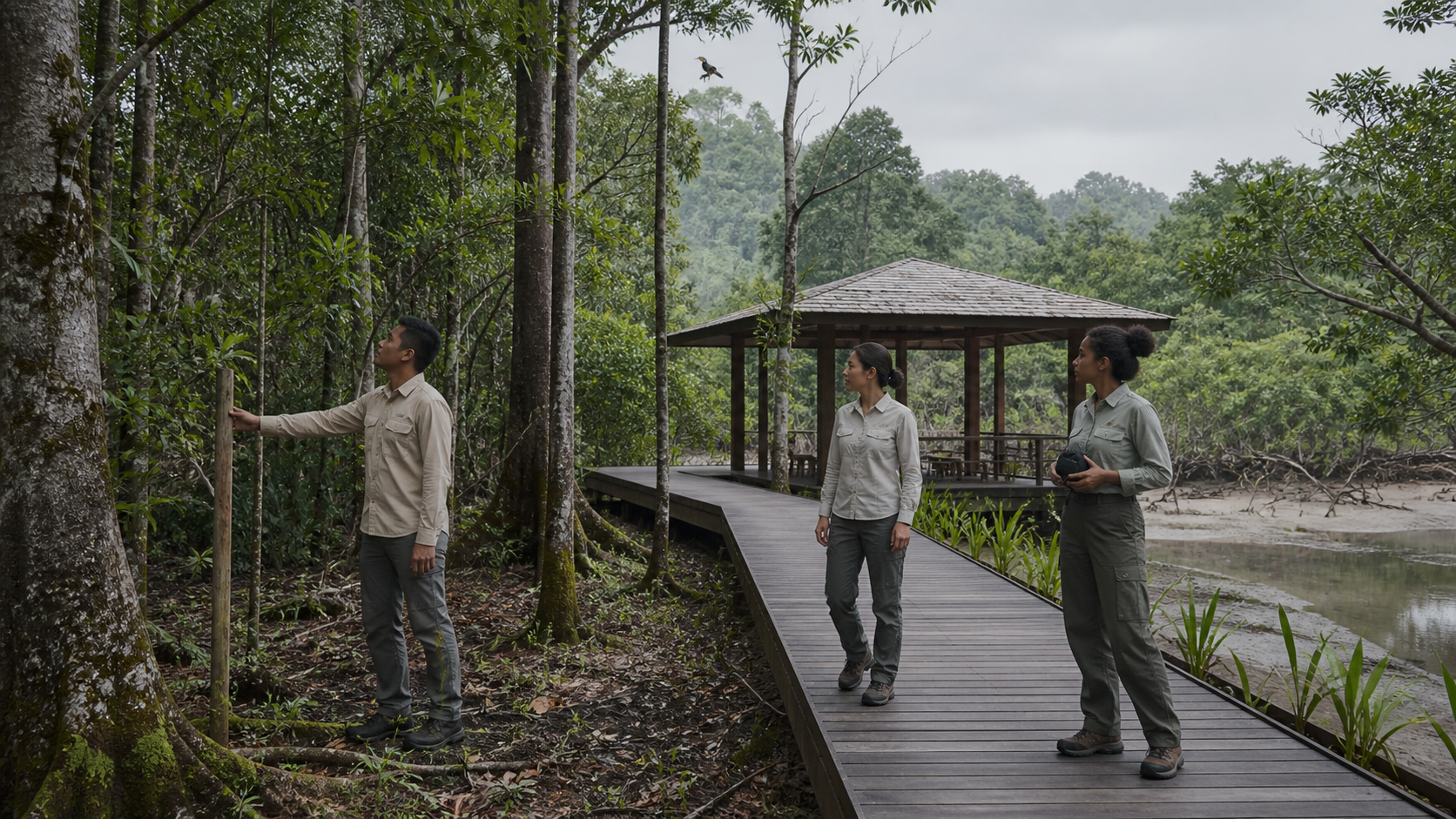
Build a species- and site-specific viewing protocol with the competent authority. It should define approach distance, group size, duration, noise, lighting, flash, food, waste, route departure, illness, breeding periods and signs that end the encounter. “Do not disturb wildlife” is too vague for a guide facing an excited group. Staff need observable stop rules and authority to use them without negotiating against the itinerary.
Choice matters for guests too. Publish the terrain, duration, heat, humidity, boat conditions, sensory environment and likelihood that wildlife will not appear. Provide a dignified opt-out and an equivalent alternative. Never guarantee a sighting or encourage a guide to close distance because the programme has been marketed around a species.
The IUCN's protected-area tourism guidelines emphasise that visitor use brings environmental, social and infrastructure effects, even when tourism can support conservation. The practical response is not to label an experience “eco” but to connect zoning, capacity, communication, monitoring and corrective action. Active directory pages for Ulu Ulu Spa and The Datai Langkawi can help researchers discover different Malaysian spa settings; directory presence does not prove shared wildlife practices, inspection, nomination, endorsement or award result.
Make restoration participation a controlled intervention
Hands-on conservation can be memorable, but participation is not proof of restoration. Coral or habitat work requires an ecological objective, the correct authority, suitable methods, trained supervision, biosecurity, sourcing controls, placement records and follow-up over an appropriate period. The number of fragments handled, seedlings planted or guests involved is an activity count, not an outcome.
Before adding a task to an itinerary, ask whether guest participation improves the work or mainly produces a story. Some interventions may be better completed by trained teams while guests observe an explanation. If participation is appropriate, test the task for accidental damage, contamination, unsafe handling, accessibility, weather and crowding. Explain what the action can and cannot achieve.
Create a chain of custody for materials and data. Record where material came from, who authorised its use, who led the activity, the site and conditions, what was done, and how follow-up will occur. A photograph of participation should not become the evidence record. It should also not be used to imply that one guest, one weekend or one resort restored an ecosystem.
The IUCN World Conservation Congress's 2025 resolution on animal welfare in sustainable tourism calls for welfare considerations, science-based monitoring and further research. A resolution is not a property standard or law. It is a useful reminder that biodiversity reporting should consider the welfare of individual animals as well as species and habitat narratives.
Separate interpretation, culture and wellbeing claims
A combined spa-and-nature programme can easily compress different kinds of knowledge into one mood. Botanical interpretation, protected-area rules, local history, community-held cultural practice, therapist expertise and guest reflection are not interchangeable. Name the source and authority for each part.
If a programme uses regional ingredients, scent stories or healing traditions, document who supplied the knowledge, how consent was obtained, how accuracy is reviewed, how practitioners are credited and how benefits return to the relevant people. “Inspired by” does not remove the need for provenance. Avoid copying sacred, restricted or community-specific elements into décor or treatment scripts simply because they appear in promotional material.
Wellbeing language needs its own boundary. A guided walk, spa treatment, scent workshop or yoga session may be offered as an experience, but terms such as healing, detoxification, restoration or transformation can imply outcomes that the itinerary has not established. Describe what happens, who leads it, the choices available and any suitability limits. Do not turn participant preference, a testimonial or a calm setting into a medical promise.
The Journal's guide to responsible retreat principles is useful for qualifications, consent, inclusion, privacy and transparent booking. Biodiversity programming adds further questions about authority, visitor pressure, wildlife welfare, material handling and ecological follow-up.
Build the evidence file before marketing
A defensible programme needs three connected records. The operating file shows routes, capacities, competencies, risk controls, accessibility, weather decisions and incidents. The conservation file shows baseline, authority, method, monitoring period, findings and corrective action. The claims file maps every public statement to the evidence that supports it, including scope, date and limitations.
Choose measures before the launch. Useful indicators may include group size, route deviations, wildlife disturbance triggers, cancelled encounters, guest compliance, material provenance, intervention survival or condition where scientifically appropriate, staff observations, complaints, incidents and corrective-action time. The relevant conservation lead should decide which ecological measures are meaningful; marketing convenience is not a method.
Compare results with the declared baseline and within the same method. A single count has little meaning without effort, season, site and uncertainty. The Journal's article on spa carbon measurement explains the same discipline in another context: define the boundary, keep allocation separate from direct measurement and use uncertainty to improve decisions rather than decorate a dashboard.
Review claims after each operating cycle. If evidence shows disturbance, low compliance or an intervention that is not performing as intended, reduce, redesign or stop the activity. Adaptive management is credible only when the programme can change. A yearly event should not become permanent merely because it has a name and booking page.
What does this mean for spa and wellness professionals?
For owners and developers, biodiversity is not a visual theme. It is a relationship with a living site and the people responsible for it. Put protected-area, ecological, cultural and access expertise into the brief before naming an experience or committing inventory.
For spa directors, appoint one programme owner who can see the complete journey and one competent conservation authority for ecological decisions. Connect booking capacity, guide deployment, treatment scheduling, weather, transport and incident response. Give both roles documented stop authority.
For therapists, guides and guest teams, training should cover scope, honest interpretation, wildlife distance, guest choice, accessibility, escalation and claims. A warm welcome does not require certainty about sightings or outcomes. Staff should be able to say that an activity is planned, monitored or still being evaluated.
For marketers and awards researchers, test evidence at the level claimed. An announced itinerary may show intent. An activity record shows delivery. A measured change, with method and time, may support a bounded outcome. None of these automatically proves broad conservation impact, cultural legitimacy, guest transformation or award merit.
A 90-day spa biodiversity programme review
Days 1–30: establish authority and baseline
List every activity, site, species reference, cultural element, ingredient and claim. Confirm the relevant owner, authority, adviser and permission. Record the baseline and existing visitor pressure. Remove any item whose origin, approval or intended conservation function remains materially uncertain.
Days 31–60: design and rehearse controls
Set capacity, routes, distances, staff ratios, access alternatives, weather limits, stop rules and guest communication. Rehearse a no-sighting day, route closure, wildlife approach, guest refusal, material error, injury and disputed claim. Check that the booking and marketing systems reflect the same limits.
Days 61–90: verify evidence and publication language
Run controlled trials with competent oversight where authorised. Test monitoring forms, incident escalation and corrective action. Review every claim against the evidence file and replace broad impact language with specific, dated statements. Set review intervals that fit the ecology, not the campaign calendar.
What remains unproven
The cited announcement does not prove that the September 2027 event will occur as described, that bookings will be fulfilled, that wildlife will be seen, that coral or habitat condition will improve, that cultural knowledge holders have endorsed every description, or that guests will experience a health benefit. This article does not assess Gaya Island Resort's compliance, conservation performance, cultural governance or award status.
The CBD, GSTC and IUCN materials are international guidance, criteria or resolutions with different scopes; they are not a substitute for Malaysian law, Sabah Parks decisions, site permits, community agreements or competent local advice. Operators must confirm current requirements for every location and activity.
Frequently asked questions
Does a protected-area location prove a spa programme is sustainable?
No. It establishes a sensitive management context. The programme still needs authority, impact controls, appropriate capacity, monitoring and honest claims.
Is guest coral planting automatically a conservation benefit?
No. It is an activity whose value depends on ecological purpose, authorisation, material, method, supervision and follow-up. Participation counts should not be reported as habitat recovery.
Should wildlife sightings be guaranteed in a premium package?
No. A credible itinerary prepares guests for uncertainty, maintains distance and gives guides authority to protect wildlife even when that means ending the encounter without a sighting.
