
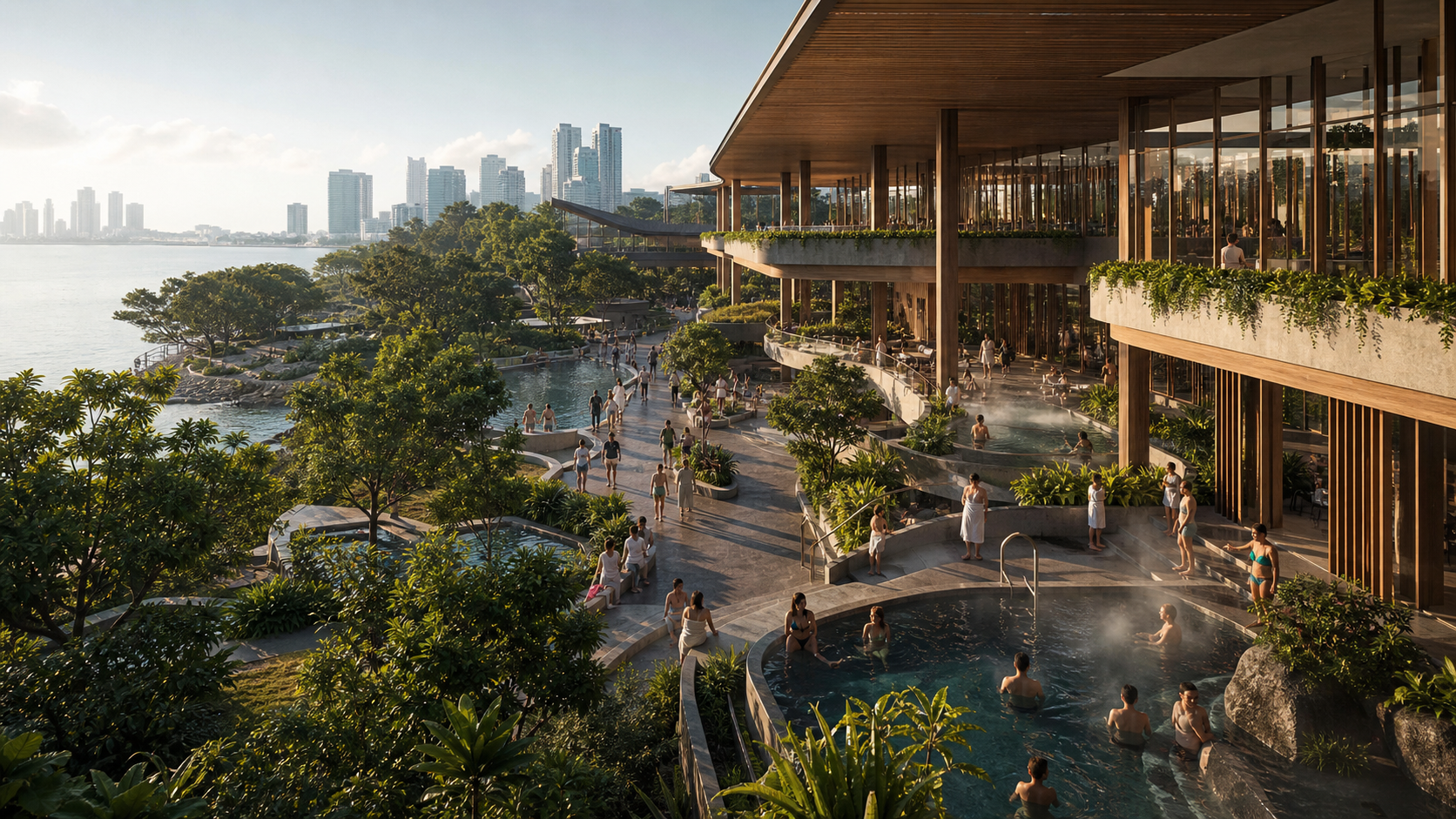
Therme Singapore has moved from tender award to groundbreaking, turning a proposed waterfront attraction into one of Asia's most closely watched tests of urban wellness infrastructure. The development is planned for Marina South, with an opening target of 2030. Its scale matters: the developer describes a building of more than 720,000 square feet, a large public coastal park, thermal bathing, family recreation, treatment rooms, food and beverage, and extensive planting within one destination. Yet the most useful question for spa leaders is not whether the renderings look impressive. It is whether a high-volume wellbeing venue can combine access, hospitality, water operations, skilled service and public space without weakening the quality of any one component. This analysis separates announced facts from future projections and examines the operating implications for spa owners, wellness professionals, investors and destination planners.
Why Therme Singapore is an urban wellness infrastructure test
Conventional resort spas are usually supporting amenities. Their guest journey, staffing and economics sit within a hotel or resort. Therme Singapore is being presented differently: as a destination in its own right, designed to serve residents and visitors at substantial volume. The developer's 19 June 2026 groundbreaking announcement describes more than 20 indoor and outdoor pools and water bodies, over 70 treatment rooms, 18 waterslides with a combined length above 1.8 kilometres, thermal and mineral pools, saunas, steam facilities, hydromassage and roughly 86,000 square feet of food and beverage space. Those figures describe a proposal under construction, not an operating result.
The distinction is important because scale alone does not create wellbeing. At this size, the guest experience depends on the coordination of systems that smaller spas can sometimes manage informally: water quality, temperature zoning, linen circulation, food safety, access control, crowd flow, maintenance, therapeutic-service protocols and the choreography of quiet and social spaces. The project therefore offers a useful case study in how the spa sector may intersect with leisure infrastructure, urban planning and visitor attractions.
Singapore's public-sector framing reinforces that wider role. The Singapore Tourism Board's tender award notice identifies a four-hectare Marina South waterfront site and says the destination is expected to receive about two million visitors annually at full capacity, with nearly half coming from overseas. That is an official projection, not a verified attendance figure. It nevertheless signals that the attraction is being planned at a civic and tourism scale rather than as a niche spa.
What has actually been announced
The factual baseline is narrower than the promotional language around the project. Therme Group says the seven-storey development, plus a basement, is scheduled to open in 2030. It divides the experience into three broad zones: Play, Relax and Restore. The announced programme ranges from family slides and pools to adults-oriented thermal environments and treatment rooms. The company also states that the landscape concept includes about 200,000 plants representing more than 200 species and that an almost four-hectare public coastal park will be accessible without an admission ticket.
Named delivery partners include Kajima, DP Architects and Therme ARC. The developer says planned systems include rooftop solar generation, smart irrigation, climate-responsive landscaping, RFID-enabled lockers and payments, robotic locker handling and ozone-supported water filtration. These are design intentions. Until the destination is commissioned and operating data is available, they should not be treated as proof of energy performance, water efficiency, frictionless service or environmental benefit.
The Singapore Tourism Board chief executive's May 2026 industry speech places the project within a broader ambition to offer urban wellness experiences in a city-in-nature setting. It confirms construction in 2026 and the 2030 visitor target. For operators, that official positioning is as significant as the amenity list: the development is being linked to destination strategy, public realm and tourism growth.

From resort amenity to city-scale system
A city-scale wellness destination changes the unit of design. Instead of asking how a treatment room supports a hotel stay, planners must ask how a complete network of spaces supports different users across a full day. Families may seek active recreation, residents may want repeat thermal-bathing routines, tourists may combine the visit with other attractions, and treatment guests may expect privacy and highly personal service. Those journeys can coexist only if noise, circulation, pricing, booking and sensory transitions are designed deliberately.
This creates an interesting contrast with Singapore's established luxury-spa market. Spa Awards' profile of Auriga Spa at Capella Singapore illustrates the intimate, resort-led end of the spectrum, while an earlier overview of luxury spas in Singapore shows how strongly the destination has been associated with hotel-based experiences. A large public-facing wellness attraction would not simply be a bigger version of those spas. It would need a different operating logic while still meeting expectations formed by them.
The urban context also matters. The Urban Redevelopment Authority's Marina South guidance describes a sustainable, community-focused, pedestrian-friendly district intended to place everyday needs within a short walk. For a wellbeing venue, connection to transit, cycling routes, shaded walking and public landscape could influence outcomes as much as the facilities behind the ticket gate. It is a reminder that wellness infrastructure can begin before the guest reaches reception.
The social-infrastructure proposition
Thermal bathing has historically operated in many societies as social infrastructure: a recurring place to wash, recover, meet and pause. Translating that idea into a contemporary commercial attraction raises questions of accessibility. Admission price, membership structure, peak-time availability, age policies, cultural comfort and disability access will determine who can use the destination regularly. A free public park broadens the civic offer, but it is not the same as broad access to the thermal programme.
The Global Wellness Institute's Wellness Tourism Initiative trends for 2026 identifies urban recovery travel, destination-scale wellness and public-facing heat rituals as emerging themes. This is an industry trend assessment, not clinical evidence. Its relevance is that investors and tourism authorities are increasingly treating walkability, nature, thermal culture and programming as a connected destination proposition rather than a collection of isolated services.
For Spa Awards readers, inclusivity should be evaluated through observable design and service choices. Are lower-cost and short-duration visits possible? Are changing facilities practical for different bodies, ages and mobility needs? Is etiquette explained without assuming prior spa knowledge? Can a first-time guest navigate heat and cold experiences safely? Are quiet environments genuinely protected? The answers will reveal whether the public-wellness promise survives contact with day-to-day operations.
A complex operating model, not just a big spa
The combined programme introduces several businesses under one roof: water attraction, thermal facility, spa treatment operation, food and beverage venue, park interface and tourism destination. Each has its own demand peaks, risk controls and service culture. Family recreation may peak on weekends and school holidays. Treatments require appointment discipline and therapist utilisation. Thermal areas depend on steady supervision and ritual programming. Restaurants add delivery schedules, kitchen workflows and independent capacity limits.
The operational challenge is to make those components feel coherent to the guest while measuring them separately behind the scenes. Useful indicators could include repeat local visitation, dwell time by zone, treatment conversion, queue duration, water and energy use per visit, staff retention, incident rates, accessibility feedback and the share of guests using more than one programme. Aggregate attendance will not show whether the destination is delivering a good wellness experience.
Existing operators can prepare for this market without copying its scale. Listings such as Auriga Spa, Capella Singapore and Banyan Tree Spa Marina Bay Sands represent recognisable, venue-specific propositions. Their competitive response may be to sharpen what a smaller format can do better: deep personalisation, place-specific rituals, highly consistent therapists, privacy and continuity between visits. Scale can widen awareness of thermal and spa experiences, while specialists retain an advantage in intimacy and identity.
Technology, water and sustainability questions
RFID access, digital payments and automated locker systems can remove friction, but they also shift the service model. Operators must plan for failed wristbands, privacy questions, payment disputes, inaccessible interfaces and guests who prefer human assistance. Technology should shorten administrative moments without making the welcome feel impersonal. It must also fail gracefully: a locker fault should not destabilise an entire arrival wave.
Water and energy claims require similarly careful scrutiny. A tropical facility with numerous pools, cooled interiors, heated environments, kitchens and laundry has significant resource demands. Solar generation, irrigation controls and ozone-supported filtration may improve particular systems, but meaningful evaluation will require transparent baselines and operating metrics after opening. Responsible reporting should ask for total water use, energy intensity, renewable contribution, waste management and maintenance performance rather than treating the presence of a named technology as a complete sustainability result.
Landscape is another operational system. Plant quantity and biodiversity targets are valuable design signals, but long-term canopy, habitat quality, thermal comfort and maintenance will matter more than installation-day counts. The relationship between the attraction and the public coastal park will be especially important. Shade, drainage, coastal resilience and comfortable connections can make the wider site part of a restorative experience even for people who do not enter the paid facility.
Workforce and training implications
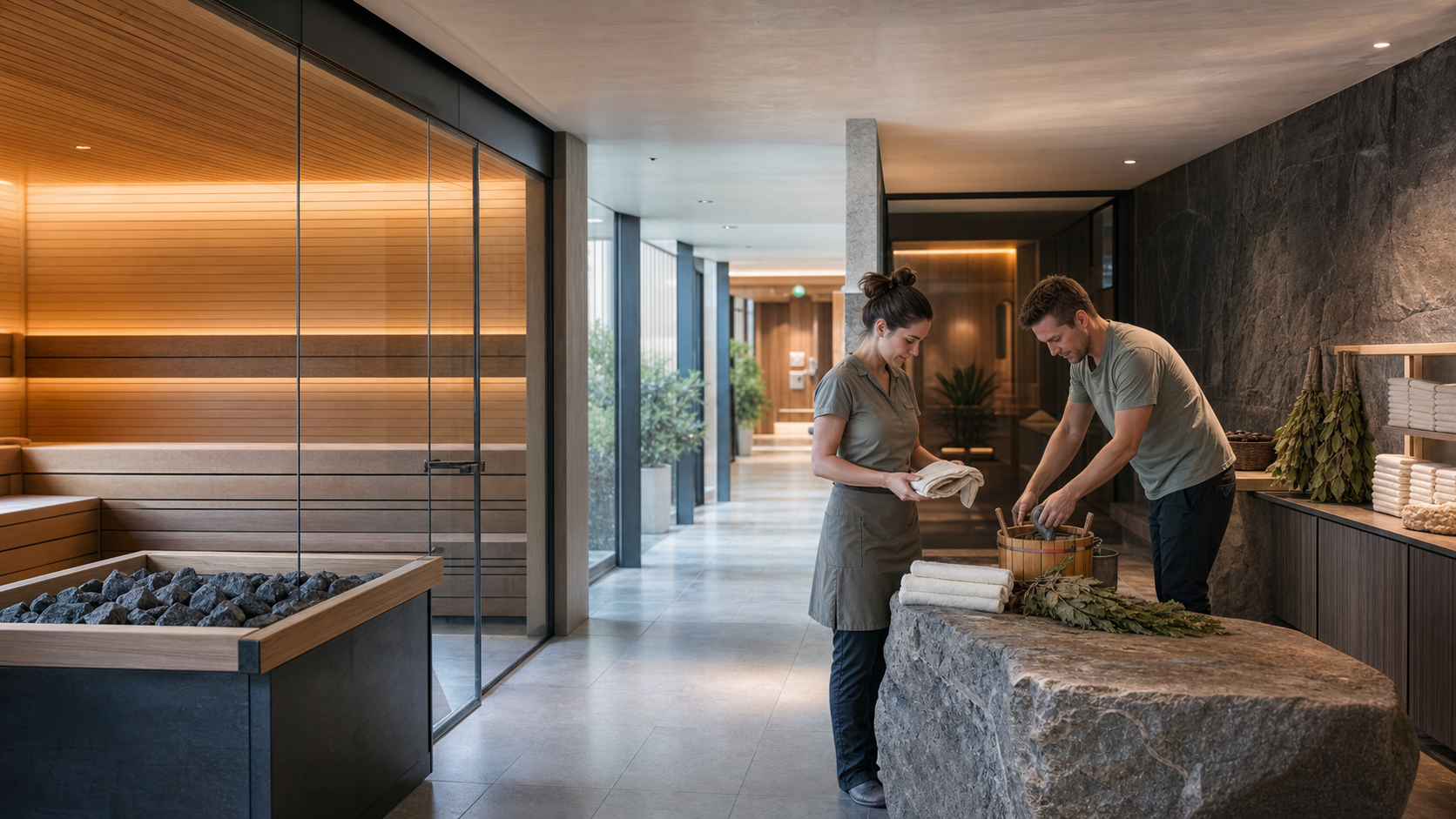
Therme Group estimates that the project could create about 400 jobs. It has also announced education agreements with Singapore's Institute of Technical Education and Republic Polytechnic and has referred to roles such as sauna masters. Again, these are projected jobs and training intentions. The details of curricula, employment terms, career progression and qualification recognition will determine their long-term value.
A venue of this type will need more than therapists. The workforce may include lifeguards, water-quality technicians, engineers, horticulture teams, guest-experience hosts, ritual leaders, cleaners, culinary staff, accessibility specialists, security personnel and digital-support roles. Cross-functional training becomes essential because guests experience one destination, not an organisation chart. A host should know when to escalate a health or safety concern; a thermal-area team should understand how a treatment booking affects the guest's timing; engineering downtime should be communicated in service language.
For the wider spa industry, the opportunity is a larger career ladder. Employees could enter through operations or recreation, specialise in thermal rituals or treatment delivery, and move into training, programming or management. The risk is a high-volume labour model that treats skilled wellbeing work as interchangeable. Retention, professional development, predictable scheduling and psychological safety will be stronger indicators of workforce quality than headline job numbers.
What does this mean for spa and wellness professionals?
First, thermal literacy is becoming strategically useful. Teams should understand heat and cold sequences, contraindication communication, hydration guidance, cleaning protocols and ritual facilitation within the limits of their qualifications. This is not a reason to make medical promises. It is a reason to build safer, clearer guest education and to know when professional medical advice is appropriate.
At a glance: how to assess Therme Singapore and the Rise of Urban Wellness Infrastructure
| Lens | Why it matters | What to verify |
|---|---|---|
| Signal | A credible trend appears across more than one campaign or launch. | Independent demand, adoption and repeat-use evidence |
| Guest value | Novelty should solve a clear guest problem or improve access. | Use case, inclusion, safety and service recovery |
| Operations | New concepts depend on training, maintenance and realistic throughput. | Skills, suppliers, downtime and cost to serve |
| Evidence | Health and sustainability claims require a higher threshold than aesthetic claims. | Source quality, limitations and review date |
What the evidence adds
A trend becomes strategically useful only when demand, delivery capability and evidence move together. Global Wellness Institute data helps distinguish structural market shifts from short-lived novelty, and ISPA research provides a spa-specific consumer and operator lens. Consult Global Wellness Institute data series and International Spa Association research library for the underlying definitions, evidence and limitations.
For readers, the practical value of Therme Singapore and the Rise of Urban Wellness Infrastructure lies in making a complex choice easier to interrogate. A polished image, a famous name or a confident claim can begin the research process, but none should end it. The stronger editorial approach is to ask what was assessed, what can be verified now and which part of the experience matters to the individual guest.
For guests and readers
For operators, Therme Singapore and the Rise of Urban Wellness Infrastructure is best treated as a management question rather than a campaign slogan. The guest promise must be visible in recruitment, consultation, hygiene, treatment delivery, accessibility, complaints and follow-up. When those systems are documented, recognition can communicate real work instead of covering gaps with prestige language.
For spa and wellness professionals
Translate the subject into observable standards: who owns the decision, which record demonstrates it, how often it is reviewed and how a guest can raise a concern. That discipline supports clearer editorial claims, stronger operations and a more credible relationship between recognition and the lived experience.
How to use this perspective
- Identify the guest problem before the technology.
- Separate a prototype from an operating result.
- Document training and maintenance requirements.
- Test accessibility and privacy implications.
- Set a review date before scaling the concept.
Editorial boundary: spa and wellness information supports informed choice but does not replace individual medical advice, local regulation or direct verification with the provider.
Related Spa Awards reading
Continue with Top Spa & Wellness Trends Shaping Award-Winning Spas in 2026 and The Role of Innovation in Award-Winning Spas: Beyond the Traditional Treatment. These perspectives add context without changing this article’s original URL or publication record.
Editorially reviewed and expanded on 16 July 2026. Time-sensitive offers, prices, personnel and operating details should be reconfirmed with the named provider.
