
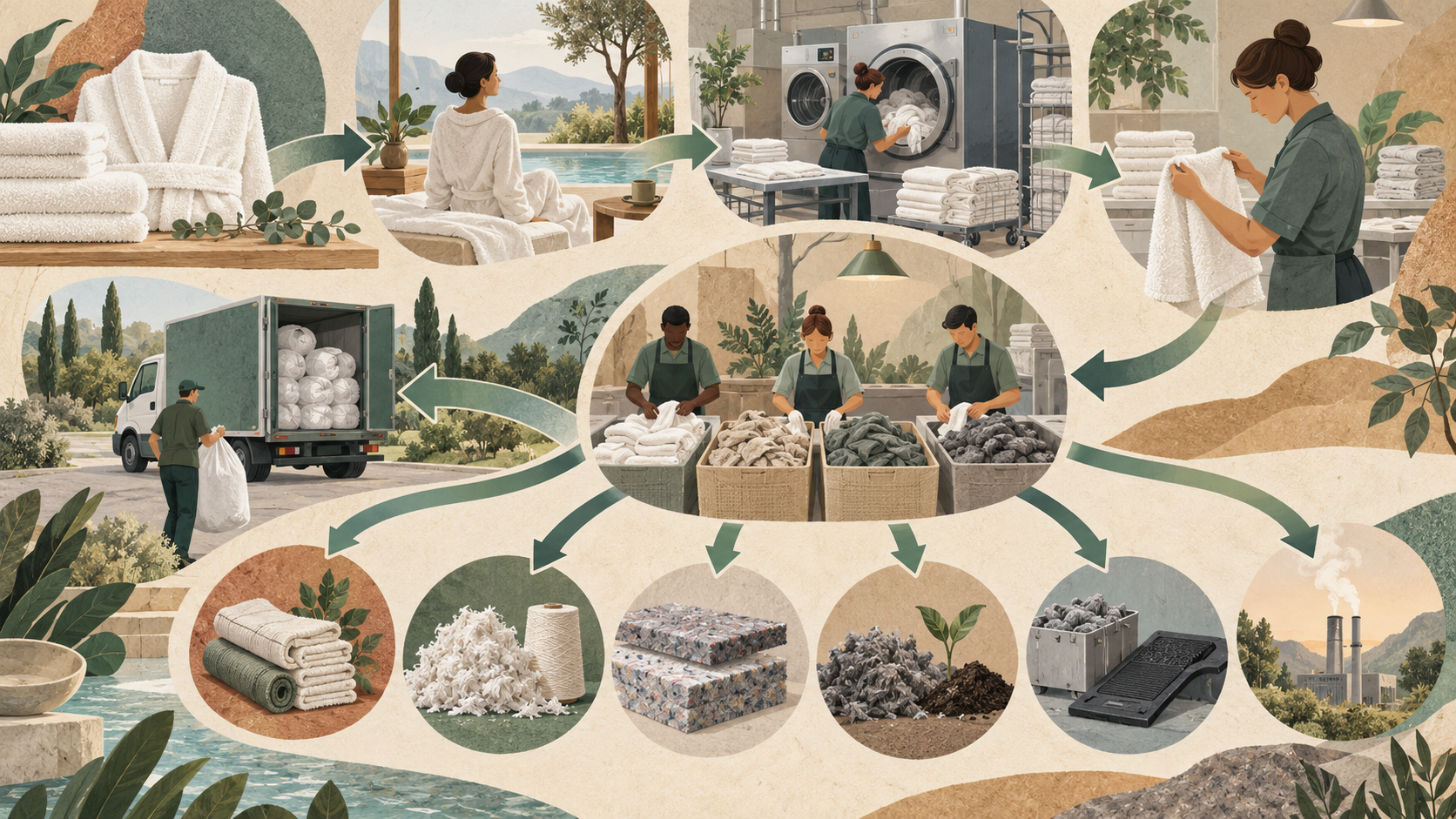
Spa textile circularity begins with a demanding service life. Towels, robes, slippers and treatment linens must support guest comfort, hygiene, laundering, storage and repeated handling before they are stained, damaged, lost, rejected or simply no longer suitable for their original purpose. Yet many procurement decisions still end at delivery. The exit route is left for housekeeping, laundry or waste teams to solve later.
A new supplier partnership offers a useful industry signal. BC SoftWear has announced that its customers can access Avena Group collection and repurposing services for selected end-of-life hospitality textiles. The initiative makes the final stage more visible, but an available take-back route is not the same as a complete circular system. Collection does not prove reuse, recycling, carbon reduction or compliance in every jurisdiction.
This guide shows how spa and wellness operators can design textile circularity as a controlled operating chain. The core discipline is simple: specify the useful life, sorting rules, evidence and destination before buying. Then preserve the distinction between a product that lasted longer, an item collected, a material accepted for processing and a verified output.
What the current spa textile announcement establishes
In its official announcement dated 24 September 2026, BC SoftWear says its customers now have access to a specialist collection and repurposing service through Avena Group. It identifies towels, bathrobes, slippers and spa linens as accepted categories and says collected items can be repurposed into new applications rather than discarded.
Spa Business network coverage published on 6 October adds that the service uses Avena’s SecureBrand solution. The report says materials may become insulation, sound boarding, geotextiles or fibre-reinforced concrete, and that identifiable branding can be removed during processing. Those are descriptions of the scheme and possible routes. They are not audited results for every item a spa supplies.
Avena’s own description of its textile-repurposing process says items are securely shredded, sorted and directed toward uses such as acoustic panels, reinforced concrete or geotextiles, with documentation provided. This is a primary source for what the contractor says its service does, not independent verification of a particular spa’s volume, output, avoided emissions or legal status.
The defensible news conclusion is therefore narrow: a spa-textile supplier and a repurposing company have announced an accessible end-of-life route for participating customers. The announcement does not establish sector-wide adoption, a textile-to-textile closed loop, universal material acceptance, local regulatory approval or measured environmental benefit.
Spa textile circularity begins before a textile becomes waste
The highest-value decision is often made months or years before collection. The WRAP Textiles Resource Hierarchy prioritises preventing waste, extending useful life and increasing reuse before recycling and lower-value end routes. For a spa, that reframes the question from “Who will collect this towel?” to “Why is this item leaving service, and could design, purchasing, use or care have prevented that exit?”
Prevention is operational, not abstract. A towel that survives more suitable wash cycles, a robe repaired before failure, a purchasing specification that avoids an inseparable mixed construction, or a stock-control change that reduces unexplained loss can all preserve value before any recovery contractor becomes involved. Teams should not extend use when hygiene, safety or guest suitability is compromised. They should define removal criteria rather than relying on appearance, habit or an arbitrary date.
Build a reason code for every retirement: worn beyond service standard, permanently stained, contaminated, torn, branding obsolete, size no longer required, surplus, guest loss or unknown. Review the pattern by product, supplier, property, laundry process and age band. The objective is not to keep every item indefinitely. It is to distinguish avoidable early failure from a controlled end of useful life.
Specify the exit before procurement
A spa textile specification should describe both entry and exit. Alongside dimensions, hand feel, colour, weight and service standard, record fibre composition, trims, embroidery, labels, coatings, expected wash conditions, repairability, disassembly needs, supplier take-back availability and known recovery constraints. Ask the intended collector or processor which combinations it can accept before the order is signed.
Do not translate “natural fibre”, “recycled content” or “durable” into guaranteed circularity. Fibre blends, elastane, dyes, treatments, adhesives, metal components and contamination can change the available route. A product may be technically recyclable but lack a local commercial processor. Another may enter open-loop material repurposing rather than return as a towel. Record the intended destination precisely enough that procurement can compare options without inventing equivalence.
Set evidence requirements in the contract. These can include product composition, test method, batch identity, care instructions, acceptance criteria, collection scope, excluded conditions, responsibility for transport, treatment route, rejection procedure, downstream reporting and what happens when the preferred route is unavailable. A marketing promise should never be the only source for an operating or environmental claim.

Build one controlled product record
Create one record for each textile type, not one generic sustainability statement for the whole linen room. Link the approved item, supplier, composition, purchase date, locations, quantity, laundry method, inspection rule, repair route, retirement code and intended destination. When a supplier, construction or treatment changes, create a new version. Otherwise teams may send a materially different product into a route that was approved for an earlier specification.
Connect the record to commercial reality. Unit price alone hides replacement frequency, laundry burden, damage, loss, storage and end-of-life cost. A more durable item is not automatically the better environmental choice, but its actual service life is an essential input. Measure use with an appropriate operational unit—such as issue cycles or occupied service days—without presenting an estimate as laboratory proof.
Grade condition before choosing the route
Sorting determines what can happen next. A clean surplus item suitable for its original purpose is not in the same state as a torn towel, a contaminated treatment linen or a mixed bag with non-textile components. The Environment Agency’s 2026 textile guidance, which applies to imports and exports involving England, distinguishes material suitable for direct reuse from waste and requires sorting, contamination control, accurate description and evidence for relevant shipments.
That guidance is not a global rulebook for every spa. It provides a useful bounded example of why teams must identify material status and destination rather than calling every outgoing sack a donation or recyclable. Operators must check the law, permits, transport controls, hygiene requirements and waste duties that apply where the property, carrier, processor and final destination are located.
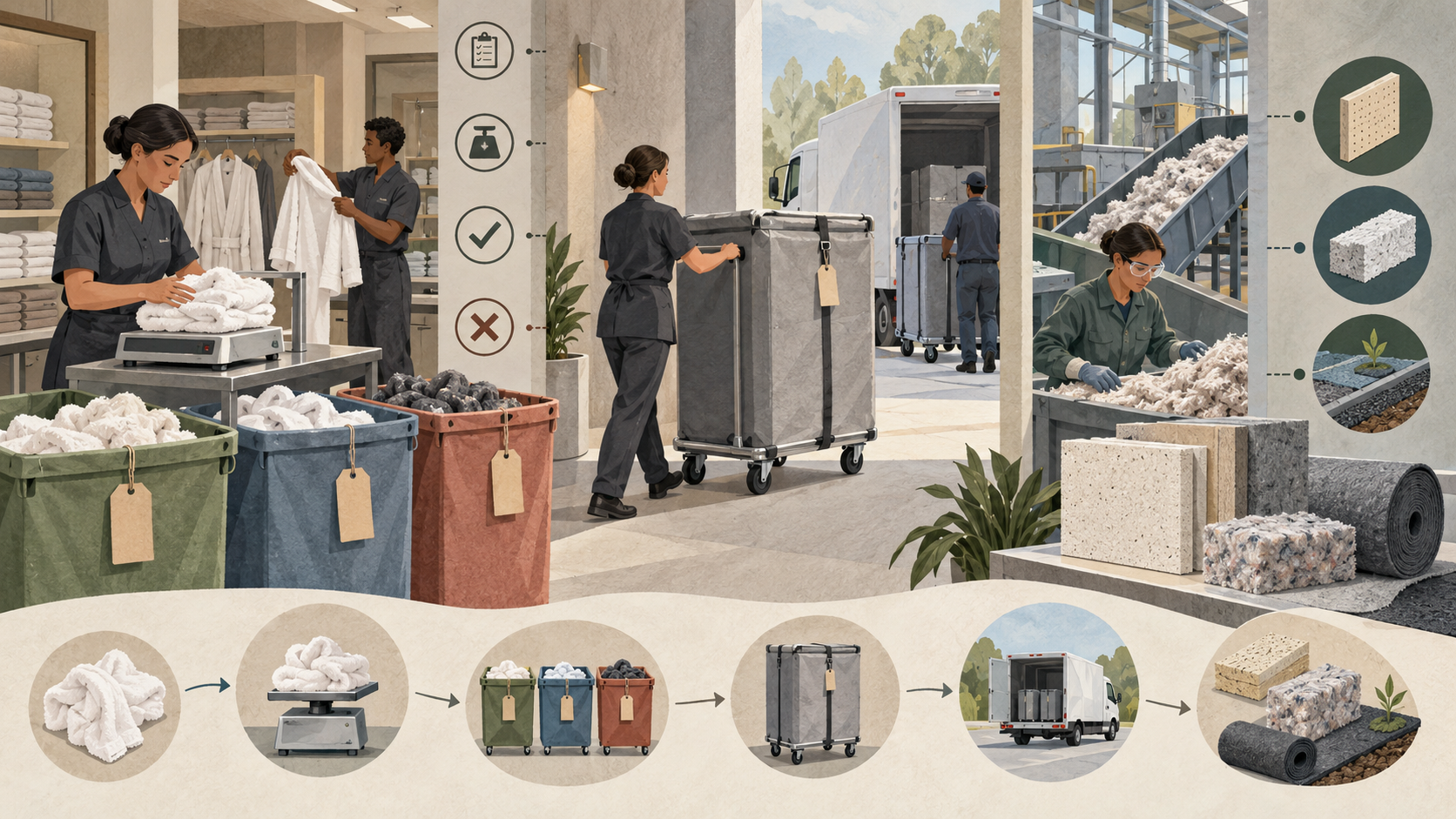
Use a simple route ladder. First assess continued use in the original service. Next consider safe repair or redeployment for an appropriate original purpose. Then assess direct reuse where lawful and suitable. Only after those options should material reuse, recycling, recovery or disposal be selected. Define a quarantine route for contamination, uncertain composition and items that the contractor rejects.
Housekeeping and laundry teams need physical rules that match the record: where each grade is held, how wet items are managed, what must be bagged separately, who can reclassify an item, how branded goods are secured and how rejected loads return to control. A coloured bin is a prompt, not proof. The written procedure, training and observed practice should agree.
Prove the chain of custody and the outcome
The UK Fashion and Textile Association’s current classification guidance emphasises that sorting and directing post-consumer material according to its reuse potential are important for compliance, environmental responsibility and value. It also points organisations toward working with appropriate partners. A collection booking is therefore the start of an evidence chain, not its conclusion.
At handover, record the property, date, product categories, grade, number of containers, measured weight, carrier, destination and transfer documentation. Reconcile the collector’s accepted weight with the property record. Preserve any rejection or contamination note. If a load is consolidated with material from other customers, ask what evidence can still be attributed to the spa and what can only be reported at a shared or estimated level.
Define evidence states in plain language: prepared for collection; collected; received; accepted for a stated process; processed; output produced; output transferred to a next user. Do not collapse them into “recycled”. A certificate of destruction may show that branding was neutralised, but it does not by itself identify the recovered material, final application or lifecycle impact.
Request a bounded destination report. It should explain the quantity accepted, route used, material loss or rejection, output category, downstream organisation where disclosable, treatment date and basis of any environmental estimate. When mass balance or modelled savings are used, retain the method and boundary. Report measured facts separately from supplier estimates and from spa calculations.
Make the environmental claim match the evidence
Environmental language should describe the state actually proved. “We introduced a collection route for selected end-of-life textiles” is different from “all our linens are recycled”. “The processor reported this load as accepted for insulation feedstock” is different from “the product was fully circular”. “A supplier model estimated avoided emissions” is different from a verified property carbon reduction.
The UK Competition and Markets Authority’s current green-claims collection says businesses must make environmental claims clearly and accurately and includes 2026 guidance about responsibility across supply chains. Although operators must assess the consumer law that applies in their own markets, the underlying discipline is widely useful: qualify scope, use current evidence, avoid hiding important limits and do not let an image or symbol imply more than the words can support.
Create a claims register connecting every public statement to an owner, evidence file, geography, product scope, reporting period, calculation method, approval date and review date. Ban undefined superlatives such as “zero waste”, “fully sustainable” or “closed loop” unless the complete claim can be substantiated. Correct or remove a statement when a processor, route, product or evidence boundary changes.
Connect procurement, laundry, operations and finance
Textile circularity fails when each team owns only a fragment. Procurement chooses the product, spa operations sets the service standard, housekeeping controls stock, laundry affects life and condition, facilities manages storage, finance sees purchasing and waste costs, sustainability prepares claims, and the authorised carrier controls the next movement. Assign one accountable owner for the full record while preserving each specialist responsibility.
Review a small set of linked measures: items purchased, items issued, loss, repair, retirement by reason, measured outgoing weight, accepted weight, rejected weight, destination by route and evidence completeness. Use cost measures alongside them, but do not claim that lower disposal cost proves lower environmental impact. Investigate changes rather than rewarding teams for moving items into the most flattering category.
The Journal’s framework for turning spa carbon measures into operating decisions is relevant when a textile project includes emissions estimates. Its guidance on proving readiness before promotion also applies: a vendor agreement, collection bin or staff briefing is not the same as a stable, evidenced service.
What does this mean for spa and wellness professionals?
Owners should approve the scope and claim boundary. Procurement leaders should design for useful life and recovery. Spa and housekeeping teams should apply consistent retirement codes. Laundry partners should report damage and process changes. Sustainability teams should preserve the evidence chain. Finance should compare lifecycle costs without inventing impact. Marketing should publish only the state the operation has reached.
Active directory records for Homewood Hotel & Spa Bath and The Royal Crescent Hotel & Spa can help teams form questions about how hotel-spa textiles move through guest, treatment and back-of-house settings. They are discovery records only. Directory presence does not prove a textile programme, environmental result, inspection, nomination or award. Confirm current practices directly with each property.
A 30-day spa textile exit pilot
In week one, select one towel or robe specification and map its purchase, issue, wash, inspection and retirement states. In week two, ask suppliers, laundry partners and authorised processors for composition, acceptance, rejection, transport and destination evidence. In week three, train one property team, label controlled holding areas and run a small measured collection. In week four, reconcile property and processor records, review rejected items and approve only the claims the evidence supports.
The pilot file should contain the product record, local legal review, approved routes, contractor checks, procedure, training record, starting inventory, retirement reasons, weights, transfer documents, acceptance evidence, destination report, calculations, exceptions and signed decision. If the product, contractor or destination changes, reopen the relevant approval rather than carrying forward an old claim.
What remains unproven
The BC SoftWear and Avena announcement does not show how many spa customers will participate, how much material will be accepted, which route each product will follow or what environmental result will occur. Spa Business reporting describes possible outputs and early participants, but it is not an audit. Avena’s process page is the contractor’s account of its service. WRAP and UKFT provide system guidance, not certification of this partnership.
The England-specific government sources do not establish requirements in another jurisdiction. They illustrate why classification, sorting, authorised transfer and evidence matter. The CMA guidance frames responsible environmental communication in the UK; it does not pre-approve a spa’s claim. Directory listings and the original illustrations in this article prove no operational practice, environmental performance, nomination or award result.
The practical conclusion is stronger than a broad green promise. Buy with an exit specification. Extend useful life without weakening service or hygiene. Grade materials before choosing a route. Preserve custody from property to processor. Report collection, acceptance, processing and output as separate states. Spa textile circularity becomes credible when every claim can be traced to the product, load, destination and evidence that actually exist.
