
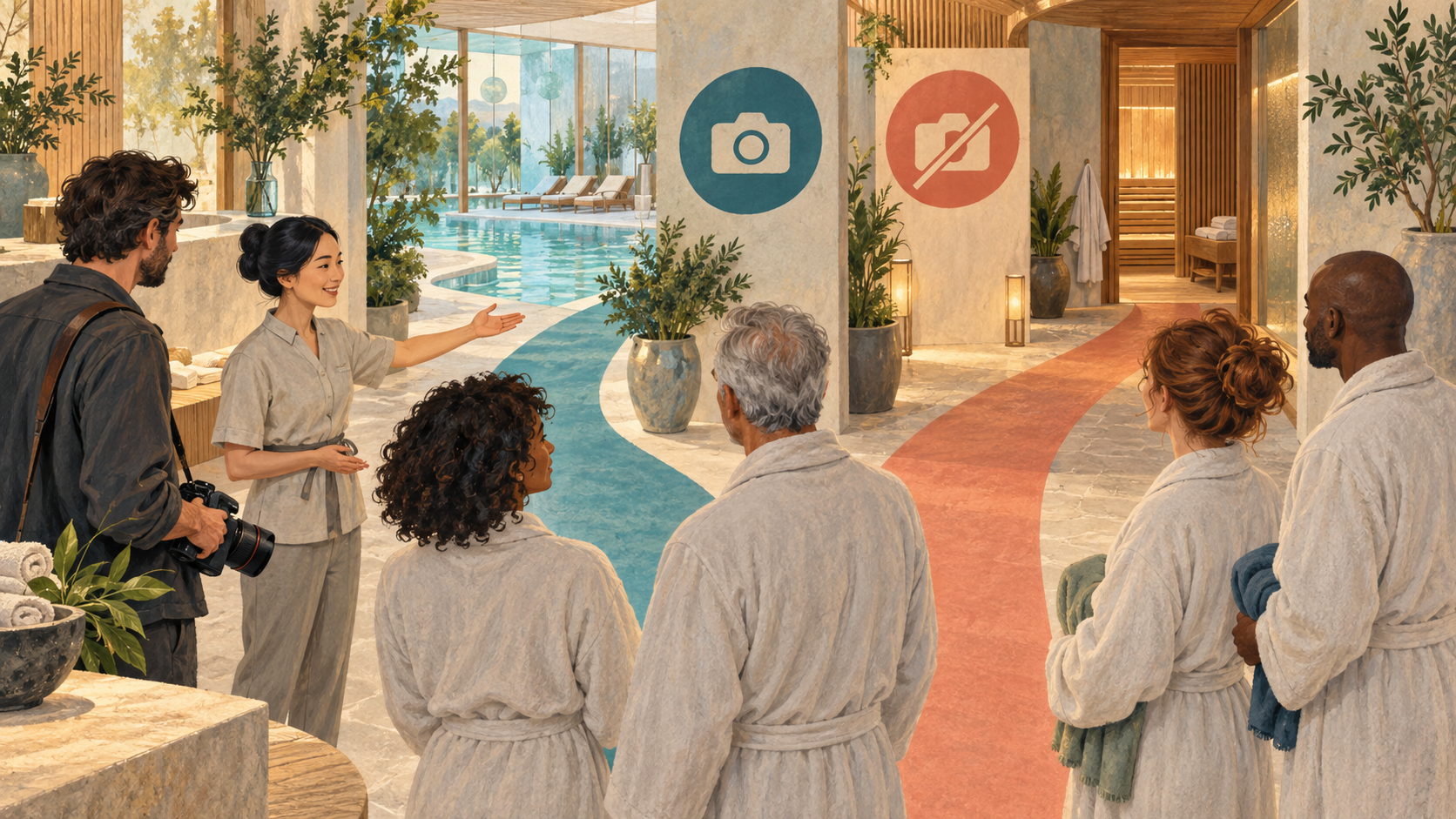
Spa photography consent is not a box hidden inside a booking form. It is an operating choice that must remain understandable before a camera enters, while an image is being made and after a file leaves the property. In a setting built around privacy, changing, touch, water and rest, a person can agree to receive a service without agreeing to become its marketing material.
The same discipline applies to staff, practitioners, visiting teachers and communities whose bathing knowledge informs a programme. A ticket, employment contract, treatment waiver, invitation or appearance in a public area does not answer every question about capture, publication, licensing, later reuse or artificial-intelligence training. Those are separate purposes with different risks.
This guide gives international spa teams a practical control system. It does not declare one legal basis valid everywhere, and it does not judge any named event, photographer or venue. Local privacy, employment, image-rights, intellectual-property, safeguarding and consumer rules still require competent interpretation. The professional standard is simpler to state: define the purpose, make camera zones visible, preserve a real refusal route, record permissions at asset level and stop reuse when the evidence no longer supports it.
What the current bathing-culture signal establishes
On 11 September 2026, Spa Business reported that photographer and author Mikkel Aaland was scheduled to discuss decades of documenting bathing traditions at Soul Gathering in Edinburgh on 12 September. The event’s official programme page listed the conversation and described limited-capacity sauna rituals, talks and creative activities, including mindful photography. The organiser’s festival page presented the day as a gathering around sauna culture, movement, ritual and community.
Those pages establish an announced programme and the sector’s continuing interest in bathing stories. They do not prove that every listed session took place, that guests were photographed, that cameras entered a sauna, or that any person or community approved a particular use. No post-event delivery record reviewed for this article resolves those points. The signal is therefore used narrowly: when documentation, creativity and embodied wellness share a programme, operators need a visible boundary between participating in the experience and participating in media.
The question is broader than one festival. Spas routinely commission launch images, practitioner portraits, treatment demonstrations, creator visits, event reels, staff content and guest testimonials. Each may be legitimate. None becomes safe merely because the resulting image is attractive or the subject initially smiled.
Spa photography consent starts with a purpose and zone map
Begin with the proposed asset, not the camera. Write down why it is needed, who decides the purpose, who will capture it, which people may be identifiable, where it may appear, how long it will be retained and whether third parties may receive it. If the answer is simply “content”, the brief is not ready. A website hero, internal training clip, security recording, press image and creator post are different processing activities and should not share one vague permission.
In the European Union, the European Commission’s current GDPR application guidance identifies putting a person’s photo on a website and video recording as examples of personal-data processing when the person is identifiable. That does not mean consent is the only possible legal basis. It means an organisation must identify an applicable basis, purpose and responsibility before collection, then respect the linked rights and safeguards. Operators elsewhere should perform the equivalent check under the rules that apply to the property, subject and intended publication.
Turn that brief into a physical zone map. Mark reception, corridors, consultation rooms, changing areas, treatment rooms, thermal rooms, pools, relaxation spaces and staff areas as prohibited, controlled or commissioned-camera zones. A prohibited zone stays camera-free. A controlled zone may allow only an authorised device at a defined time. A commissioned zone is a closed set, not a promise that anybody passing through can be recorded.
The Irish Data Protection Commission’s event-photography guidance explains that identifiable images are personal data and that organisations need a lawful basis. It notes that large-event group photography may be assessed under legitimate interests with balancing and visible notice, while smaller events may use a practical method to distinguish people who consent from those who do not. A spa should treat that as a jurisdiction-specific example, not a universal formula. In a close, wet or partially clothed environment, reasonable expectations and potential impact can be very different from a conference hall.

Separate capture, selection, publication and reuse
Permission is easier to govern when the media journey is split into stages:
- Capture: may this person, practice, object or space be recorded now?
- Selection and editing: who may review the files, crop them, combine them with copy or remove identifying detail?
- Publication: which named channels, territories, audiences and time period are covered?
- Reuse: may the asset support paid advertising, partners, licensing, archives, future campaigns or machine-learning systems?
A yes at one stage is not automatically a yes at the next. The French data-protection authority CNIL illustrates this purpose boundary in its guidance on legal bases: consent to use a person’s image for company-event communications does not also provide consent to reuse it in an AI training dataset. The example is framed within GDPR and AI development, but the operating lesson is widely useful. Describe each materially different use before asking for a decision.
Design withdrawal and objection routes at the same time as publication. Record a contact, response owner, decision deadline and takedown process. Do not promise that every copy can be recalled from the internet if that is impossible. Explain what the operator controls, what a publisher or platform controls and what may remain in lawful archives. If the organisation relies on a basis other than consent, do not misleadingly call the notice a consent form; document the correct rights and assessment.
Use an asset identifier that follows the file from contact sheet to final export. The record should connect the subject or authorised representative, purpose, legal basis or permission route, allowed channels, exclusions, date, expiry or review trigger, photographer, editor, storage location and publication history. A folder named “approved” is not enough when different people approved different uses.
Make refusal workable inside the guest journey
A refusal is not free if it costs the guest access to the experience they already bought, exposes them to staff pressure or makes them stand in a conspicuous penalty area. Provide an equivalent camera-free route and explain it before arrival where practical. At reception, repeat the boundary in plain language. Inside the property, use simple visual signals that can be understood without reading a long policy.
Do not seek a decision when a person is undressed, in treatment, affected by heat, surprised by a creator or trying to avoid delaying a group. Ask early and renew the check when the context changes. A person who agreed to a portrait in reception has not thereby agreed to be filmed entering a pool. A guest who accepts a wide crowd image has not agreed to a close-up testimonial.
Control incidental capture. Close the set, schedule around other guests, adjust sightlines, cover reflective surfaces, remove mirrors where possible and assign a spotter who is not operating the camera. Review backgrounds for names, booking screens, health forms, locker numbers, tattoos, mobility equipment and conversations that could identify somebody or reveal more than the intended subject.
Creators and guests carrying their own phones need a rule that is consistent with the property’s promise. A venue may permit personal photographs in selected areas while prohibiting recording in changing, treatment or quiet zones. Staff should be able to intervene without debating follower counts. Safety, dignity and the agreed service experience are the control points.
Staff and practitioners need their own choice
Employment changes the power balance. A therapist may reasonably fear that refusing a campaign will affect shifts, promotion or team relationships. Treat appearance in public marketing as a distinct assignment unless the role genuinely requires it and the applicable employment framework supports that conclusion. Explain consequences accurately, offer alternatives and keep the refusal away from performance scoring.
Separate proof of technical practice from promotional identity. Hands, equipment setup or an actor may communicate a protocol without identifying the employee. If a real practitioner is needed, agree the service being demonstrated, clothing, touch boundaries, spoken claims, credits and editing. Never turn a staged image into evidence that a real guest received a treatment or obtained a result.
External photographers, agencies and influencers need written operating limits: approved zones, device list, escort, raw-file security, subcontractors, publication approval if agreed, retention, deletion and incident reporting. A creator’s audience does not replace the property’s duty to manage the set it authorised.
Give communities control over cultural documentation
Personal image permission is only one layer when a spa documents a living bathing practice, language, song, plant use, ritual sequence, garment, story or community space. An individual may agree to appear while lacking authority to release collective knowledge. The operator must identify who holds, practises and transmits the material, and who can decide what may be recorded, adapted, credited, commercialised or kept private.
UNESCO’s Ethical Principles for Safeguarding Intangible Cultural Heritage give communities, groups and relevant individuals a primary role. The principles call for transparent collaboration and free, prior, sustained and informed consent, respect for customary access limits, protection of moral and material interests, and community involvement in preventing decontextualisation, commodification and misrepresentation. These are overarching ethical principles, not a substitute for local law or a declaration that every spa practice is formally recognised heritage.
WIPO’s documentation guidance likewise says projects involving traditional knowledge and traditional cultural expressions need clear objectives and an assessment of risks and benefits, particularly for Indigenous peoples and local communities. WIPO notes that documenting and displaying material may expose it to misuse or misappropriation. Recording is therefore not automatically preservation, and visibility is not automatically benefit.
Build a community-led documentation brief before production. It should name decision-makers, restricted elements, approved context, language, attribution, review points, compensation or benefit-sharing where agreed, archive access, future adaptation, correction and withdrawal processes. Return approved files and meaningful metadata to the people who authorised them. If the knowledge holder turns one scene away from the camera, that limit belongs in the production record and survives the enthusiasm of future campaigns.

Build an asset register that can stop publication
The media library should show more than filename and copyright. Record the source, creator, creation date, depicted people and places, release or other governance basis, allowed use, cultural restrictions, credit, expiry, edits, published URLs and current owner. Store the release evidence securely rather than embedding unnecessary personal details in a widely shared image file.
Set automatic review triggers for a new channel, paid promotion, partner use, translation that changes meaning, major crop, synthetic alteration, AI training, staff departure, request from a subject or community, and any incident suggesting the original explanation was incomplete. The safe state for an unclear asset is “hold”, not “probably approved”.
Marketing approval should never convert a media release into a quality claim. A photographed treatment is not proof of effectiveness, legal compliance, inspection, guest satisfaction, nomination or award merit. If an image is staged, illustrative, archival or generated, label it honestly where context could otherwise mislead.
What does this mean for spa and wellness professionals?
For owners and boards, require a camera-zone map, asset-level provenance and a funded takedown process. Ask which uses are essential and which can be met with spaces, objects, actors or original editorial illustration instead of identifiable guests.
For spa directors, appoint one set lead who can close a zone, pause capture and protect the normal guest journey. Confirm that refusing media does not remove the service or create a worse route.
For therapists and practitioners, separate participation in treatment delivery from participation in marketing. Verify the exact scene, claims, clothing, touch, credit, channel and later-use boundary before production begins.
For photographers and creators, work from the approved shot list and maintain the link between file identifiers and permissions. Do not keep or publish incidental frames simply because they are visually strong.
For cultural partners, retain authority over context, restricted knowledge, attribution, adaptation and the return of materials. The Journal’s frameworks on putting knowledge holders in control and making room for culture in sauna programming provide related operating questions.
For marketers and awards researchers, treat active Spa Nomination Directory pages for Hells Gate Geothermal Park & Mud Spa, Rotorua and Thermae Bath Spa only as discovery starting points for different bathing settings. Directory presence establishes no photography policy, cultural authority, partnership, inspection, nomination or award result.
A 30-day spa photography consent review
Days 1–7: map purposes and spaces
List every camera use, controller, vendor, channel and retention rule. Walk the guest and staff journey, designate prohibited and controlled zones, and remove any standing permission that cannot be tied to a purpose.
Days 8–14: test choice
Ask staff and guest representatives to follow both the media and camera-free routes. Check advance notice, on-site signals, language access, disability access and whether refusal changes price, service, waiting time or treatment by staff.
Days 15–21: audit the library
Sample current website, social, press, training and advertising assets. Match each one to its creator, permission or legal basis, channel, expiry, credit and cultural limits. Hold files that cannot be resolved.
Days 22–30: rehearse a stop
Simulate a guest objection, staff withdrawal, community correction, accidental background capture and unauthorised partner repost. Confirm that the team can locate the asset, stop scheduled publication, contact recipients, document the response and learn from the incident.
What remains unproven
The reviewed sources do not establish that Soul Gathering recorded guests, that any listed activity occurred as announced, or that its organiser had an inadequate media policy. They do not measure how common photography disputes are in spas or prove that one consent method works across jurisdictions and settings.
No notice, release, legal basis or asset register guarantees that a person understood every future consequence of publication. Community participation does not make all cultural material open for commercial reuse. De-identification claims require careful testing because a body, tattoo, voice, location or combination of details may still make somebody recognisable.
The defensible standard is an evidence chain: purpose before capture, a real camera-free choice, authority appropriate to the person and culture, permissions attached to the asset, controlled publication, honest labelling and a working stop route. That chain supports useful storytelling without treating access to a spa, event or tradition as ownership of its image.

