
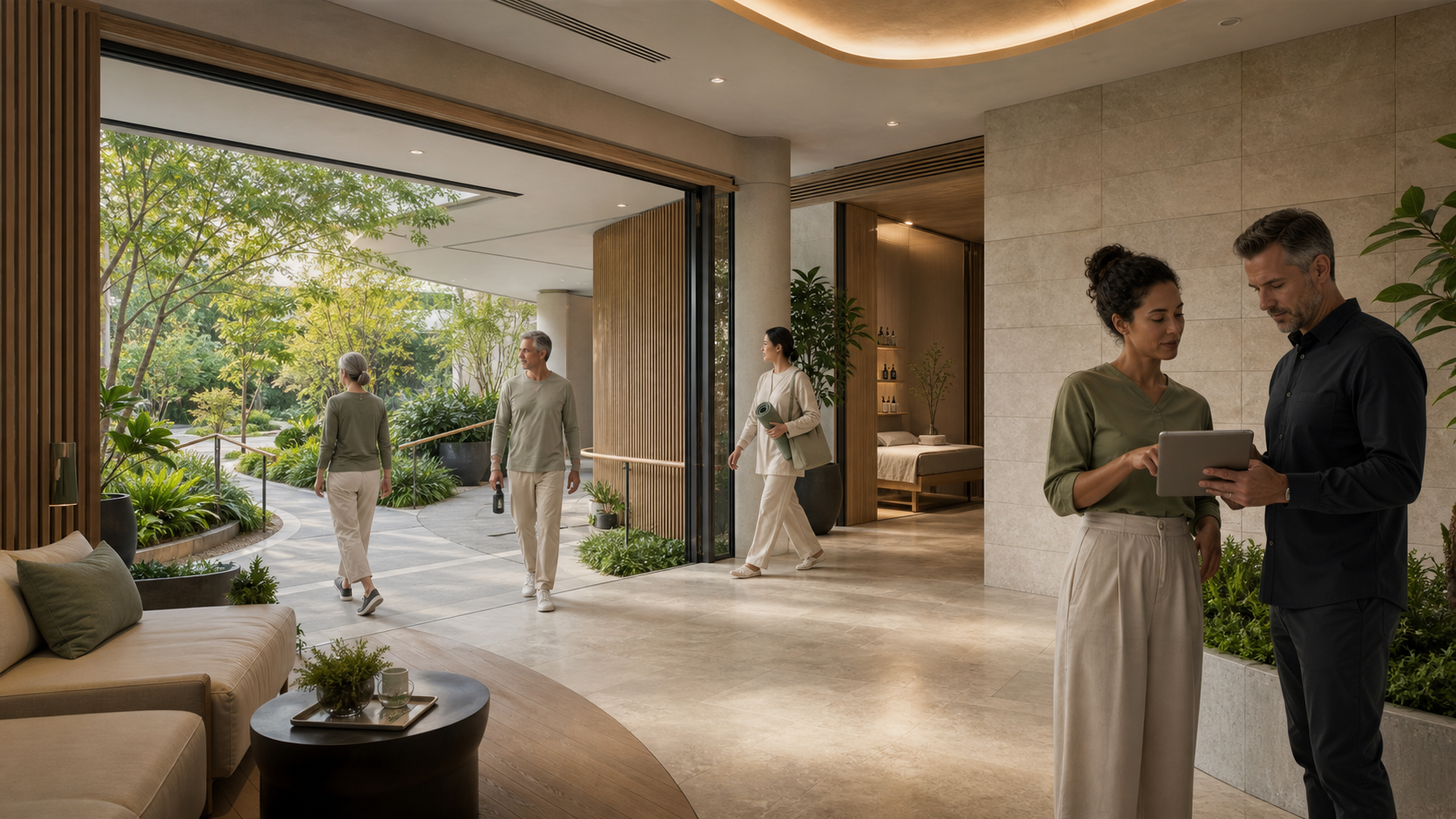
A premium spa can be beautifully designed and still operate inside a building that makes wellness difficult. Air quality, moisture control, accessible routes, food access, maintenance, staff coordination and the surrounding neighbourhood influence daily experience long before a treatment begins. That is why Marriott International’s new agreement with healthy-building certification system Fitwel is relevant beyond branded residences. Wellness beyond the spa suite must function at portfolio, property and operational level—not only as an amenity list. For spa professionals, the useful question is not whether a certificate can replace hospitality. It is how spa expertise can become part of a documented building-wide system without turning a design standard into a medical or commercial promise it cannot support.
What Marriott announced—and what it did not
Marriott’s official announcement on 22 June 2026 said the company had signed an agreement to integrate Fitwel solutions across its global branded-residential portfolio. The agreement makes Marriott Fitwel’s first Enterprise Partner and first hospitality company with the Champion+ designation. Marriott described 153 open residential properties and 183 in its pipeline. Spa Business reported the agreement on 10 July as a signal for the wellness sector.
The announcement also identified a completed pilot: The Ritz-Carlton Residences Chicago, Magnificent Mile, received a two-star Fitwel certification in March. Marriott said several more branded residences were expected to achieve certification by the end of 2026. Those are two different kinds of fact. One property had a stated certification; the wider programme was an agreement and implementation plan. The announcement did not say that all 336 open and pipeline properties were certified, that every residence would receive the same rating, or that a spa department was the subject of a separate assessment.
It also did not publish resident health outcomes, comparative operating data or proof that the agreement increases property value. Leadership statements about value, resilience and customer experience explain strategic intent. They are not independent confirmation of future financial or health performance. Keeping that boundary clear makes the news more useful: this is a real portfolio-governance move whose results still need to be demonstrated.
Why wellness beyond the spa suite matters to operators
Spas often inherit decisions made years before opening. Plant rooms determine ventilation and humidity control. Floor levels and door widths shape access. Drainage, waterproofing and material specifications influence maintenance. Back-of-house routes affect clean and used linen flows. Acoustic separation changes whether a treatment room is calm in practice. When these systems fail, a treatment protocol cannot compensate.
Fitwel’s current certification overview describes tailored scorecards for sites, multifamily residential buildings, low-rise residential assets, workplaces, retail and other building types. It says the scorecards contain more than 55 evidence-based design and operational strategies, weighted across seven health-impact categories. The model is therefore wider than a gym, sauna or treatment room. It considers the conditions and choices a building makes possible.
That is an important correction to amenity-led wellness marketing. A cold plunge, meditation room or rooftop garden may be appealing, but its presence does not answer who can reach it, how it is maintained, what information users receive, whether risks are managed, or whether the wider building supports healthy day-to-day use. The same is true in hotels and spas. A feature becomes an operating service only when responsibility, inspection, access, communication and review are attached to it.
Certification is a framework, not an outcome guarantee
A certification can create a common language and require evidence. It cannot remove the need to understand scope. Fitwel states that its strategies are voluntary and that no individual strategy is a prerequisite; projects accumulate points towards one-, two- or three-star ratings. That flexibility can help different properties choose appropriate interventions. It also means the star level alone does not tell a spa director which exact strategies were implemented or how consistently they perform after certification.
Ask what boundary was assessed
Was the assessment for a whole residential building, a site, owner-controlled common areas or another defined asset? Did it cover an operating building or a design-stage proposal? Which spaces and policies sat within the project boundary? A spa located inside a certified development should not automatically market every treatment, programme or practitioner as independently certified unless the certification owner explicitly confirms that scope and permits the claim.
Separate strategy evidence from property outcomes
The evidence behind a design or operational strategy is not the same as evidence that one named property improved resident health. A 2023 critical review of healthy buildings found that definitions and performance metrics vary and argued for multi-level strategies, ongoing monitoring and occupant feedback. A 2024 study comparing WELL- and LEED-certified offices found higher perceived indoor-environment satisfaction in the WELL-certified sample across most measures, while also noting that earlier comparisons had produced inconsistent results and often lacked methodological rigour. That research concerns other certification systems and offices, not Marriott residences or spas. Its relevance is methodological: measured building performance and user experience still matter after a badge is awarded.
For editorial, sales and awards material, use precise verbs. A property can be “working towards,” “registered for,” “designed in line with,” or “certified under” a standard; those phrases are not interchangeable. Name the rating, date, project boundary and certifying body where they are verified. Avoid turning certification into claims that residents or guests will sleep better, recover faster, live longer or avoid disease.
Air, water and moisture turn wellness into facilities work
Spa environments put particular pressure on building systems. Heat, steam, showers, pools, oils, fragrances, wet textiles and high cleaning frequency interact with ventilation, surfaces and drainage. A healthy-building strategy therefore needs engineering, housekeeping and spa operations in the same conversation.
The US Environmental Protection Agency’s indoor-air factsheet, updated in June 2026, identifies materials, furnishings, temperature, moisture, humidity, plumbing, heating, ventilation and air-conditioning among the factors that affect indoor air. Its practical hierarchy is source control, improved ventilation, then filtration and air cleaning. This is not a spa certification checklist, and local law and engineering standards prevail. It does show why buying a sensor or purifier without investigating sources, airflow and maintenance is not a complete plan.
Water systems require similar discipline: documented treatment, temperature control, testing, cleaning, incident response and competent oversight under the rules that apply to the property. Moisture evidence should connect design details to inspections and corrective work. Scent should be reviewed as a material and exposure choice, not assumed to be universally calming. Spa teams can identify real use patterns—doors held open, wet towels stored temporarily, treatment products introduced into rooms—but facilities specialists must assess and control the building systems.
Access, movement, food and connection widen the brief
Healthy buildings are not only mechanical systems. The World Health Organization’s housing and health guidelines bring together evidence on temperature, injury hazards, accessibility for people with functional impairments, air and water quality, noise and other conditions. WHO wrote the guidance for housing policy and implementation, not as a hotel or spa rating. Its intersectoral approach is still instructive: no single department owns every condition that shapes health and safety.
For a spa, this can mean step-free arrival information, dignified changing options, legible wayfinding, reachable controls, resting points, lighting and acoustics that work for different users, and a booking description that identifies heat, water, stairs or outdoor terrain before purchase. The Journal’s earlier discussion of inclusive spa experiences is relevant because access is a chain of decisions, not one adapted treatment.
Movement also belongs across the property rather than only inside a fitness studio. Attractive routes, visible lifts and stairs, safe surfaces, seating intervals and truthful distance information support choice without policing rest. The Journal’s analysis of movement-friendly spa programming offers a practical distinction: make voluntary movement easier while preserving rest and professional boundaries.
Food access and social connection require the same realism. A roof garden is not automatically an equitable food programme, and a residents’ lounge does not prove community. Operators should document who can use a space, how people learn about it, whether timing excludes some users, and what participation or feedback shows. Premium design should improve these practical conditions rather than conceal them.
Where spa expertise belongs in building governance
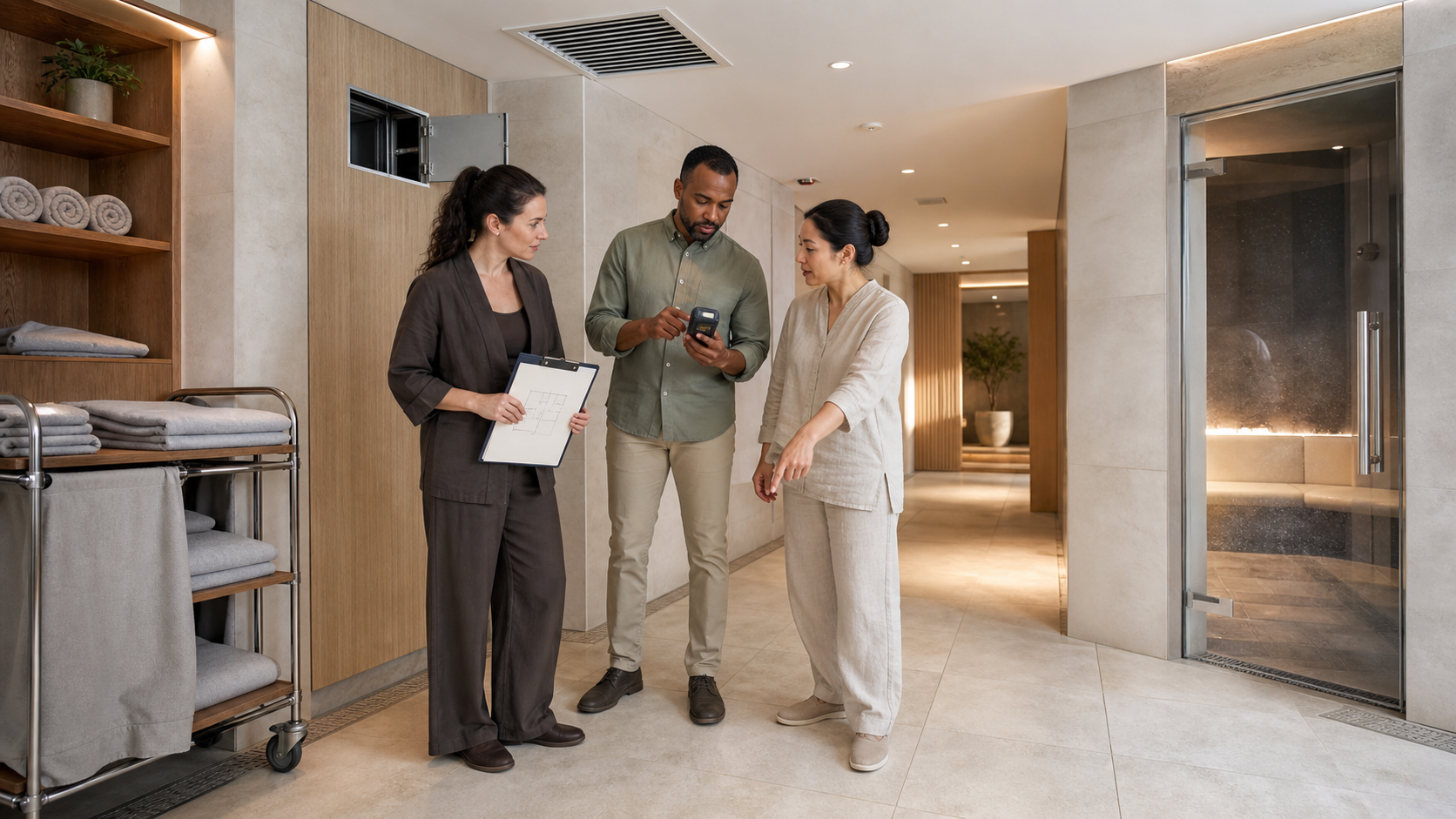
During design and fit-out, spa teams should provide operational scenarios rather than a wish list. Map guest and staff routes, wet and dry flows, peak loads, product storage, cleaning access, heat and humidity changes, noise sources, accessible alternatives and emergency procedures. Record who approves later substitutions, because a cheaper surface or relocated grille can change performance.
Before opening, commission systems under realistic conditions. A quiet empty treatment room is not the same room with a heated bed, equipment, products, staff and consecutive bookings. Test water, ventilation, drainage, controls, lighting, acoustics and access. Train teams to recognise warning signs and escalate them; do not rely on a handover manual that front-line staff never see.
During operation, connect preventive maintenance, complaints, incidents and guest feedback. Track recurring humidity, odour, temperature, slip, access and noise issues by location and time. A resolved complaint is useful, but patterns are more valuable than anecdotes. Document the investigation and fix, not only the response sent to the guest.
At portfolio level, define a small set of comparable controls while preserving local requirements. The purpose of a shared standard is not to make every spa look identical. It is to make responsibilities, evidence and escalation consistent enough that leaders can see where performance differs and why.

What does this mean for spa and wellness professionals?
For owners and developers, bring spa operations, engineering, accessibility and housekeeping into design decisions early. Ask what certification scope applies, what evidence is required and which operating costs continue after opening. Budget for commissioning, training and maintenance rather than treating certification as a one-time marketing expense.
For spa directors, translate brand-level wellness language into controls the team can observe: accurate pre-arrival information, equipment and water logs, room-condition checks, product inventories, access testing, incident routes and documented corrective action. Challenge claims that exceed the evidence, even when the underlying amenity is attractive.
For facilities and housekeeping leaders, include spa use patterns in the building plan. Review changes with the spa team before adjusting ventilation schedules, cleaning chemistry, linen storage, room layouts or water-system routines.
For designers and consultants, specify performance and verification, not only appearance. Show how guests and staff use the space, how components are maintained, and how an equivalent experience works when the headline route is inaccessible.
For awards researchers and directory users, request evidence that matches the claim. Active directory profiles for JW Marriott Venice Resort & Spa and The Spa at Phulay Bay, a Ritz-Carlton Reserve provide discovery context for two Marriott-branded hotel spas. Their inclusion does not establish Fitwel participation, residential status, a site visit, a current award result or verification of the practices discussed here.
A 30-day building-wellness evidence audit
In week one, define boundaries. List the building, common areas, spa, fitness, food and outdoor spaces; identify ownership and operating responsibilities; and record every certification or wellness claim with its source, date and exact scope.
In week two, walk the property with spa, engineering, housekeeping and an access lead. Follow guest and staff routes. Review air, moisture, water, noise, heat, surfaces, storage, cleaning and information at the point where each issue occurs. Photograph or log conditions for internal evidence, respecting privacy.
In week three, compare documents with delivery. Sample maintenance records, training completion, access information, complaints, incidents and corrective actions. Choose two recurring gaps that can be fixed safely and within professional scope.
In week four, verify the changes and update ownership. Record what improved, what remains open and who will recheck it. If the organisation wants to claim health, financial or behavioural outcomes, commission an appropriate evaluation instead of converting satisfaction comments into proof.
What remains unproven
The Marriott-Fitwel agreement does not prove that the entire residential portfolio is certified, that all projects will use identical strategies, or that hotel spas are automatically included. The Chicago pilot’s stated two-star certification does not establish resident health outcomes. Fitwel’s evidence base supports its strategies, but it does not validate every marketing inference made by a property. Research on adjacent standards cannot be transferred directly to Fitwel residences or spa guests.
The durable opportunity is more grounded. Healthy-building frameworks can move wellness from an amenity conversation to a documented system of design, operation and review. Spa professionals bring essential knowledge of heat, water, touch, privacy, movement, products and guest behaviour. Their contribution becomes credible when it connects to engineering, access, housekeeping and evidence—and when the public claim says exactly what has been verified.
Frequently asked questions
Did Marriott certify all its branded residences with Fitwel?
No. Marriott announced a portfolio-level agreement and identified one two-star pilot property. It said several additional branded residences were expected to achieve certification by the end of 2026.
Does a healthy-building certificate certify a spa treatment?
Not automatically. Certification scope may cover a building, site or defined spaces and policies. A treatment, practitioner or outcome needs its own applicable evidence and professional governance.
Can a spa claim health outcomes from better building operations?
It can accurately describe verified features and controls. Claims about individual or population health outcomes require suitable research, scope and regulatory review; a feature list, certificate or satisfaction survey is not enough.
Does directory presence prove certification or an award?
No. A directory profile supports discovery. It does not prove Fitwel participation, certification scope, operating performance, a site inspection, nomination or award result.
