
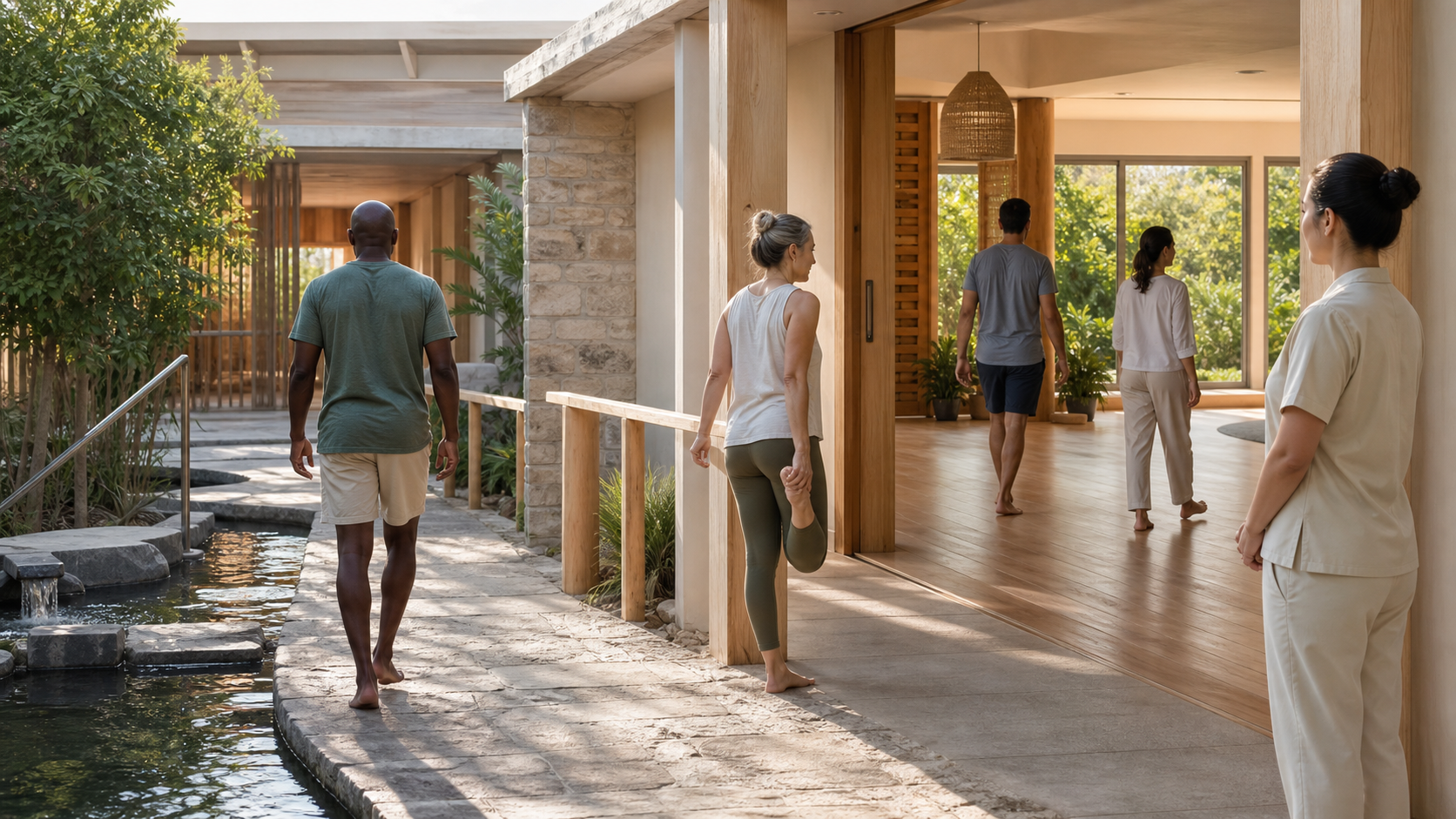
A spa journey can include an hour of treatment and still leave the guest sitting for most of the day. That tension matters after the United Kingdom’s four Chief Medical Officers refreshed their physical activity guidance on 10 July 2026. The numerical target for adults did not change: the guidance still asks people to work towards at least 150 minutes of moderate activity each week, or an equivalent combination at higher intensity, alongside muscle-strengthening activity. The important shift is in emphasis. Small bouts count, daily movement matters, strength and balance deserve attention, and long periods of inactivity should be broken up where possible. For operators, the opportunity is not to make medical promises. It is to reconsider spa movement programming as a sequence of accessible choices before, between and after conventional services.
What changed in the guidance—and what did not
Spa Business reported the update as an industry signal on 11 July. The original Department of Health and Social Care announcement is more precise: the existing recommended activity levels remain, while newer evidence strengthens the focus on light-intensity activity, reducing prolonged sitting, and including strength and balance through life. The refresh covers children, adults, older adults, disabled people, and women during pregnancy and after birth.
The full UK Chief Medical Officers’ report says adults should aim to be active every day, work towards at least 150 minutes of moderate activity or 75 minutes of vigorous activity a week, and strengthen major muscle groups on at least two days. It also says activity can be accumulated in bouts of any length. For older adults, strength, balance and flexibility receive particular attention. Yet the report does not create a spa standard, certify any programme, or instruct hospitality businesses to assess individual medical suitability.
That distinction prevents two errors. The first is presenting an unchanged weekly target as a newly discovered threshold. The second is turning a population-level guideline into a promise that one class, treatment or itinerary will prevent disease. Spa teams can use the update as a design prompt while keeping health assessment, diagnosis, rehabilitation and individual clinical advice with appropriately qualified professionals.
Why spa movement programming needs a wider definition
Movement programming is often treated as a timetable of yoga, Pilates, gym sessions or guided walks. Those services may be valuable, but a timetable reaches only guests who notice it, feel welcome, are available at the right time and believe the session suits them. The refreshed guidance points towards a wider operating question: how can the whole guest journey make voluntary movement easier without making stillness, rest or disability feel like failure?
A broader model includes the formal class, but also the route to it, the clarity of the description, alternatives at different intensities, opportunities to stand or move between seated experiences, access to attractive walking or wheeling routes, and staff language that invites rather than pressures. These are design possibilities, not universal prescriptions.
The World Health Organization’s physical activity and sedentary behaviour guidelines offer an international comparison. WHO also says some activity is better than none, that all activity counts, that adults should limit sedentary time, and that muscle strengthening benefits everyone. WHO’s adult range is 150–300 minutes of moderate aerobic activity or 75–150 minutes at vigorous intensity each week for substantial health benefits. National guidance, professional scope and accessibility requirements still apply in each market; the UK update should not be presented as a global legal rule.
Design for starting points, not ideal guests
The person most likely to join an advanced class is not necessarily the person for whom a small, welcoming movement opportunity is most meaningful. A movement offer designed around an already active, able-bodied guest can unintentionally create a high entry threshold. Images of athletic performance, unexplained intensity labels, fixed standing sequences, narrow routes or staff assumptions can all communicate that the programme is for somebody else.
The UK report says the gains per additional minute are proportionately greater for people starting at the lowest activity levels, while also noting that thresholds can discourage participation. That does not mean every guest should be urged to exercise. It means programme descriptions can explain the starting point, pace, environment, duration and available adaptations. Guests should be able to choose rest without judgment, ask about access before booking and stop an activity without having to justify themselves.
Make the invitation legible
Replace labels such as “all levels” with useful detail. State whether a session is seated, standing or mixed; whether it includes floor work, steps, heat or outdoor terrain; how long it lasts; what equipment is used; and which options are available. “Gentle” is not an objective intensity measure. The UK report uses a talk test to explain moderate and vigorous activity, but intensity remains relative to the individual. A spa should avoid deciding that a guest is fit or unfit from appearance, age or disability.
Offer equivalent dignity, not a lesser option
An adaptation should not feel like removal from the experience. Seating with arms, clear circulation, reachable equipment, uncluttered floors, acoustic clarity and visible staff support can improve participation without turning the studio into a clinical setting. A parallel route should receive the same attention to scenery, materials and hospitality as the headline route. The Journal’s earlier discussion of inclusive spa experiences is relevant here: access is an operating quality, not a decorative claim.
Strength and balance require programme substance
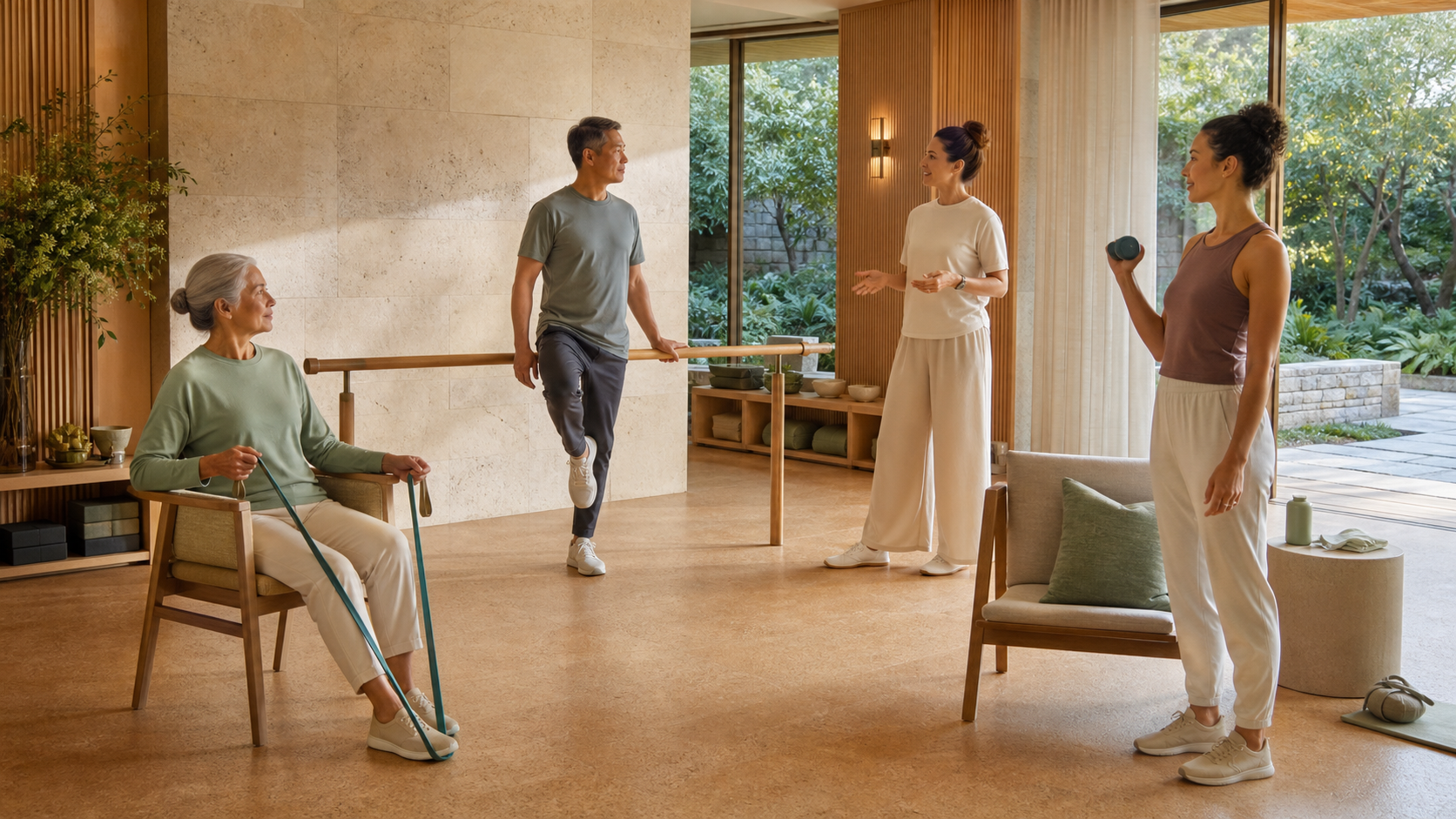
Adding the words “strength” and “balance” to a menu is not enough. Operators need to decide what capability the session is designed to practise, who leads it, what equipment and space it requires, how options are communicated, and where professional responsibility begins and ends. A decorative pair of hand weights in a guest room is not a programme. Nor does a single balance pose demonstrate that an offer is suitable for older adults or people returning after inactivity.
The UK guidance highlights muscle strengthening on at least two days a week for adults and strength, balance and flexibility for older adults. It also advises people who have recently been inactive or who use GLP-1 medicines to pay particular attention to maintaining muscle strength. A spa should report that as guidance, not use it to target medicine users with an unsupported treatment claim. Any offer intended for a defined health population needs appropriate expertise, screening, consent and referral arrangements under local rules.
For a general hospitality programme, substance can be simpler. Use qualified movement professionals whose credentials match the activity. Keep participant numbers consistent with safe observation. Inspect floors, chairs, bands and weights. Give a clear briefing and stopping option. Record incidents and near misses. Review whether the advertised level matches what is delivered. These are operational controls; they do not prove a health outcome, but they make the service more accountable.
Break up sedentary time without policing rest
Spas are places where lying down, sitting quietly and doing less can be entirely appropriate. The objective is not to turn a relaxation lounge into a fitness circuit. The useful distinction is between chosen rest and a journey that makes immobility the default because every transition, refreshment and activity is organised around another seat.
Operators can map the itinerary from arrival to departure. Where do guests queue? How long are consultations? Is water available only from seated service? Can a person move between thermal areas without losing orientation? Does a half-day package stack long seated or reclining periods with no optional change of posture? A short invitation to walk, wheel, stand, stretch or visit an outdoor space may be enough. The invitation should be optional, culturally appropriate and paired with an equally dignified resting choice.
Environmental design can help. A looped route is easier to understand than a dead end. Handrails, shade, seating intervals, even surfaces and clear wayfinding can widen participation. Attractive stairs can be visible without hiding the lift. A garden destination can reward the journey, while information about distance, slope and surface helps guests decide. None of these features should be marketed as treatment for a condition without evidence and the required authority.
Build professional boundaries into the service
The movement professional’s job title, training and permitted scope should be clear to booking teams and guests. A yoga teacher, personal trainer, physiotherapist and medical practitioner have different qualifications and responsibilities, which vary by jurisdiction. A luxury setting does not blur those boundaries. Staff should know what information they can collect, when to pause, how to respond to a disclosed condition and where to refer a question they are not qualified to answer.
Consent is more than a waiver. The guest needs a truthful description before choosing, space to ask questions, a practical way to decline, and no penalty for stopping. Data collection should be proportionate. If a general class does not require a diagnosis, the spa should not invite unnecessary disclosure of sensitive health information. If a programme does require screening, the process and data handling must meet applicable professional, privacy and legal standards.
Marketing needs the same discipline. “Supports opportunities to move” describes a service. “Reverses ageing,” “prevents falls,” “preserves muscle on weight-loss medication” or “treats inactivity” are medical or outcome claims that require a very different evidence and governance basis. The WHO physical activity fact sheet summarises population evidence and global inactivity estimates; it does not validate a particular spa class, device or package.
Measure participation without manufacturing proof
A spa can evaluate delivery before attempting to claim health impact. Start with reach: how many eligible guests saw an accurate description, booked, attended and completed the activity? Examine access: were adaptations requested, available and used; did guests abandon a route because of steps, heat, noise or unclear wayfinding; did class times exclude particular itinerary groups? Review operations: cancellations, instructor changes, equipment faults, incidents and feedback themes.
Participation figures need denominators. Twenty attendees may be strong for a 24-person retreat and weak for a 500-guest resort. An increase after moving a class could reflect timing rather than better content. Satisfaction is not evidence of improved strength or reduced disease risk. Self-reported energy after a session may be useful guest feedback, but it is not a clinical endpoint.
Global context also needs care. A 2024 Lancet Global Health pooled analysis combined 507 population-based surveys with 5.7 million participants and estimated that 31.3 per cent of adults were insufficiently active in 2022. The study concerns population trends across 197 countries and territories. It does not identify spa guests, measure the effect of wellness travel, or prove that hospitality programming changes activity after departure.

What does this mean for spa and wellness professionals?
For owners and general managers, treat movement as part of the guest operating system rather than a small fitness department. Ask whether the property gives people appealing, accessible choices across the day and whether commercial copy stays within the evidence. Fund training, route improvements and equipment maintenance before funding a large outcome claim.
For spa directors, inventory every formal and informal movement opportunity. Check descriptions against delivery, map sedentary stretches in packages, test access with different users and create a referral protocol. The earlier Journal article on realistic wellness goals provides useful context: a credible promise should help a guest choose a manageable next step rather than sell transformation.
For movement professionals, define scope, entry level, progressions, alternatives and stopping criteria. Document the session plan and any incident. Do not infer medical suitability from a booking note or appearance. If a guest’s question falls outside your competence, pause and refer rather than improvising an answer.
For designers, connect the studio to the rest of the spa. Review surfaces, gradients, acoustics, lighting, resting points, water access, storage and navigation.
For awards researchers and directory users, request evidence that matches the claim: current schedules, qualifications, access information, incident controls, feedback methods and documented improvements. Active directory profiles for Thermae Bath Spa and ESPA at Lucknam Park help readers discover two UK spa settings. Their inclusion is not an award result, endorsement, site visit or verification that either property applies the 2026 guidance.
A 30-day movement-programming review
In week one, map the current guest journey and list every class, route, transition and extended seated or reclining period. In week two, verify instructor scopes, descriptions, access information, equipment checks and escalation procedures. In week three, test two modest improvements with real users: perhaps clearer level information, a supported alternative, a different class time or an optional route between services. In week four, compare participation, access requests, incidents and feedback, then decide what to keep, revise or stop.
Do not claim success because a new timetable exists. A review is complete only when the spa can show what changed in delivery and what was learned. If the property wants to study health outcomes, it needs an appropriate research design, consent, expertise and governance rather than a marketing survey.
What remains unproven
The 2026 UK refresh does not show that any specific spa programme improves population activity, strength, balance or long-term health. It does not create an international certification, prescribe a universal class design or establish that every guest should move during a spa visit. WHO guidance provides global context but does not remove national differences. The pooled global inactivity estimate describes populations, not the customers of an individual property.
The responsible opportunity is narrower and more useful. Spa movement programming can make small, voluntary actions visible and welcoming; add credible strength and balance options; reduce avoidable sedentary stretches; respect rest; and connect formal sessions to the physical journey through the property. Operators should describe what they actually provide, measure delivery, protect professional boundaries and leave medical claims to evidence that can support them.
Frequently asked questions
Did the UK change the adult target in July 2026?
No. The adult target remains at least 150 minutes of moderate activity each week, or an equivalent combination, with muscle-strengthening activity on at least two days. The refresh changes emphasis and supporting evidence rather than introducing a new target.
Must a spa add exercise to every treatment package?
No. Rest may be the appropriate and chosen purpose of a spa visit. The operational question is whether guests have truthful, accessible and voluntary movement choices, not whether staff pressure everyone to exercise.
Can a general spa class serve guests with health conditions?
Suitability depends on the individual, the activity, the professional’s scope and local requirements. A spa needs accurate information, adaptations, consent and a clear referral route; an editorial framework cannot assess an individual guest.
Does directory presence prove an inclusive movement programme?
No. Directory presence supports discovery. It does not prove current programming, accessibility, health outcomes, award status or compliance with the updated guidance.
