

A new full-body light system has given the spa sector a timely reason to examine spa light therapy as an operating proposition, not just a striking piece of equipment. Metawell by Gharieni has introduced MLX ChromoZone with multiple light wavelengths, preset programmes and programme-specific soundscapes. Those are supplier and product-launch facts. They do not, by themselves, establish a health result, regulatory classification, safe protocol for every guest or viable service for one property.
The professional task begins before menu copy is written. A spa needs to connect the exact product, intended use, configuration, evidence, guest information, staff competence, maintenance and claims in one controlled file. That file must remain specific to the jurisdiction and service. This guide explains how to build it without converting a launch announcement, a scientific paper, a directory record or an illustration into proof of efficacy, compliance, nomination or award recognition.
What the current spa light therapy launch establishes
Spa Business reported the product launch on 6 October 2026. Its report describes a full-body system combining four targeted wavelengths with soundscapes and says the equipment has 15 programmes. The manufacturer’s official product page identifies green, yellow, red and near-infrared wavelengths, skin-phototype selection, preset programmes and integrated sound.
That establishes what the supplier currently describes. It does not independently verify every programme name, biological mechanism, guest benefit or commercial outcome. It also does not show how a particular spa will configure the equipment, screen guests, train staff, maintain the system or describe the service. The article’s starting point is therefore intentionally narrow: the launch is a current industry signal that triggers due diligence.
Separate four evidence states from the first meeting. State one is a supplier statement. State two is a technical specification or instruction supplied for the exact model and market. State three is independent evidence relevant to the same parameter, population and claim. State four is the property’s own operating record. A statement does not become stronger merely because it appears in a brochure, training slide, sales conversation and web page.
Spa light therapy starts with intended use
Before procurement, write one plain-language sentence describing what the property intends to offer. Is it a sensorial light-and-sound experience, a general-wellness service, a cosmetic service, a recovery proposition or a treatment linked to a named condition? Each version changes the questions that follow. The spa should not let the most ambitious marketing phrase silently define the service after the contract is signed.
Regulatory boundaries differ by country and by claim. The US Food and Drug Administration’s January 2026 general-wellness guidance explains a US compliance policy for low-risk products that promote a healthy lifestyle. It does not turn every product carrying the word “wellness” into a low-risk non-device, and it is not a global classification. A property outside the US needs its own competent jurisdictional review.
European guidance illustrates why wording matters. The European Commission’s Medical Device Coordination Group guidance on borderline products says the specific medical purpose is set by the manufacturer and that the principal intended action described in labelling and claims must be assessed case by case using current scientific knowledge. Operators should obtain the model’s instructions, declarations and authorised claims for the market where it will be used, then confirm what the property itself may say.
Separate the product, protocol and claim
“Light therapy” is not one standard exposure. The product record should identify the exact model and software version. The protocol record should identify wavelength or combination, intensity, exposure duration, distance, body area, programme, frequency, phototype selection and any accessories. The claim record should state the exact sentence the spa wants a guest to understand. If any of those three changes, the evidence review may need to reopen.
This is important because a study of one wavelength, dose, application site or clinical population does not automatically substantiate another configuration. A supplier may legitimately cite research on photobiomodulation as background while a spa still lacks evidence for a specific menu promise. The operator should ask whether the published intervention matches the installed product, delivered parameter, intended user and claimed outcome—not whether the paper contains the same broad technology name.
A 2025 umbrella review of randomised photobiomodulation trials synthesised 15 meta-analyses covering 204 trials and more than 9,000 participants. It reported moderate-certainty evidence for some condition-specific outcomes, while most other outcomes had low or very low certainty because of heterogeneity or small-study effects. That is a reason to read claim by claim, not permission to market the full review as proof for every spa programme.

Build a spa light therapy claims register
Create a line for every direct and implied claim across the treatment name, menu, booking page, consultation, signage, staff script, social post, image, testimonial and partner channel. Record the owner, audience, jurisdiction, evidence relied on, permitted wording, mandatory qualification, approval date and review date. Include sensorial statements as well as objective health, performance, sleep, recovery, skin or mood statements.
The whole impression matters. A neutral phrase beside medical imagery, a dramatic before-and-after composition or a testimonial about a condition may imply more than the words alone. The UK’s ASA and CAP remind therapy advertisers that efficacy claims need robust clinical evidence, while subjective descriptions of calming surroundings or personal experience occupy a different category. Their guidance is UK-specific, but the operating lesson travels: distinguish observable service facts, subjective experience and objective outcome claims.
Do not solve a weak claim with a small disclaimer. If the headline, imagery and staff explanation create a therapeutic promise, a footnote may not repair the message. Do not use “clinically tested” without identifying what was tested, on whom, at which parameter and for which outcome. Do not turn a component study into proof for the complete service, or a regulatory mark into evidence of a result it was not designed to establish.
The register also prevents drift. A carefully approved “light-and-sound relaxation experience” can become “sleep therapy” after a booking-platform rewrite or enthusiastic staff conversation. Require change control for programme names, benefits, imagery, testimonials and sales scripts. Archive replaced wording so the property can reconstruct what a guest saw on a particular date.
Commission the service, not only the equipment
A delivered machine is not a live service. Commissioning should confirm room conditions, electrical and ventilation requirements, access, cleaning compatibility, software, programme settings, timer behaviour, stop controls, protective equipment, maintenance tasks and escalation routes. The property should retain the supplier instructions and any local technical inspection, then document what was actually installed rather than relying on the sales configuration.
Build a version-controlled protocol for each offered programme. It should state who may operate it, the approved configuration, guest position, duration, monitoring, cleaning, reset, record and stop criteria. If the operator selects skin phototype or another guest characteristic, define how that information is gathered, who may interpret it, where it is stored, and what happens when staff are unsure.
Screening is not a borrowed checklist. Obtain contraindications, precautions and referral conditions for the exact product and local service scope. Translate them into questions guests can understand, staff can administer consistently and managers can audit. Decide how medication questions, pregnancy, photosensitivity, recent procedures, eye concerns, implanted equipment or active conditions are handled by qualified people. This article does not determine those answers.
Training should end in demonstrated competence. Attendance at a supplier presentation is only input. Staff should show they can identify the model and current protocol, prepare the room, give the approved explanation, screen within scope, configure the session, use stop controls, clean the system, record a deviation and escalate a concern. Retrain after software, programme, instruction or menu changes.
The Journal’s commissioning standard for connected strength equipment offers a useful adjacent principle: an asset becomes an operating service only when configuration, competence, maintenance, guest information and exceptions are controlled together. Light-based equipment needs its own evidence and safeguards, but the governance chain is comparable.
Record exceptions before measuring success
Define an exception pathway before the first guest. Staff need a clear action for discomfort, unexpected skin response, visual symptoms, anxiety, equipment fault, configuration error, incomplete screening or a request outside the spa’s scope. The record should distinguish an adverse event, service complaint, device fault, protocol deviation and ordinary preference. Each category can require a different owner and escalation.
Set temporary stop rules and reopening authority. A repeated minor issue can matter even when no single event appears serious. Managers should be able to quarantine a programme, preserve logs, contact the supplier, seek clinical or regulatory advice where appropriate, and reapprove the service only after the cause and control are documented. Commercial pressure must not override that route.
Measure the operation before the benefit. Useful early indicators include completed screening, correct configuration, protocol adherence, cleaning completion, downtime, faults, early stops, incidents, complaints and staff escalations. Bookings, utilisation, repeat purchase and contribution can follow, but they do not prove a health outcome. Testimonials should never replace a defined outcome method or product-specific evidence.
Test the guest journey and commercial case
Walk through discovery, booking, pre-arrival information, consent or acknowledgement, preparation, session, aftercare and follow-up. The service name, duration, price, clothing guidance, sensory conditions, staff role and cancellation terms should agree across every channel. Guests should know whether the experience is self-contained, part of another treatment or offered under a qualified practitioner’s supervision.
Build the business case with the same discipline. Include purchase or lease cost, room conversion, training, staff time, consumables, cleaning, energy, maintenance, software, insurance, marketing review, downtime and replacement. Model capacity from the full room cycle, not exposure time alone. A claim that the technology does not increase therapist workload should be tested against the local journey, oversight rules and exception rate.
Active directory records for Waldorf Astoria Spa Berlin and The Fontenay Hamburg can support discovery questions about how urban hotel spas describe facilities, services and guest access. They do not show that either property offers this device or any specific light protocol. Directory presence is not evidence of efficacy, compliance, nomination or an award result.
What does this mean for spa and wellness professionals?
Owners should approve the intended use and risk appetite. Spa directors should own the guest journey and operating protocol. Technical and facilities teams should verify installation, maintenance and fault controls. Qualified clinical or regulatory advisers should review boundaries that exceed the property’s competence. Marketing should use only claims that the evidence file and jurisdictional review support. Procurement should retain the supplier record without treating it as independent verification.
Editorial and awards teams need the same separation. A sophisticated installation, training certificate, positive testimonial, directory page or generated illustration is not proof of a guest outcome or award merit. Ask which exact service is operating, under what protocol, with what evidence, since when, and how exceptions are recorded. The Journal’s guide to keeping the evidence chain visible can help teams preserve study, translation, implementation and result as distinct states.
A 30-day commissioning file
In week one, define intended use, market, service scope and proposed claims; collect current product documents and identify unresolved jurisdictional questions. In week two, map every proposed claim to product-specific evidence and remove wording that outruns it. In week three, complete the room, protocol, screening, maintenance, cleaning, incident and staff-competence controls. In week four, rehearse the guest journey and exceptions, reconcile the commercial model and approve either a bounded launch, more evidence work or a hold.
The file should contain model and software identifiers, instructions, supplier claims, independent review, adviser decisions, programme settings, screening logic, competence records, maintenance schedule, room checks, claims register, channel screenshots, incident path, commercial assumptions, approval minutes and review dates. A later programme, parameter or claim change should trigger the relevant parts of the file again.
What remains unproven
The launch coverage and manufacturer page do not prove that the system produces every described wellbeing outcome for every guest. The scientific review does not evaluate this specific product or every preset programme. Regulatory guidance from the US, EU or UK cannot be transplanted as legal advice into another country, and general-wellness language does not by itself establish classification or compliance.
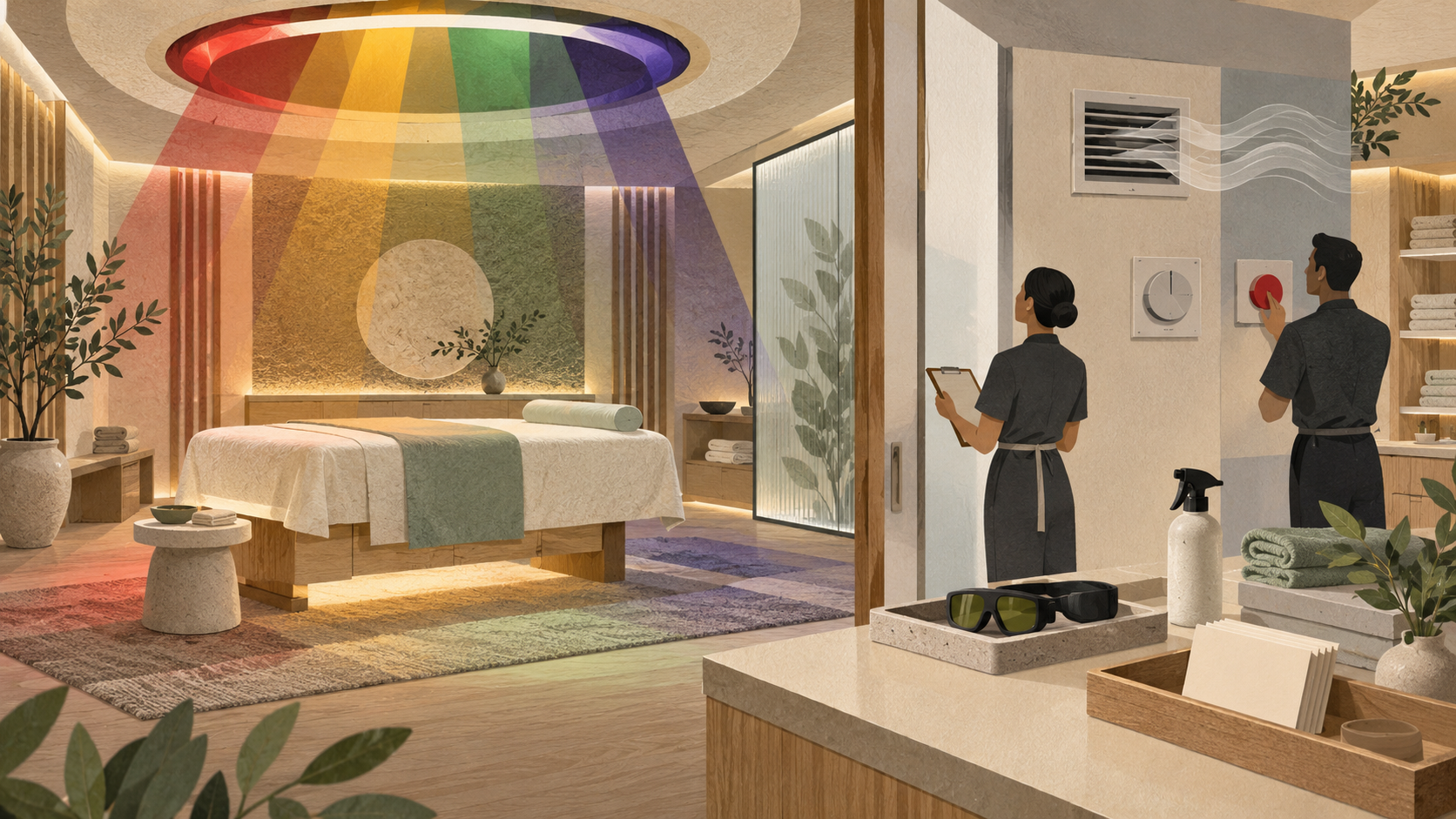
This article has not visited, tested or commissioned the equipment. It does not determine contraindications, dose, treatment suitability or medical benefit. The directory links do not prove that the named spas offer light therapy. The original illustrations are fictional and show no documentary access, product endorsement, nomination or award.
The operational conclusion is narrower and stronger: commission the evidence before the menu. Keep the product, protocol and claim connected but distinct. Approve only the wording, configuration and guest journey that the property can support. Then keep measuring the live service, because a successful launch is not the end of the evidence chain.
