
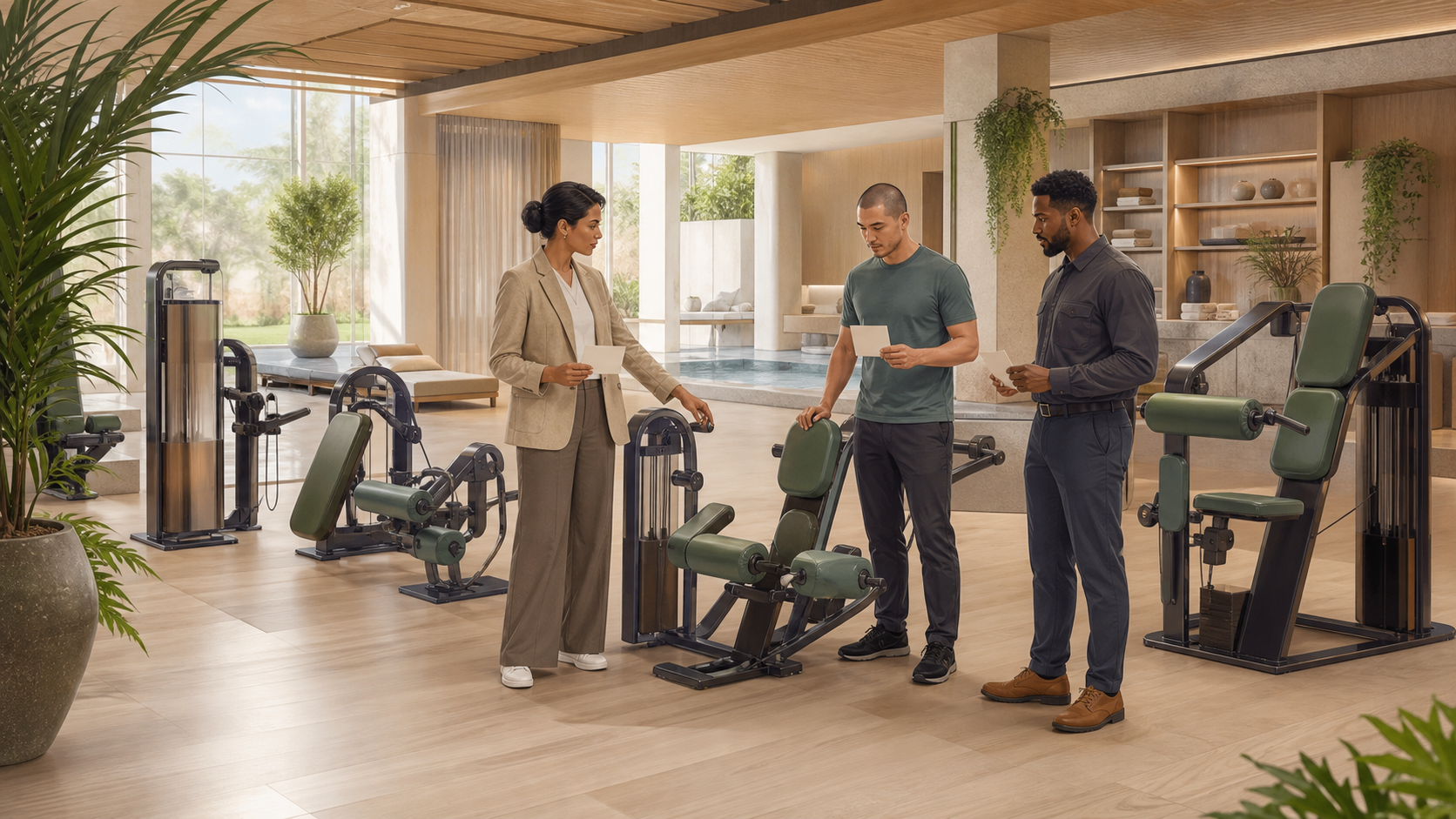
A new commercial fitness launch makes connected strength equipment a timely question for spa and wellness operators. On 19 August 2026, Spa Business reported that Finnish equipment group HUR had introduced VOA Fitness, a brand intended to take pneumatic resistance and connected programming into commercial fitness, spa and wellness settings. The launch is a useful signal; it is not proof that any particular spa should buy the system or that the equipment produces a promised result.
The operating decision is wider than machine selection. A connected circuit combines physical equipment, software, member profiles, programme logic, staff judgement, utilities, floor space, maintenance and public claims. Each component can alter safety, access, privacy and service quality. A precise resistance increment or personalised screen does not make the complete service commissioned.
This article uses the launch to build an international professional framework. It distinguishes manufacturer descriptions from independent standards, population guidance from individual prescription, and recorded activity from verified benefit. It does not assess VOA equipment, compare suppliers, provide medical advice or infer any visit, test, partnership, nomination or award result.
What the VOA launch establishes
VOA's official company history says the brand was created in 2026 from HUR's work with pneumatic resistance. The page describes Aerokin as a system using controlled air rather than conventional weight stacks and says fitness professionals remain the decision-makers. These are first-party statements about the company's origin, design intention and operating position.
The current product page lists a connected platform, individual programmes, equipment settings, training data and adjustments as small as 100 grams. It also says programmes and settings can follow a member across compatible machines. Spa Business reported a 17-machine range at launch. Together, the sources establish a current commercial offer and its stated features, not independent evidence of ease of use, inclusivity, durability, privacy performance, energy savings or outcomes in a spa.
That boundary matters. Heritage in healthcare does not automatically make a commercial wellness service clinical, suitable for every person or supported for every claim. A platform that can generate a programme does not remove professional responsibility. Operator control of data does not by itself define lawful purpose, access, retention or deletion. The manufacturer can supply a product; the spa still owns the service it creates around it.
Connected strength equipment starts with a service boundary
Define the offer before selecting hardware. Is the circuit an unsupervised amenity, an orientation-led facility, a coached class, an individually programmed service or part of a regulated clinical pathway? Who may use it, at what times, under whose supervision and after which introduction? What happens when the software, network, pressure supply or one machine is unavailable?
Write the boundary at guest level. State what is included, what information is requested, what a coach reviews, which adaptations are available and what the service does not do. Do not describe a general strength session as diagnosis, rehabilitation or treatment unless the property has the legal scope, qualified professionals, governance and evidence required for those services.
The Journal's spa movement programming analysis explains why population recommendations need inclusive entry points and professional limits. Apply the same discipline here. The equipment may support a programme, but the service boundary determines consent, competence, emergency response, records and claims.
Commission machinery, space and utilities together
Begin with documented supplier due diligence. Confirm the exact model, intended setting, user class, conformity information, installation requirements, instructions, adjustment range, maximum loads, software dependencies, warranty, service support and spare-parts plan. Record which standards the supplier claims and obtain the evidence relevant to the market where the equipment will be placed into service.
The BSI catalogue identifies BS EN ISO 20957-1:2024 as the current general safety and test standard for stationary training equipment. Its published scope includes equipment in hotels, clubs, rehabilitation centres and studios where access and control are regulated by a responsible owner. BSI's record for BS EN ISO 20957-2:2024 adds requirements for stationary strength equipment, including equipment using pneumatic and other alternative resistance. These public records establish relevant standard scopes; they do not certify a product or replace the complete standards, local law, manufacturer instructions or competent assessment.
Commission the room as well as the machine. Verify floor loading, anchoring where required, operating and maintenance clearances, reach ranges, transfer space, circulation, lighting, ventilation, acoustic conditions, power, network, pressure supply, emergency access and cleaning. Test adjustments with people of different sizes and starting abilities. A route can be technically wide yet unusable if a bench, bag, screen or queue occupies it.
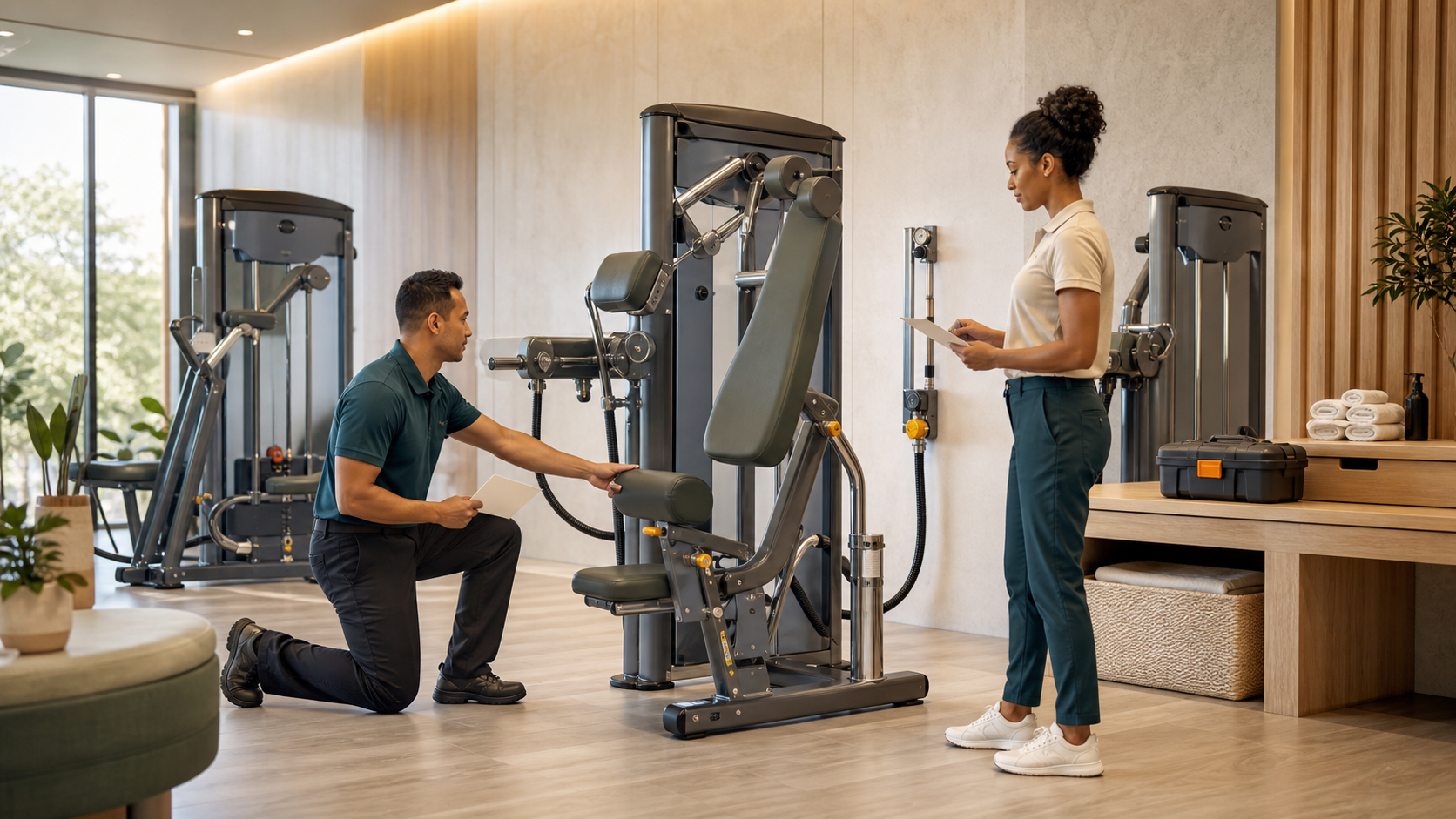
Create acceptance tests for every configuration. Check stability, guards, stops, adjustment locks, upholstery, handles, cables or hoses, resistance changes, displayed settings, login and logout, programme transfer, loss of connectivity and safe restart. Record asset identifier, software version, result, exception, owner and approval. A showroom demonstration or delivery note is not an acceptance record.
Keep programme decisions human-led
World Health Organization guidance recommends regular physical activity and includes muscle-strengthening activity for adults and older adults. For older adults, it also describes multicomponent activity that emphasises balance and strength. Those are population-level recommendations. They do not validate a particular machine, prescribe a load for an individual or prove that one spa programme prevents a fall, extends life or treats a condition.
Give qualified coaches authority over programme scope, technique, progression and stopping decisions. Define what the platform may suggest and what requires review. Train staff to recognise when a request falls outside the service and needs referral. A generated plan should never make an employee feel obliged to accept a setting they cannot explain or observe safely.
Design a clear first session: orientation, adjustment, chosen goals, suitable starting point, technique, communication signals and exit. Make a non-connected or data-minimal route available where practical. Measure adherence and service delivery before claiming benefit. Completion, load moved or sessions logged are activity records, not automatically evidence of improved health or wellbeing.
Separate three evidence layers in programme review. Delivery evidence shows that the planned session occurred with the intended settings and supervision. Change evidence compares a defined measure using a consistent method over a suitable period. Outcome evidence asks whether any change is meaningful, attributable and relevant to the claim. Do not collapse those layers into one dashboard score. If the service is marketed around confidence, independence or longevity, define what the words mean, how they are supported and which limits the guest sees before booking.
Treat progress data as a separate service
Connected equipment may move settings and training data between machines. Before launch, map every item collected or derived: identity, contact details, goals, assessments, equipment settings, repetitions, resistance, range, attendance, staff notes and any imported data. Name the purpose, system, access roles, retention period, export route, correction process, deletion process and processor for each item.
The NIST Privacy Framework 1.0 is a voluntary, risk-based tool for identifying and managing privacy risk. NIST also stresses that cybersecurity and privacy are related but distinct: a secure system can still create privacy problems through unnecessary collection, opaque use or unexpected combination. The framework is not law, but its separation of business purpose, individual impact and controls is useful across jurisdictions.
Consent is not a decorative screen. Explain which data are needed to operate the session, which support optional personalisation, who sees them and whether refusing an optional use changes access. Do not bundle marketing, research or third-party sharing into a necessary service action. Test logout, shared-device visibility, staff permissions, exports, account closure and offline operation with the same seriousness as a mechanical stop.
The Journal's body-scanning trust framework provides a related method for purpose, consent and measurement. Connected strength adds a repeated-use question: data can accumulate over months, change staff decisions and travel between machines. Review whether every field still serves the stated purpose rather than keeping it because storage is easy.

Build inspection and maintenance into the timetable
Opening checks are the start of control, not its conclusion. Set inspection and maintenance intervals from risk, usage, environment, supplier instructions and experience. Include visible condition, adjustment mechanisms, fasteners, guards, upholstery, connections, hoses, resistance consistency, software version, network behaviour, cleaning and any safety-critical function.
The UK Health and Safety Executive says work-equipment inspection should follow a risk assessment that considers the equipment, workplace, people using it and experience of use. Its guidance is jurisdiction-specific, but the operating principle is portable: frequency should respond to real risk and deterioration, not an arbitrary calendar alone.
Reserve time and competence for maintenance. Do not let peak demand turn a reported fault into a note for later. Define who can isolate a machine, what label prevents use, who may repair it, what evidence permits return and how similar assets are checked after a repeated fault. Preserve service records with the asset and software history.
What does this mean for spa and wellness professionals?
For owners and general managers, approve a service model, not a purchase list. Budget for floor preparation, utilities, privacy work, staff competence, maintenance, software support and downtime. Require evidence before using accessibility, sustainability, medical or outcome language.
For spa directors, hold one readiness register across equipment, room, staff, programme, data and guest communication. Give a named person authority to pause a machine or connected feature without waiting for a commercial decision.
For coaches and therapists, understand the boundary between instruction, adaptation and regulated care. Observe technique and response; do not treat a platform recommendation, inherited programme or previous load as a command. Record only what the service needs.
For facilities and technology teams, test combined failures. A mechanically sound machine may become unavailable through a pressure, power, network or account problem. A software update may change settings or permissions without moving any hardware.
For marketers and awards researchers, distinguish availability from evidence. A product launch, installation, connected profile, directory page or strong brand heritage does not establish guest benefit, inclusivity, privacy performance, nomination or award merit. Active directory pages for Canyon Ranch and Chiva-Som International Health Resort support further spa research; they do not indicate that either property uses the equipment discussed here or has any relationship to this launch.
A 30-day connected strength equipment review
Days 1-10: define and document
Freeze the intended service, user groups, supervision, professional scope, room plan, equipment schedule, supplier evidence, standards review, utilities, software dependencies and data map. Write acceptance criteria and public-language limits. Confirm escalation contacts and replacement parts before installation pressure begins.
Days 11-20: install and challenge
Run mechanical, spatial, digital and privacy acceptance tests. Include different body sizes, mobility needs, low starting strength, shared-device use, connectivity loss, wrong permissions, unavailable equipment, interrupted sessions and cleaning turnover. Correct findings and repeat the affected test; do not close an item from explanation alone.
Days 21-30: rehearse and release
Observe complete sessions across quiet and busy periods. Check orientation, adjustment, coaching, handover, consent, logout, equipment reset, cleaning and fault response. Release only the verified boundary, monitor exceptions and compare published promises with real delivery. Keep planned features labelled as planned.
What remains unproven
This review did not inspect, operate or compare VOA or HUR equipment. It did not verify product conformity files, independent safety tests, software security, privacy performance, environmental claims, installations, sales, user outcomes or staff experience. Manufacturer pages and Spa Business establish the announced offer and stated features only.
No concern described here is presented as an observed failure. Operators must identify current local law, applicable standards, professional scope, data obligations, manufacturer instructions and competent advice for their own property. The illustrations are fictional and do not reproduce a real machine or facility.
Frequently asked questions
Does a small resistance increment prove that equipment is suitable for everyone?
No. Adjustment resolution is one feature. Suitability also depends on the complete machine, range, access, setup, user, programme, supervision, environment and applicable professional judgement.
Can a spa use WHO guidance to prescribe an individual programme?
No. WHO guidance provides population-level recommendations. Individual programming needs a defined professional scope, relevant information, qualified judgement and referral boundaries.
Does operator ownership of training data settle privacy responsibility?
No. The operator still needs a clear purpose, lawful and transparent processing, appropriate access, security, retention, correction and deletion controls under the rules that apply to its guests and location.
