
Spa conversation zones need an operating specification
A quiet policy often looks simple from a booking page: conversation is welcome here, lowered there and absent somewhere else. In a working spa, however, those words meet splashing water, ventilation, doors, hard finishes, music, rituals, emergency messages and guests with different communication needs. A label cannot control that system. A credible zone needs an acoustic target, a visible boundary, an accessible route, a staff response and a way to test whether choice survives at busy times.
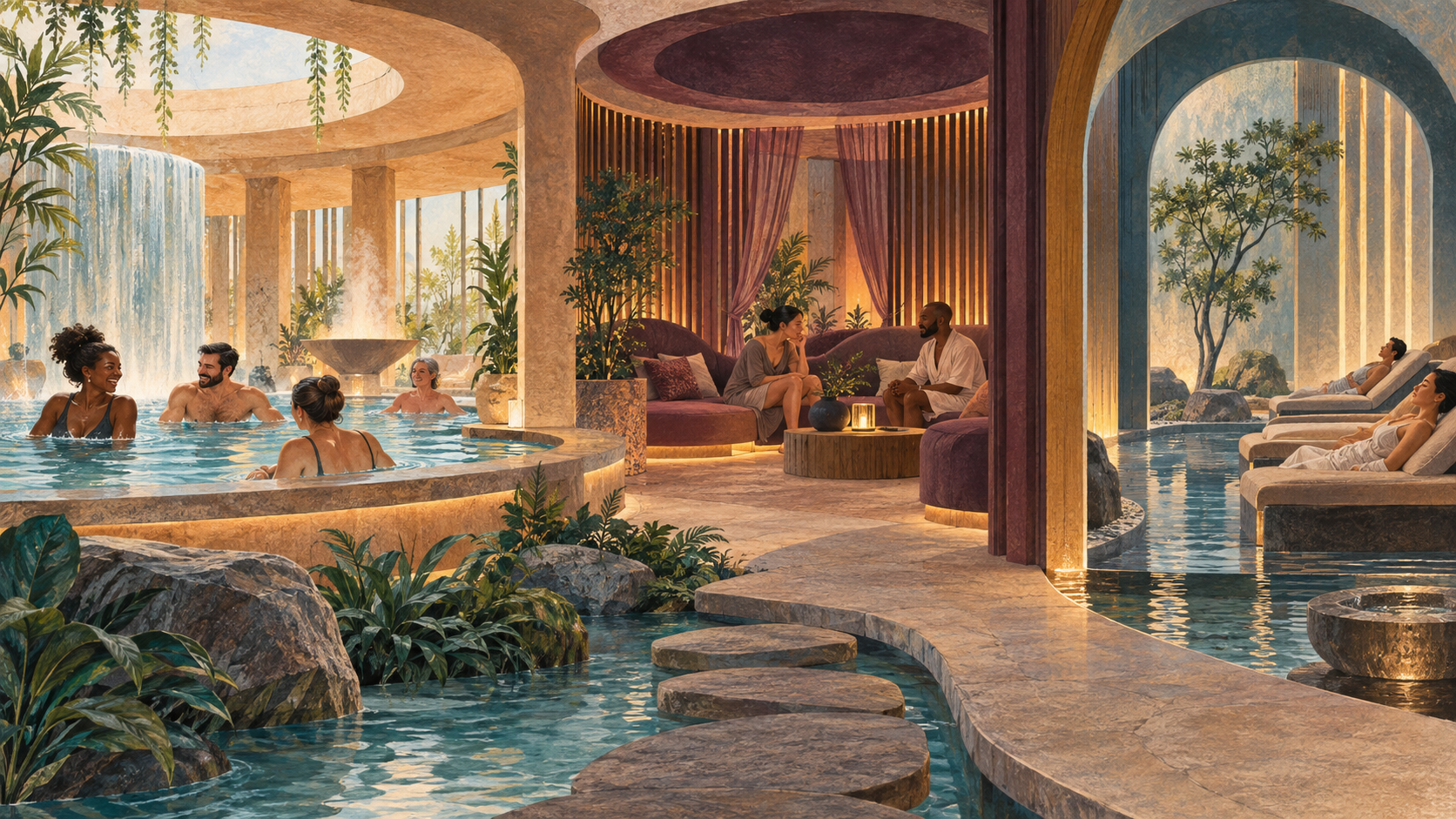
A current Calgary project makes that operating question timely. A 24 September Spa Business report describes a planned thermal spa organised around Social, Whisper and Silent spaces. The concept is useful because it treats conversation as part of the guest journey rather than one rule for an entire building. It is still a plan, not evidence that the zones are open, acoustically separated, accessible, consistently supervised or effective.
What the current Calgary sources establish
The official Forum Thermal site says the venue is intended to open in late 2026 in central Calgary and describes more than 18,000 square feet of indoor and outdoor space. Its amenities are presented across social, whisper and silent categories. The operator describes a self-directed thermal experience in which guests can move among heat, cold and rest rather than follow a mandatory sequence.
The venue's current FAQ says the areas will be marked. Conversation is planned to be welcome at a respectful volume in social zones, kept to a whisper in whisper zones and excluded from silent zones. It also states that personal devices will not be allowed within spa areas and describes timed access, capacity limits, guided rituals and staff intervention when one guest's volume affects others.
Spa Business adds planned facility detail: six pools, three saunas, two steamrooms and five treatment rooms, including a larger sauna intended for group rituals and a separate soundproof room. Those details come from the project and trade reporting. They do not establish a completed building, an operating permit, final acoustic performance, safe capacity, guest satisfaction or an award result. Pricing, partners and programme details may also change before opening.
Define behaviour before specifying sound
“Social”, “whisper” and “silent” are service promises, not measurable instructions on their own. Write an operating definition for each. A social zone might allow conversation among nearby companions without shouting across a pool. A whisper zone might allow brief low-voice conversation while protecting neighbouring rest. A silent zone might exclude conversation, calls and amplified audio while retaining necessary staff and emergency communication.
Describe exceptions before they become conflicts. A guest may need to communicate with a support person, interpreter or service provider. Staff must be able to give safety instructions. Someone may need urgent help. A guided ritual may temporarily change the normal sound condition. The rule should protect the zone's purpose without punishing disability-related communication or asking staff to choose between calm and safety.
Use plain examples at booking, arrival and each transition. Tell guests whether laughter, group conversation, whispering, meditation audio, live music and staff-led rituals are expected in that space. Avoid moral language such as “good guests stay quiet”. The aim is predictable choice, not a hierarchy in which sociability is treated as careless and silence as superior.
Commission acoustics, not just signage
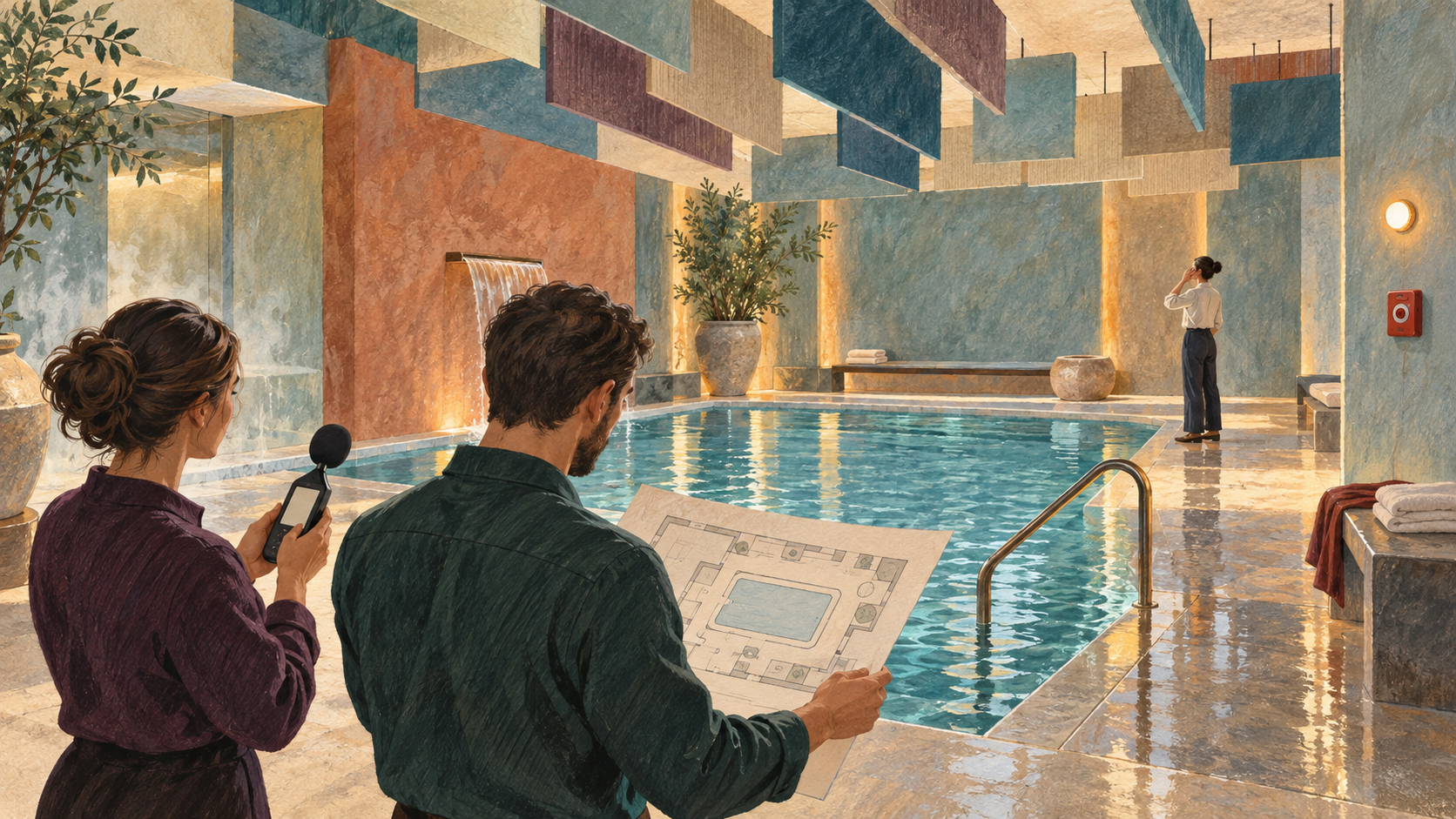
Wet environments amplify the gap between intention and experience. Water, tile, glass and stone reflect sound; pumps and ventilation add a continuous background; voices rise when speech becomes harder to understand. A silent room beside a lively pool can fail even when every sign is correct. Acoustic separation, reverberation control, doors, seals, equipment noise and circulation paths therefore belong in the same commissioning file as the zone names.
The 2024 annex to the US Model Aquatic Health Code discusses noise and reverberation in indoor aquatic facilities. It explains why excessive reflected sound can interfere with staff communication and public-address intelligibility, and why absorbent materials address reflected sound rather than all sound generated by patrons. The MAHC is US guidance, not Alberta law or proof that one design complies. Its value here is the commissioning logic: measure the real room, test communication and distinguish architectural control from behavioural control.
Test each zone empty, at expected normal occupancy and under a demanding but plausible programme. Include pumps, water features, HVAC, doors, background audio and any group ritual. Measure at boundaries as well as at the centre. Confirm that emergency messages and direct staff instructions remain intelligible. Record the test method, occupancy, equipment state, locations, results, corrective work and sign-off owner. A single handover reading cannot represent every operating condition.
Make the transition legible to more than one sense
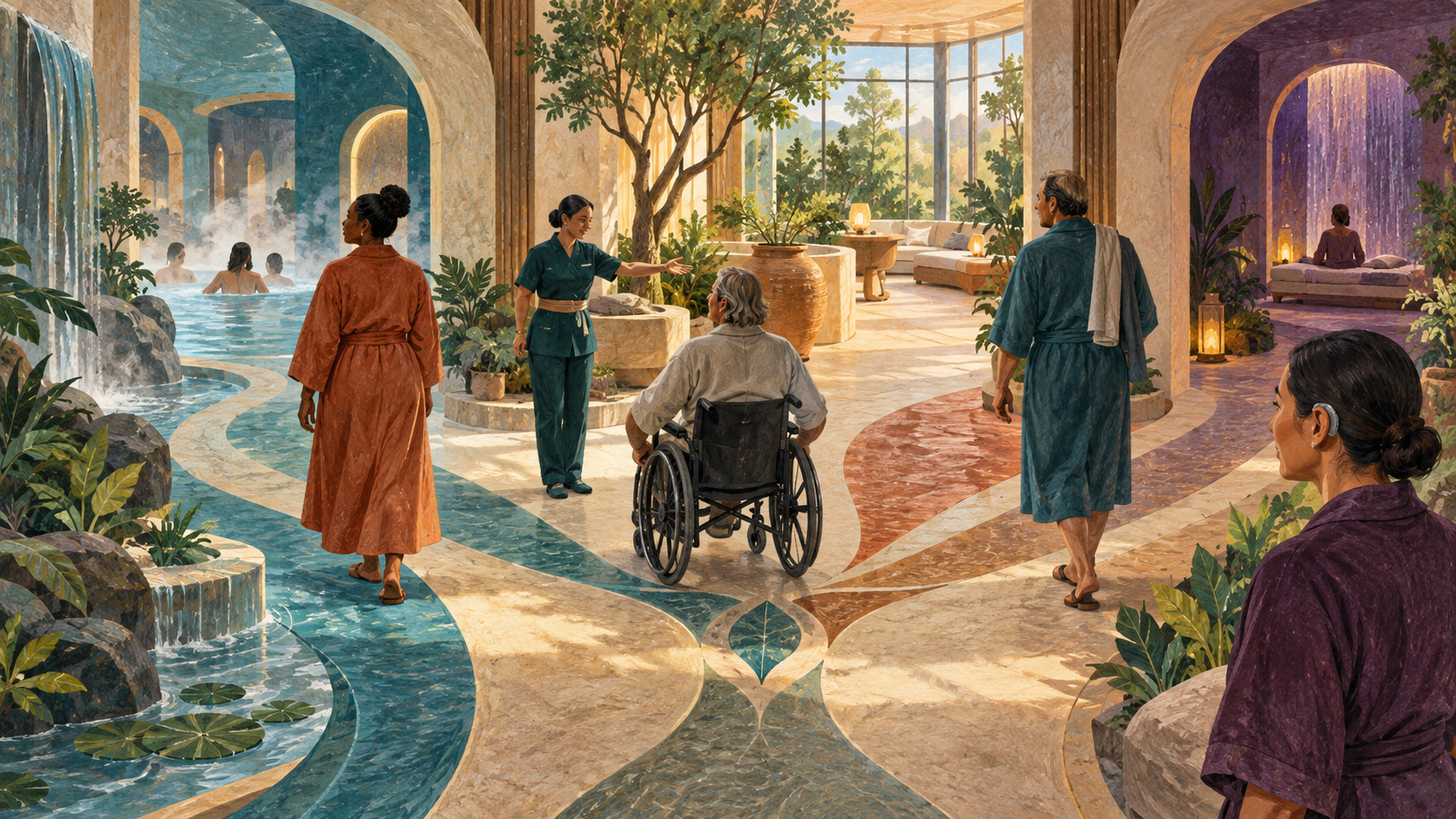
A guest should understand that the sound condition is changing before crossing the boundary. Colour alone is insufficient, and text alone may be hard to read in steam, low light or without glasses. Combine concise language with consistent symbols, contrast, lighting, material changes and staff explanation. Keep mandatory safety signs visually distinct from experience guidance.
Accessibility Standards Canada's 2026 draft wayfinding standard describes multi-sensory navigation using visual, tactile and auditory cues. It remains a draft and is not evidence of compliance at this project. It nevertheless offers a useful review question: can a guest locate, understand and leave a zone when one sensory channel is unavailable or the environment is busy?
Test the journey with people who use mobility aids, hearing devices, sign language, lip reading or cognitive supports, and with people who are sensitive to noise, glare, scent or crowding. Do not assume that a silent zone is automatically accessible. Low lighting may obstruct communication, a heavy acoustic door may block access, soft flooring may impede wheels and an audible cue may be lost under water noise. Document limitations honestly and provide an assistance route that does not require public disclosure of a condition.
Protect the right to change direction
A self-directed circuit needs genuine alternatives. Guests should be able to leave a loud ritual, bypass a cold plunge, find a quieter rest point or rejoin companions without crossing a bottleneck. A zone map is not choice if every route funnels through the same crowded chamber or if moving away means abandoning the rest of a paid experience.
Review transitions for sightlines, slip risk, temperature change, queue spill, robe and towel storage, drinking water, seating and staff visibility. A conversation boundary may need a small buffer rather than an abrupt line. If doors create acoustic separation, check that they do not hide distress or undermine supervision. If an outdoor zone changes with weather, define how the remaining indoor spaces absorb demand.
The Government of Alberta's health standards and guidelines page links current pool standards and operator resources. Those requirements govern public-health and safety matters; they do not certify a conversation-zone concept. Operators need the applicable local approvals and inspections in addition to their experience design. A successful acoustic idea never substitutes for water quality, safe circulation, emergency readiness or competent supervision.
Capacity and programming change the soundscape
Capacity is not only a revenue or water-treatment number. It determines how much conversation, movement and queueing a zone must absorb. Set a design capacity, an operating capacity and a programme-specific capacity. A social pool during general access, a large guided sauna ritual and a silent rest chamber require different controls even when their floor area is similar.
Model simultaneous events. A live performance may leak into silent space. A busy changeover can turn a whisper corridor into a meeting point. A DJ session can alter staff communication and neighbouring residential noise. Closing an outdoor terrace may push social guests into quieter rooms. Record these dependencies in the programme calendar and give the duty manager authority to reduce admissions, relocate an activity or pause amplified sound.
Do not use guest complaints as the first measuring device. Establish scheduled observations by time, programme and occupancy. Track whether zones remain available, whether people can find an alternative, how often staff intervene, where conversations migrate and whether safety communication is clear. The objective is not zero sound; it is delivery of the stated choice without losing safety or dignity.
Train staff for consistent, respectful intervention
Guests experience the policy through people. Write a short intervention sequence: observe the effect, approach discreetly, name the zone and available alternative, allow time to respond, and escalate only when disruption continues or safety requires it. Provide wording for a group, a support person, a guest who did not perceive the sign and a guest who needs an accommodation.
Avoid subjective enforcement. Accent, age, disability, group size or familiarity with spa etiquette must not become a proxy for “too loud”. Staff should respond to the effect in the defined zone, using the same steps for everyone. Supervisors need a route for accommodation decisions and complaints that does not force front-line staff to debate private health information.
Rehearse the difficult combinations: a safety announcement in a silent room, a distressed guest during a ritual, a group that separates across zones, a hearing-aid user who cannot understand a whisper, a door left open and sound from an event arriving in a rest area. Record what changed after rehearsal. Training is evidence only when it is current, role-specific and reflected in practice.
Measure service delivery before making wellness claims
Conversation choice can be evaluated without claiming a health outcome. Useful service measures include zone availability, wayfinding comprehension, perceived ability to choose, relocation requests, intervention frequency, repeat disruption, staff response time, equipment noise, emergency-message intelligibility and complaints resolved. Review results by programme and occupancy so an average does not hide a failing peak period.
The WHO environmental-noise guidelines explain that unwanted noise is a health and wellbeing concern across several sources. They do not supply a universal decibel target for a thermal spa's social, whisper and silent rooms. Operators should resist converting broad public-health guidance into a precise promotional promise. Local requirements, acoustic expertise, the specific room and the intended activity must shape the test.
Do not infer relaxation, stress reduction, sleep improvement or social connection from a zone label or satisfaction score. Those are separate claims requiring suitable evidence. Report what the service delivered: guests could identify the zones, change route, hear safety information and obtain staff support under the tested conditions. That narrower evidence is more useful than an unsupported promise of renewal.
What does this mean for spa and wellness professionals?
For owners, designers and operators
Translate every conversation-zone name into a joint brief for architecture, acoustics, accessibility, safety, programming and service. Approve the boundary, test condition, capacity, exception and accountable owner before marketing. The Journal's guide to commissioning heat, cold and flow provides an adjacent framework for treating a thermal circuit as a controlled system rather than a list of amenities.
For guest-experience and front-line teams
Explain choice before enforcement. Give guests a map, clear examples and a dignified route to move or ask for help. Review the approach alongside guidance on designing safety, calm and choice together, while keeping each venue's audience, age rules and risk assessment distinct.
For editors and awards researchers
Ask whether the venue is planned, commissioned or operating; then request evidence at the relevant stage. Active Canadian directory records such as Nordik Spa-Nature and Scandinave Spa Whistler are separate discovery references for thermal-spa readers. Directory presence does not connect either venue to Forum Thermal, verify the Calgary concept, indicate nomination or prove an award result.
A 30-day conversation-zone commissioning review
Days 1–7: define the promise
List every public and internal description of each zone. Agree the permitted behaviour, exceptions, transition, capacity and available alternative. Remove language that promises an emotional or health result.
Days 8–15: test the room and route
Measure background sound, reverberation, transfer and communication with all equipment running. Walk every boundary using visual, tactile and staff-supported information. Include realistic occupancy and accessibility scenarios.
Days 16–23: rehearse operations
Run general access, a busy changeover, a guided ritual and an emergency message. Practise respectful intervention, accommodation and relocation. Log defects by location and owner rather than blaming guests.
Days 24–30: approve and monitor
Close critical defects, set operating limits and publish only verified conditions. Establish observations by time and programme, a complaint-review cadence and a trigger for acoustic or accessibility reassessment after any material change.
What remains unproven
The reviewed sources establish an announced Calgary project, a late-2026 target, a planned mix of thermal amenities and a stated Social, Whisper and Silent model. They do not establish that the venue has opened, received every approval, completed acoustic or accessibility commissioning, operated at the described capacity, delivered the proposed programmes or produced a guest outcome.
This article has not inspected Forum Thermal, reviewed drawings, measured sound, audited staff practice or assessed Alberta compliance. It does not evaluate the two directory venues and makes no nomination or award claim. Its defensible conclusion is operational: conversation zones become credible when guests can understand them, choose among them, leave them, hear necessary safety information and obtain consistent support under real operating conditions.

