
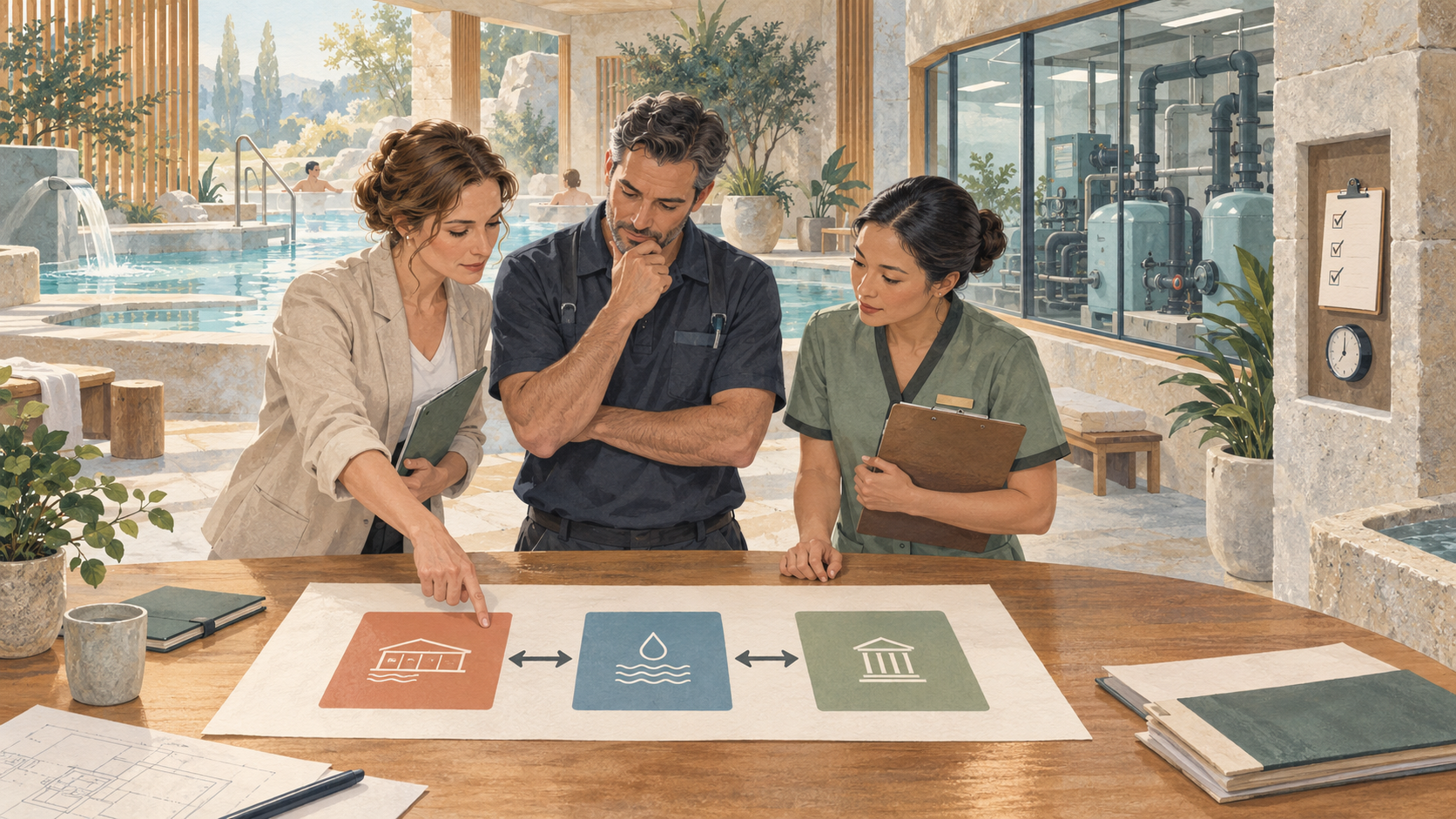
Public spa operations standards depend on more than a test result. They depend on a controlled chain connecting the facility, the current operating standard, the water-quality reference, local legal requirements, trained people and a documented decision to remain open or close. When one link changes, an old procedure can look complete while pointing to the wrong technical source.
That is the practical significance of the 2026 revision to ANSI/PHTA/ICC-2, the American National Standard for Public Pool and Spa Operations and Maintenance. The revision does not announce that every public spa in every country must follow one new set of values. Instead, it removes specific recreational-water values from the operations standard and directs users to the separate ANSI/PHTA/ICC-11 water-quality standard. For operators, the immediate task is change control: identify which document now owns each requirement, determine what the local authority has adopted, and update the live operating system without creating a gap.
This article uses the revision as an international case study, not as universal legal advice. A voluntary standard, a model code, government guidance and an enforceable local rule are different evidence states. Spa professionals need to know which one applies, which one informs good practice and who can prove that staff are working from the correct version.
What the 2026 public spa operations standards establish
The Pool & Hot Tub Alliance announcement says ANSI/PHTA/ICC-2 2026 was published following approval through the American National Standards Institute process. PHTA describes it as recommended minimum guidance for operations and maintenance across public pools, spas and other aquatic venues, covering water vessels, mechanical systems, chemical-treatment systems, decks and ancillary spaces.
The important revision is deliberately narrow. The current PHTA-2 information page says specific recreational-water-quality values were removed to avoid duplication. The standard now references ANSI/PHTA/ICC-11 as the authoritative source for those technical values. PHTA presents this as a coordination improvement across its standards, not as evidence that any venue is compliant or that the standard has automatically become law.
The International Code Council’s report confirms the same reference change and says PHTA-2 2026 has been accepted into the 2027 International Swimming Pool and Spa Code. “Accepted into” a model code is still not the same as enacted in a jurisdiction. Local adoption, amendments, effective dates, licence conditions and health-department directions remain matters to verify with the authority having jurisdiction.
Public spa operations need a visible reference chain
A standard can contain a requirement directly, incorporate another document by reference or point to supporting guidance. Those routes create different update risks. If an operating procedure copies a numeric water value from an older edition of PHTA-2, the procedure may become stale even though the document header still says “pool operations”. If it simply says “follow the current standard”, staff may not know which standard, edition or local amendment controls the decision.
Build the chain explicitly. Start with the legal or contractual requirement that applies to the site. Record the adopted code, regulation, permit condition, licence, inspector direction or corporate requirement. Then record the external standard it cites, every referenced document needed to use that standard, and the internal procedure that translates it into work. Finish with evidence: training, checks, calibrations, inspection records, deviations, closure decisions and reopening authorisation.
Each link should show a title, edition, publication date, effective date where known, source URL or controlled copy, owner and next review trigger. If the source is paid or access-controlled, record who is licensed to consult it and how an operator on duty obtains the approved requirement. A screenshot, search snippet or supplier summary is not a controlled technical source.
Separate authority from usefulness
Use a simple hierarchy in the standards register: legally adopted requirement; permit or authority condition; recognised consensus standard; government or public-health guidance; manufacturer instruction; and internal operating rule. The order is not a universal legal ranking, because jurisdictions differ. It is a prompt to identify authority rather than treating every PDF as interchangeable.
A model code still requires jurisdictional adoption before it can be treated as an applicable local rule. The World Health Organization’s recreational-water resources likewise maintain international guidance for swimming pools and spas. Such material can inform professional review, but it does not erase current local duties. Verify the jurisdiction first, then use external guidance to test whether the local control system is complete.
Map PHTA-2 to PHTA-11 before changing a procedure
The PHTA-11 page identifies ANSI/PHTA/ICC-11 2026 as the current water-quality standard for public pools and hot tubs or spas. It says the document provides recommended minimum specifications for water-quality parameters and separates the acceptable values from the technologies used to achieve them. That distinction matters: a target value, a treatment method and proof of stable control are not the same thing.
Do not respond to the reference change by replacing one number in a laminated checklist. First create a clause map. For every PHTA-2 process that depends on water quality, record the corresponding PHTA-11 source, the local requirement and the internal action. Include routine testing, instruments, calibration, sampling points, record frequency, response thresholds, authority notifications, closure, corrective treatment, verification and reopening. Mark any element that the available summary cannot establish and obtain the licensed standard or competent advice before changing practice.
Then compare scope. Confirm that the venue, vessel and use are covered. A hotel hydrotherapy pool, public hot tub, treatment-only water installation and natural thermal pool may not sit in the same regulatory category. “Spa” in a business name does not prove that an aquatic standard applies, while an aquatic vessel inside a hotel may be regulated even when access is restricted or no separate fee is charged.
Turn the reference change into property controls
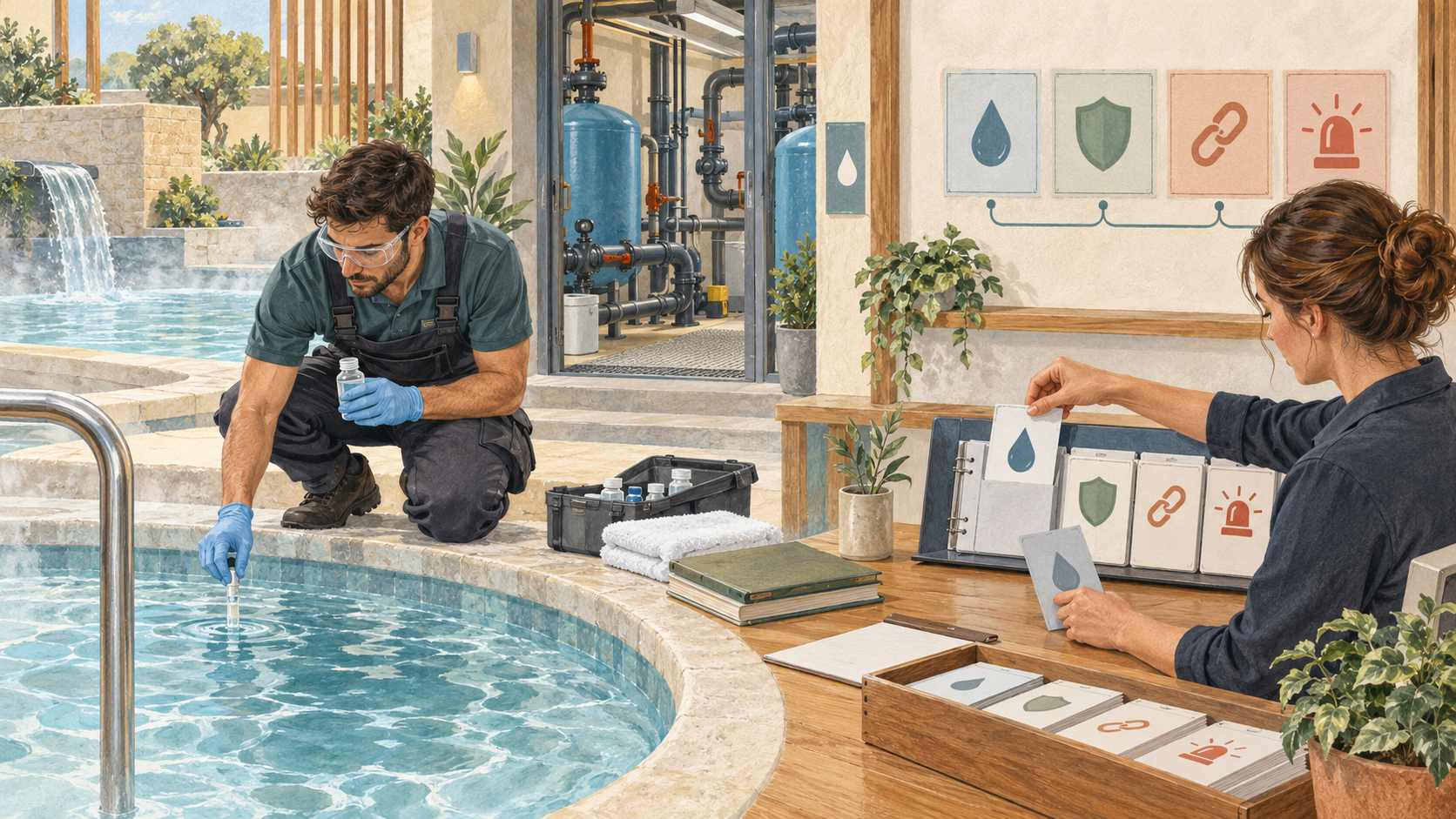
Standards management belongs in operations, not only in compliance. Give one accountable person authority to coordinate the update, but assign each control to the team that performs it. Engineering may own plant condition and calibration. Aquatic operations may own sampling and bather-area checks. Housekeeping may own hygiene tasks. Duty management may own closure and guest communication. Procurement may control chemicals, instruments and service providers. Senior management must ensure that decisions, resources and escalation routes agree.
For each affected procedure, record four states: reviewed with no change required; revised and approved; training pending; or implemented and verified. Do not label the project complete when a document is uploaded. Completion means the right people can find the current instruction, use it during a real shift and produce the required evidence.
Control temporary copies. Remove obsolete wall charts, bookmarked PDFs, shared-drive duplicates and contractor handouts, or mark them clearly as superseded. Preserve archived versions for traceability without leaving them available as live instructions. Where an automated water-management system contains thresholds or alerts, treat configuration as part of the controlled change and independently verify the settings.
Keep water records connected to the operating decision
A log is useful only if its result leads to an action. Record who performed the check, the instrument or method, time, location, result, expected range, immediate response, escalation and final status. Make corrections traceable rather than overwriting the original observation. If a value is out of range or an instrument is suspect, the procedure should tell the operator whether to retest, restrict access, close the vessel, call a competent person or notify an authority.
The UK Health and Safety Executive’s spa-pool guidance is jurisdiction-specific, but it illustrates the breadth of a working control system: design, commissioning, operation, maintenance, testing, water-quality monitoring and inspection frequency sit together. It also highlights why spa-pool systems need active infection-risk management. Operators elsewhere must apply their own law and current technical requirements, but they should still ask whether their records connect the whole system rather than collecting isolated measurements.
Shift handovers need the same clarity. The incoming responsible person should see vessel status, last checks, outstanding maintenance, temporary controls, contractor activity, incidents, unusual bather load and any authority communication. A green status should mean that every required condition is current, not merely that the water looks clear.
Rehearse closure and reopening before the exception
A revised standard should trigger a tabletop exercise. Give the team a plausible scenario: a result outside the approved range, a failed dosing component, an unreadable instrument, a missed check or a complaint suggesting a water-quality issue. Ask who stops admission, how the vessel is isolated, who verifies the technical response, what is recorded, when the authority or specialist is contacted and what evidence is required before reopening.
Reopening needs an authorised decision, not the end of a timer. Define the required corrective work, stable results, equipment condition, cleaning or treatment record, independent verification where applicable, guest-area inspection and named approval. If local rules require a particular test, interval or authority clearance, that requirement controls. Do not improvise a universal reopening formula from this article.
Communication is part of control. Staff need an accurate message that states what is closed, what remains available, what happens to bookings and who answers technical questions. Avoid health assurances that go beyond the evidence. A directory listing, inspection appointment, supplier visit or completed checklist does not prove that a vessel is safe to reopen.

What does this mean for spa and wellness professionals?
For owners, the revision is a reminder to fund access to current technical sources, competent review, training and verification. For spa directors, it is a prompt to know exactly which aquatic controls sit inside their responsibility and which require engineering, public-health or specialist authority. For technicians, it means every target and response rule should point to a controlled source. For commercial teams, it means availability claims must change immediately when an operating decision closes a vessel.
The approach extends the Journal’s guidance on commissioning a spa’s return to service after maintenance and commissioning heat, cold and flow in contrast therapy. Those articles address planned shutdowns and connected thermal experiences. This one addresses the reference system that tells a public aquatic venue which operating rule, water-quality source and local authority decision govern today’s work.
Readers can explore directory records such as Thermae Bath Spa and Sky Lagoon in Reykjavík. These are discovery links only. Directory presence does not establish which standard applies, local adoption, current water quality, inspection status, compliance, certification, nomination or an award result. Confirm live access and operating information directly with the venue and relevant authority.
A 30-day public spa standards review
In week one, identify every aquatic vessel, authority, permit, adopted rule, consensus standard and referenced document. In week two, map PHTA-2 or the relevant operating source to water quality, maintenance, inspection, training, closure and reopening procedures. In week three, approve necessary changes, withdraw obsolete copies, update system settings and train every affected role. In week four, observe live checks, run a closure-and-reopening exercise, correct gaps and record the next review trigger.
The final evidence file should contain the applicability decision, standards register, licensed-source access, clause map, gap assessment, approved procedures, removed-copy record, configuration verification, training evidence, exercise results, unresolved actions and sign-off. Keep the standard’s publication, model-code acceptance and local legal adoption as separate dates.
What remains unproven
The publication of ANSI/PHTA/ICC-2 2026 does not prove that a jurisdiction has adopted it, that an individual facility complies, or that following it alone satisfies every legal duty. The public summaries do not replace the complete licensed standards. Acceptance into the 2027 model code does not establish a local effective date. The cited US, UK and WHO materials have different scopes and legal status.
The defensible conclusion is operational: public spa water management needs a visible reference chain. When a standard moves technical values into a separate source, operators should verify applicability, control editions, update procedures, train staff, test decisions and preserve evidence. That is how a document change becomes a safer and more accountable operating system—without inventing compliance, health outcomes or recognition.
