
Hotel Pilates needs a service boundary
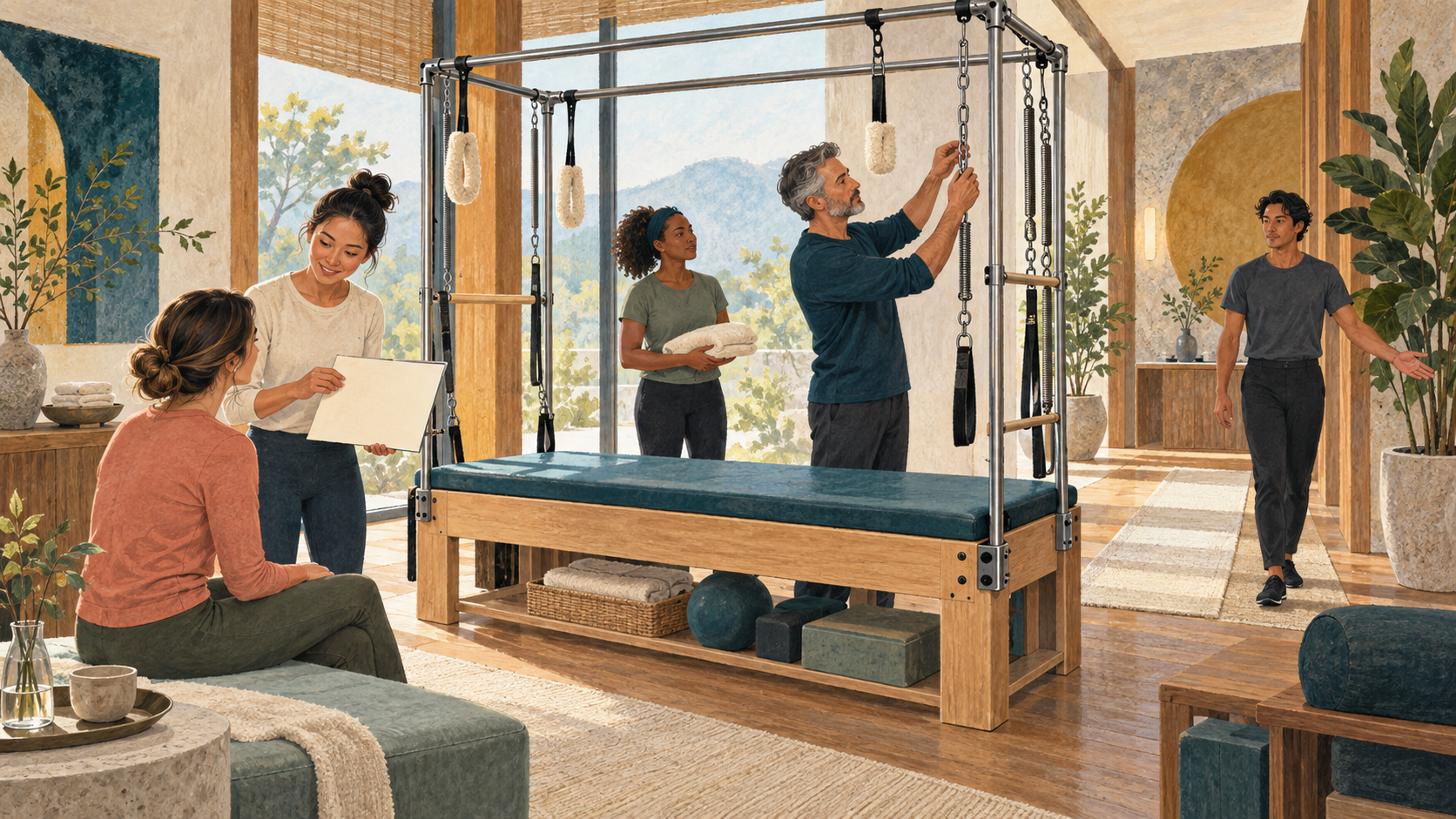
Hotel Pilates can look like a simple extension of the fitness room: add a specialist apparatus, offer private instruction and let guests choose a package. The operating reality is more demanding. A Cadillac-style unit uses springs, bars, straps and elevated attachment points. The instructor may assess posture, change resistance and document progress. Marketing may also move from exercise language into pregnancy support, postnatal recovery, body sculpting or injury rehabilitation. Each step changes what the guest is being promised and what the operator must control.
A current hotel announcement makes that boundary worth examining. On 15 September 2026, Kempinski Hotel Fuzhou announced private Cadillac Pilates sessions at its health club. The operator describes 90-minute, one-to-one or one-to-two sessions, postural assessments, targeted exercises and photography to record progress. The same release presents separate wellness and recovery programmes covering areas such as pregnancy, postnatal recovery and sports injury rehabilitation.
Those statements establish what the operator says it offers. They do not by themselves establish the qualifications behind every activity, a clinical result, universal suitability, equipment condition, local professional scope or an outcome from any package. This article uses the announcement as a bounded international prompt: before a hotel sells Pilates alongside rehabilitation language, it should define the service, the competent provider, the apparatus controls and the evidence behind each claim.
What the current source establishes
The dated Kempinski release identifies the location, session length, private formats and broad programme descriptions. It names a team lead and lists experience across several movement disciplines. It also refers to assessments, corrective exercise, exercise and nutritional plans, progress photography, and packages ranging from 10 to 100 sessions. These are issuer-supplied descriptions of a commercial offer, not an independent assessment of delivery or results.
The release does not publish the exact apparatus model or manufacturer manual, inspection record, instructor-to-service competency matrix, referral criteria, contraindication process, image-retention policy, incident data or outcome dataset. It does not explain which services are exercise, which are therapeutic Pilates, and which are delivered under a regulated health profession. Silence does not prove that these controls are absent. It means a reader cannot verify them from the announcement.
That distinction matters for every hotel operator. A premium room, private format or long package may improve continuity, but none proves competence or efficacy. The first governance task is therefore to separate the visible experience from the evidence needed to support it.
Define four service states before sale
Write a service-state register before naming packages. The first state is general exercise: movement instruction for a guest who fits the programme’s documented suitability criteria. The second is condition-aware exercise: modifications based on disclosed needs or advice from an appropriate professional, without diagnosing or treating. The third is therapeutic Pilates, where the provider’s qualifications, assessment, records and ongoing adaptation support a more complex purpose. The fourth is regulated care, which may include diagnosis or rehabilitation within a licensed profession and local legal scope.
The labels cannot be chosen for marketing effect. The Pilates Association Australia’s practitioner scope document offers one professional model, not a global law. It links Pilates scope to qualifications, education, experience and competency; calls for readiness screening, supervision and referral; and adds assessment and record requirements when a service is considered therapeutic. It also distinguishes lower-risk clients from more complex conditions that require further study and relevant experience.
A hotel should map each public phrase to one of these states and then verify what local law, insurer conditions and professional standards require. “Private Pilates instruction” and “sports injury rehabilitation” are not interchangeable descriptions. If the operator cannot name who holds the relevant decision authority, the higher-scope phrase should not be sold.

Verify competence against the exact promise
A biography is not a competency matrix. Build one row for every service and one column for the decisions required: screening, apparatus set-up, movement assessment, programming, pregnancy or postpartum modification, post-injury work, nutrition discussion, emergency response, referral and recordkeeping. Record the qualification, supervised education, recent practice, insurance and local authority that supports each decision.
Generic experience in yoga, mat Pilates or personal training does not automatically establish competence on every Cadillac configuration. Equally, competence to teach a lower-risk exercise session does not establish authority to diagnose pain, prescribe rehabilitation or advise on a complex pregnancy. The matrix should show where another professional’s recommendation is needed and who can accept, reject or modify it.
Test the matrix with scenarios rather than certificates alone. Can the instructor explain what changes when a guest reports a recent injury? Can they decline a requested movement that falls outside the programme? Can reception describe the service without upgrading “support” into “treatment”? Can a substitute instructor see which package elements they are authorised to deliver? A safe system makes these answers visible before a booking.
Commission the apparatus as a controlled system
A Cadillac is not furniture. Springs store energy; clips and eyelets bear load; straps and stitching wear; a push-through bar can move quickly; and accessories create trip or strike hazards when poorly stored. The operator needs the exact manufacturer instructions for the installed model, because a general Pilates checklist cannot resolve model-specific assembly, loading or maintenance questions.
As a practical example, the Balanced Body Contrology Cadillac manual and safety guidance calls for regular apparatus inspection, resetting and cleaning after use, checks of springs, clips, straps, attachment points and safety chains, and control of the push-through bar during sessions. It is primary guidance for that manufacturer’s equipment, not a universal certificate for another product.
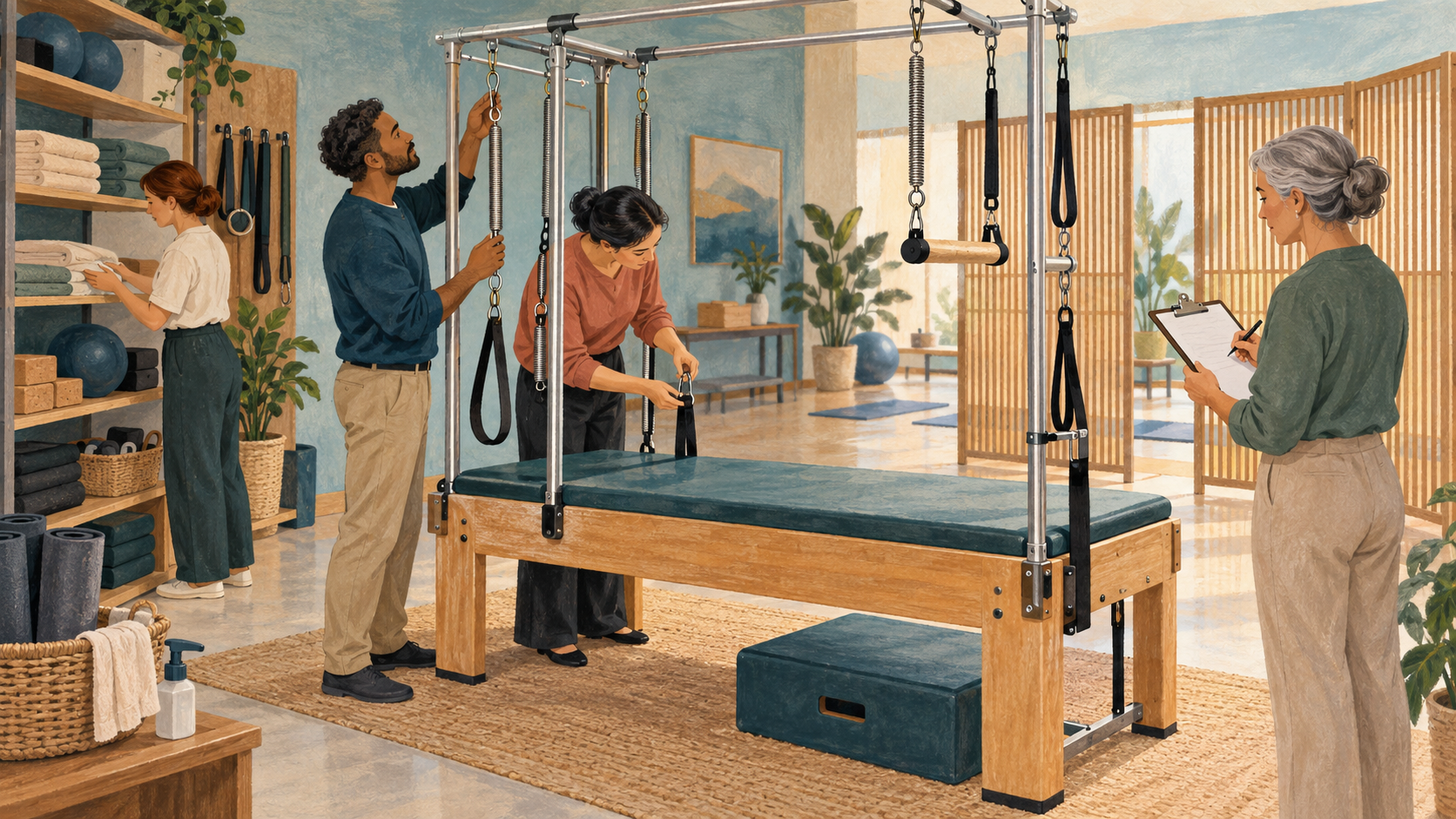
Create four records: installation and acceptance; pre-opening visual checks; scheduled preventive maintenance; and fault isolation with return-to-service approval. Give every component a clear identifier. An instructor must be able to remove the unit from service immediately if a spring, clip, strap, fastener or safety device is uncertain. Commercial pressure must not convert “not yet checked” into “probably fine”.
Control the room as well as the apparatus. Preserve access around the frame, keep unused springs and accessories secured, prevent unsupervised guest access and define privacy without blocking observation or emergency help. Cleaning products must follow the manufacturer’s material instructions. After any unusual load, impact or incident, inspect the affected system before the next session.
Make assessment produce a decision, not a diagnosis
A postural or movement assessment should answer a defined operational question: proceed under the programme, modify within scope, pause for more information, refer, or decline. It should not become an open-ended search for defects. Name each observation method, its limitations and the decision it can support. Avoid turning ordinary variation in posture into a condition that conveniently requires a large package.
The guest should understand what is being observed, why it matters, who will see the record and whether participation is optional. If photographs are proposed, obtain a separate, specific choice. Define framing, device, storage, access, retention and deletion. Progress images are not proof of pain relief, rehabilitation, fat loss or structural correction, and they should not migrate into marketing or general guest profiles.
Reassess only at useful decision points. A repeated measure can show that a planned task changed under the same method; it does not automatically show why. The record should distinguish guest-reported experience, instructor observation, completed exercises and any externally supplied clinical advice. That separation protects both continuity and claim accuracy.
Pregnancy and postpartum offers need their own route
Pregnancy and postpartum services should not be ordinary sessions with softer springs. Define the intended population, exclusions, current professional input, stage-specific modifications, stop signs and handover route. The provider must know which decisions remain exercise instruction and which require an obstetric, physiotherapy or other appropriately qualified assessment under local rules.
The American College of Obstetricians and Gynecologists’ exercise guidance says that physical activity is generally safe for healthy people with normal pregnancies, while advising discussion with an obstetric professional and listing precautions and warning signs for stopping. This is US clinical guidance for pregnancy, not clearance for a particular guest, hotel programme, instructor or apparatus sequence.
Use a consent conversation that preserves choice without demanding unnecessary medical history. Explain foreseeable sensations, positions, supports, supervision and the ability to stop. Record the minimum decision needed for safe continuity. “Pre-conception conditioning”, “pregnancy relief” and “full-cycle postnatal recovery” each convey different expectations; each needs its own scope, evidence and qualified review rather than one umbrella disclaimer.
Write stop, incident and referral rules together
Stop rules should cover the guest’s request, pain, dizziness, breathlessness, weakness, unexpected symptoms, loss of control, equipment noise or movement, a detached component, a supervision interruption and any information that places the session outside scope. Staff need authority to stop without seeking permission from sales or reception.
The response sequence should identify who secures the apparatus, who supports the guest, when emergency services are contacted, what is recorded and how privacy is protected. Preserve relevant equipment state after an incident rather than resetting it automatically. Do not resume the session or return the apparatus to use until the appropriate review is complete.
Referral is a decision boundary, not an endorsement network. Tell the guest what question needs qualified input, but do not imply a shared care relationship unless one genuinely exists and is authorised. A medical note may inform restrictions; it does not transfer the hotel’s duties for equipment, supervision, accurate marketing or staff competence.
Make claims match the complete service
Build a claim register for the menu, booking engine, press release, instructor script, package name, photographs, testimonials and partner content. For each statement, record whether it describes an observable feature, an intended experience, a performance outcome or a health result. Then retain evidence that matches the actual service, population, duration and conditions.
The US Federal Trade Commission’s health-products guidance is jurisdiction-specific but provides a useful discipline: objective health-related claims should be truthful, not misleading and adequately substantiated, including implied messages. Evidence for Pilates generally does not automatically validate a hotel’s exact apparatus sequence, instructor mix, package duration or rehabilitation claim.
Use restrained language where the service evidence supports only process. “Private supervised session” can be verified operationally. “Designed around stated movement goals” can be tied to a documented consultation. “Corrects posture”, “scientifically guided fat loss”, “treats injury” or “ensures recovery” asks for much more specific evidence and, potentially, a different professional and regulatory framework. A disclaimer at the bottom cannot repair a strong unsupported promise at the top.
What does this mean for spa and wellness professionals?
For hotel and spa directors, Pilates is a service system rather than an attractive apparatus. Procurement must connect the exact model to installation, maintenance and fault records. People teams must verify competence against each advertised decision. Guest-experience teams must make alternatives and stopping easy. Marketing must keep exercise, therapeutic purpose and regulated care in separate evidence states.
Two existing Journal guides extend the operating file. Connected Strength Equipment: A Commissioning Standard for Spas covers acceptance, maintenance, software and return-to-service controls for active equipment. Spa Qualification Checks: Verify Scope Before Hiring explains why a certificate, provider name and role title remain separate from current authority and observed competence. Neither article validates this hotel service.
Directory pages are discovery records only. Readers exploring other Kempinski spa contexts can browse Kempinski The Spa – Siam Kempinski Hotel and Kempinski Hotel Corvinus Budapest Spa. Their presence does not establish that they offer Cadillac Pilates, share the Fuzhou programme, have been inspected for this article, or hold any nomination or award result.
A 30-day hotel Pilates control review
Days 1–7: classify every promise
Inventory service names, assessments, apparatus, progress methods and public claims. Assign each activity to general exercise, condition-aware exercise, therapeutic Pilates or regulated care. Freeze any phrase whose provider authority or evidence cannot be named. Record local legal and insurer requirements.
Days 8–14: verify people and equipment
Build the competency matrix, inspect original qualifications and test scenario decisions. Match the installed apparatus to its manual, component inventory and maintenance schedule. Rehearse isolation, substitute staffing and a fault discovered immediately before a paid session.
Days 15–21: test the guest route
Walk booking, screening, explanation, consent, supervised use, stopping, incident response and referral. Test pregnancy and post-injury enquiries without making a diagnosis. Verify that photography is separately optional and that stored information cannot flow into marketing by default.
Days 22–30: align claims and reopen
Compare the verified operating file with every public channel and package script. Remove or qualify claims that outrun the evidence. Correct gaps, retest the complete route and approve return to sale only when people, apparatus, records and words describe the same service.
What remains unproven
The reviewed operator source establishes that Kempinski Hotel Fuzhou announced private Cadillac Pilates and related wellness and recovery programmes with stated formats and features. It does not establish clinical efficacy, staff authority for every advertised purpose, equipment condition, pregnancy suitability for an individual, rehabilitation outcomes, data governance, incident performance or the results of a long package.
The Pilates Association Australia, manufacturer, ACOG and FTC materials provide professional, equipment, pregnancy and claims context within their own scopes. They do not inspect or endorse the named hotel. This article does not report a visit, test, nomination, winner, partnership or award. Its conclusion is procedural: hotel Pilates becomes more credible when the operator defines the service before the session, verifies competence against the promise, controls the exact apparatus and keeps every health claim within matched evidence.

