

Why fine bathing and dining needs an operating boundary
Fine bathing and dining is an arresting hospitality proposition: a guest may move between heat, cold, rest, food and conversation without treating the meal as an afterthought or the bathhouse as a short appointment. The appeal is easy to understand. The operating challenge is equally clear. A seamless guest experience can only be built from service states that remain individually controlled.
That distinction matters because thermal facilities and restaurants do not share the same hazards, records, competence or stop rules. A single booking does not merge water treatment, food safety, allergen communication, wet-floor control, thermal supervision and guest choice into one discipline. It creates more handovers between them.
A current London announcement makes the question timely. It does not prove that the proposed experience is open, safe, commercially successful or suitable for any particular guest. It does offer spa leaders a useful design exercise: if bathing and dining become one extended journey, what evidence must travel with the guest, and what evidence must remain inside each specialist operating system?
What the Sonara announcement currently establishes
Sonara's current website describes the business as London's first Fine Bathing & Dining Club and invites visitors to register for opening, membership and reservation news. That language establishes a pre-opening proposition, not a completed service. The UK's official company register records Sonara Ltd as an active private company, incorporated in 2024. Company status is not evidence that a venue has opened or that any promised facility has been commissioned.
A Spa Business report published on 8 September 2026 says the planned Chelsea club will combine thermal bathing, treatments, dining and social time in a multi-hour format. It describes an intended sequence in which a dining table remains the guest's base between bathing cycles, while also making clear that the treatment offer was still being developed. Those are reported plans. They should not be converted into claims about actual menus, staffing, guest outcomes, opening performance or legal compliance.
The report places the proposed club at One Twenty King's Road. The architect's own project page confirms that One Twenty King's Road is a mixed-use development with workspace, retail and leisure space. It does not independently verify Sonara's fit-out, operating readiness or tenancy terms. Keeping those evidence levels separate is the first useful lesson: an active company, a completed host building and an announced hospitality concept are three different facts.
Fine bathing and dining needs one service map
Before designing packages or scripts, draw the whole visit as a sequence of observable states: arrival, changing, initial rest, heat, cooling, dry recovery, food order, meal, further rest, optional return to thermal facilities, treatment, changing and departure. Add every possible pause, refusal, delay and early exit. Then assign an accountable team to each state.
The map should not prescribe a universal cycle. It should show where the guest can choose, where staff need current information, where an area has its own capacity, and where a change in condition requires a different response. A restaurant server does not become a thermal supervisor because the guest is wearing a robe. A spa host does not become the authoritative source for recipe changes because the meal sits inside a wellness itinerary.
Use a small handover card for each transition. It can state the destination, responsible role, information that may be passed, information that must not be passed, and the conditions that stop the transfer. The card is an operating tool, not a medical questionnaire. Most transitions may need only a simple confirmation that the guest wishes to continue and that the destination is ready.
Make every return to heat an explicit decision
An extended experience differs from a fixed thermal circuit because the guest may eat, rest and socialise for an uncertain period before deciding whether to return. The earlier bathing cycle is therefore not a permanent clearance. The next entry is a new service state.
Write a visible return-to-heat rule before launch. It should identify who can pause admission, how live capacity is checked, how guests receive current instructions, where drinking water and seated rest are available, and how staff respond when someone chooses not to continue. It should also distinguish general hospitality guidance from individual medical advice. The operator can describe the service, access conditions and stop process without promising that a sequence will deliver detoxification, recovery, longevity or another health result.
Water systems keep their own controls throughout the day. The UK Health and Safety Executive's HSG282 spa-pool guidance covers design, commissioning, operation, maintenance, water-quality testing and inspection. Its relevance does not disappear when the commercial proposition is built around a meal. Likewise, the HSE says pool supervision and emergency arrangements must follow a site-specific risk assessment. A reservation duration or membership tier cannot substitute for that assessment.
Keep food safety independent and connected
The meal needs a complete food-safety system even when it is marketed as one stage of a bathing ritual. Current Food Standards Agency guidance says businesses must have food-safety management procedures based on HACCP principles, while also controlling suppliers, transport, traceability and staff training. Those records belong to the food operation. The spa team may need an agreed escalation route, but it should not duplicate or improvise the restaurant's control plan.
The integrated journey creates practical questions that a normal menu tasting will not answer. Can a dish be identified correctly when guests move between tables and relaxation spaces? How is a delayed plate controlled? Who knows when a recipe or garnish has changed? What happens when the thermal area reaches capacity while a guest's food is ready? Can waiting staff reach the table without crossing a wet route or carrying hot items near barefoot guests?
Rehearse these questions at realistic pace. A quiet staff preview can conceal the pressure created by simultaneous bathing cycles, table turns, cleaning tasks and private-group arrivals. Commission the journey with the planned staffing pattern and with ordinary failures introduced deliberately: a delayed table, a closed thermal room, a spilled drink, a changed ingredient, a missing towel and a guest who wants to leave early.
Allergen information must survive the whole journey
The UK government's current food-business guidance states that operators must provide accurate allergen information, update it when recipes or ingredients change, ensure staff know about those changes and serve the correct food to the correct customer. It also requires procedures to prevent allergen cross-contamination. The full requirements are set out in the official food-allergy guidance for businesses.
In a bathing-and-dining club, the table may be a base while the guest moves elsewhere. That makes identity and timing controls more important, not less. Use a restaurant-owned method that survives robe changes, seat changes, group bookings and interrupted courses without displaying sensitive information. Confirm the dish at service. Never infer dietary suitability from a wellness goal, treatment choice or membership profile.
Keep claims disciplined too. A menu can describe ingredients and culinary intent. It should not turn "light", "restorative" or "designed for the journey" into an unverified medical or performance promise. The same rule applies in reverse: a spa treatment should not be described as making a meal safe or compensating for an allergen, food-safety or hydration failure.
Design the wet-to-dry route as a service boundary
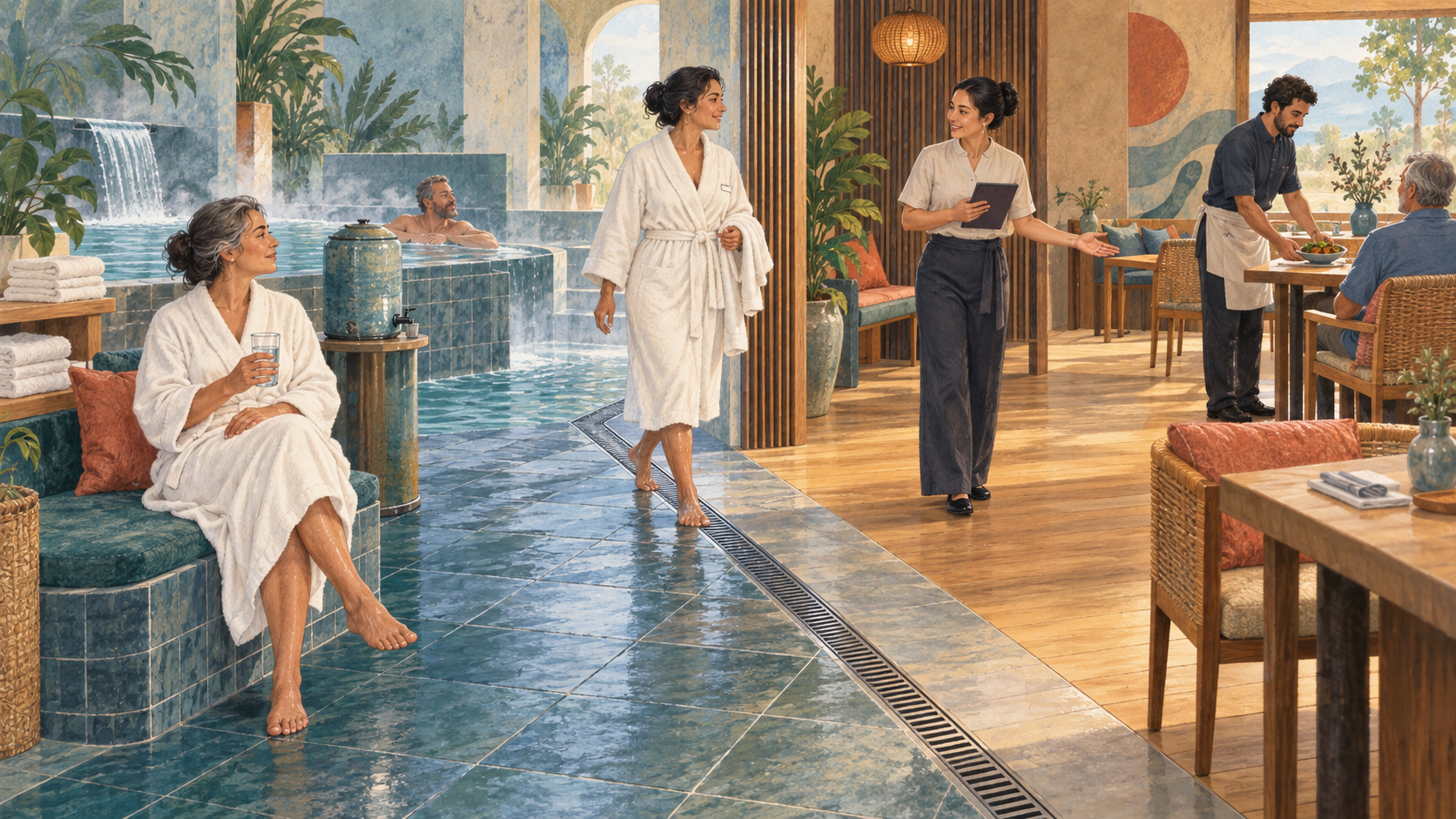
A beautiful threshold can still be an operational weak point. Bare feet, robes, carried glasses, hot plates, steam, cleaning schedules and changing light all meet where the wet and dry zones connect. The HSE's hospitality guidance notes that most slips happen on wet or dirty floors and directs operators to assess risks, prevent leaks and spillages, maintain surfaces and clean at the right time.
The useful response is not a warning sign placed after the design is complete. Map drainage, floor resistance, seating, towel return, visibility, lighting, server routes, waste collection and cleaning access together. Keep food preparation and carrying routes out of wet circulation wherever possible. Give staff a fast way to close or divert a route, and show guests an equally dignified alternative.
Accessibility belongs inside the same exercise. A level route is not enough if a guest cannot find a dry seat, use a handrail, understand where a robe is required, hear an instruction or leave one part of the experience without abandoning the whole booking. Test the journey with different mobility, sensory and communication needs, then record what remains unavailable. Inclusion is not proven by allowing entry; it is demonstrated through usable choices and recovery when a choice cannot be delivered.
Build one incident bridge, not one merged record
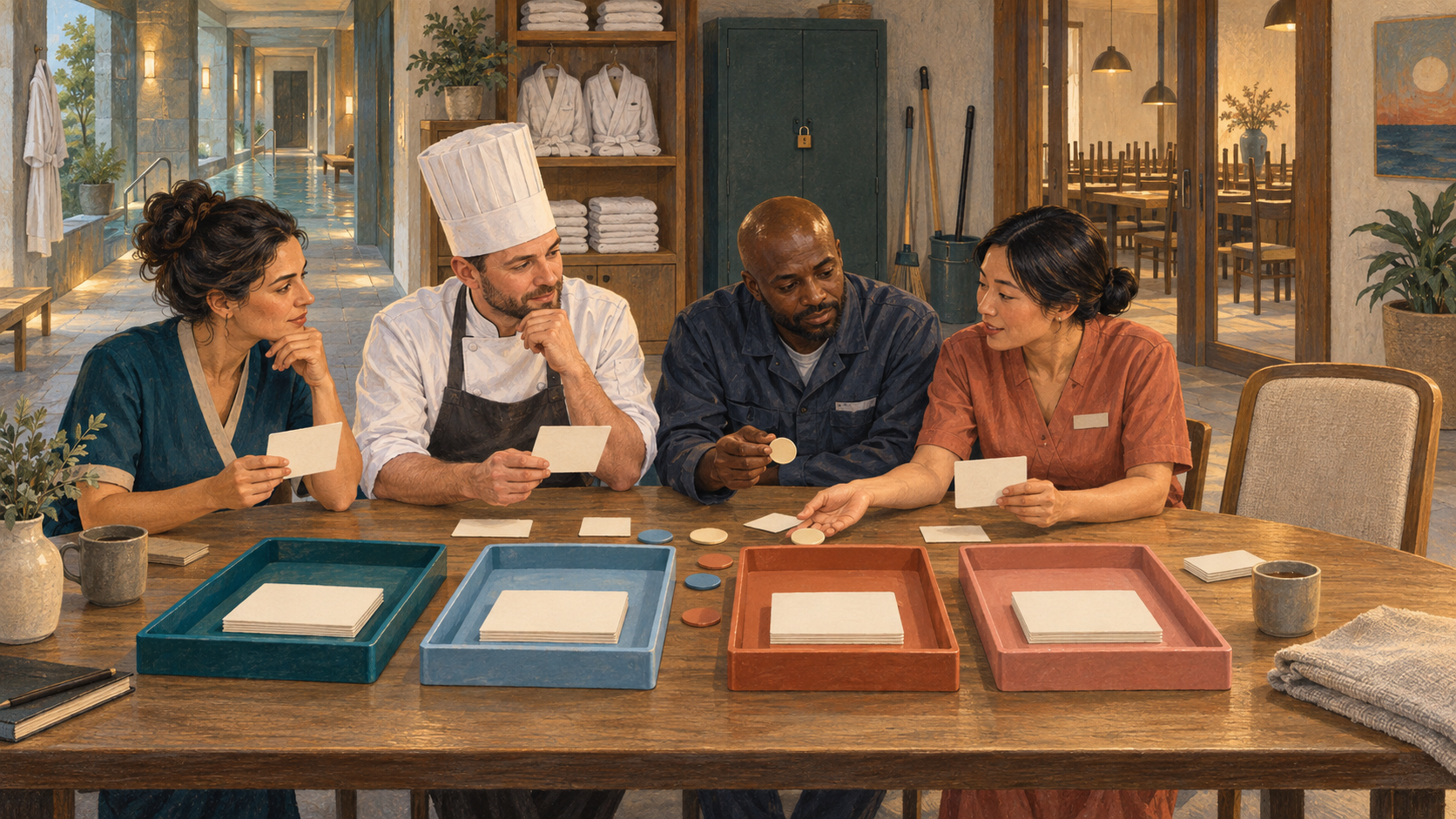
Thermal, food, facilities and front-of-house teams need separate operating records because they control different hazards. They also need one agreed incident bridge. Define the few events that trigger a cross-team review: a guest becomes unwell while moving between zones, a dish reaches the wrong table, water or food contaminates a shared route, a facility closes during a meal, or an evacuation separates a group.
The bridge should preserve time, location, service state, immediate action, team ownership and follow-up without copying entire treatment notes, dietary histories or membership profiles into a general log. The purpose is to reconstruct the handover and correct the system. It is not to build a speculative health narrative about the guest.
Measure each operating layer with its own denominator. Water checks, food deviations, allergen queries, slips, thermal refusals, delayed courses, route closures and early departures can all matter, but combining them into a single "wellness score" would erase the difference between safety, preference and experience. Trends should lead to specific corrective action, named ownership and a later check that the change worked.
What does this mean for spa and wellness professionals?
The opportunity is larger than adding food to a thermal ticket. It is to design hospitality in which rest, conversation and choice are treated as real parts of the experience. The professional obligation is to make the joins as strong as the individual services.
Start with the sequence. Existing Journal guidance on commissioning heat, cold and flow can help teams define thermal states, while the recent framework for keeping every modality accountable shows why one branded journey still needs component-level evidence. In a bathing-and-dining model, add the food system and the wet-to-dry handover without collapsing either into generic "wellness".
Use directory records only as disclosed starting points. Aire Ancient Baths in Paris and Thermalbad & Spa Zürich are active Spa Awards directory routes that can help a researcher compare how thermal destinations describe their identity and location. Their inclusion here does not establish dining integration, operating quality, a relationship with Sonara, a nomination or an award result.
For a pre-opening concept, keep a claim register beside the service map. Label each statement as announced, designed, installed, commissioned, rehearsed, available, delivered or measured. Do not promote a future treatment as available, a building feature as a successful guest journey, or a directory presence as recognition. When evidence advances, update the exact claim rather than the whole story at once.
Finally, give guests a graceful way to stop. A seamless itinerary must not become a compulsory one. A person should be able to rest longer, skip a return to heat, decline a course, leave a group or end the visit without being told they have broken the ritual. Choice is both a service quality and an evidence discipline: it prevents completion rates from being mistaken for suitability.
A 30-day commissioning exercise
Days 1–7: map
List every guest state, route, team, capacity decision, information handover and stop condition. Mark which claims are still announcements. Confirm that water, food, allergens, facilities and emergencies each have an accountable owner.
Days 8–14: rehearse
Run the complete journey with real timings and planned staffing. Introduce controlled failures and observe the handovers. Include guests or reviewers with different access needs. Record facts, not impressions, and keep personal data to the minimum needed.
Days 15–21: correct
Change routes, scripts, timing, capacity or ownership where evidence shows a weakness. Retest the correction. A completed action is not proof that the problem is solved until the affected step works under operating conditions.
Days 22–30: release claims carefully
Publish only the services that are commissioned and available. Keep future treatments, facilities and events labelled as future. Approve menu, thermal and wellness language through their relevant owners, then monitor the first delivered journeys without converting early enthusiasm into a health, commercial or award claim.
What remains unproven
Current sources do not establish Sonara's opening date, final treatment menu, commissioned facilities, operating procedures, guest capacity, prices, accessibility, membership terms, food offer, safety performance, demand, outcomes or awards status. Promotional descriptions of the future club and the host building must not be presented as documentary evidence of a completed interior or delivered service.
The framework in this article is professional guidance, not a venue audit, medical protocol, legal opinion or certification standard. Each operator must apply current law, competent advice, manufacturer instructions and site-specific risk assessment in its own jurisdiction.
Questions before a bathing-and-dining journey goes on sale
- Which team owns each service state and each handover?
- How does a guest pause, skip or end the sequence?
- How are food identity and allergen information protected while guests move?
- Where do wet guests, servers, cleaners and emergency responders cross?
- What evidence is separate, and what event activates the incident bridge?
- Which claims are announced, commissioned, available or measured today?
