
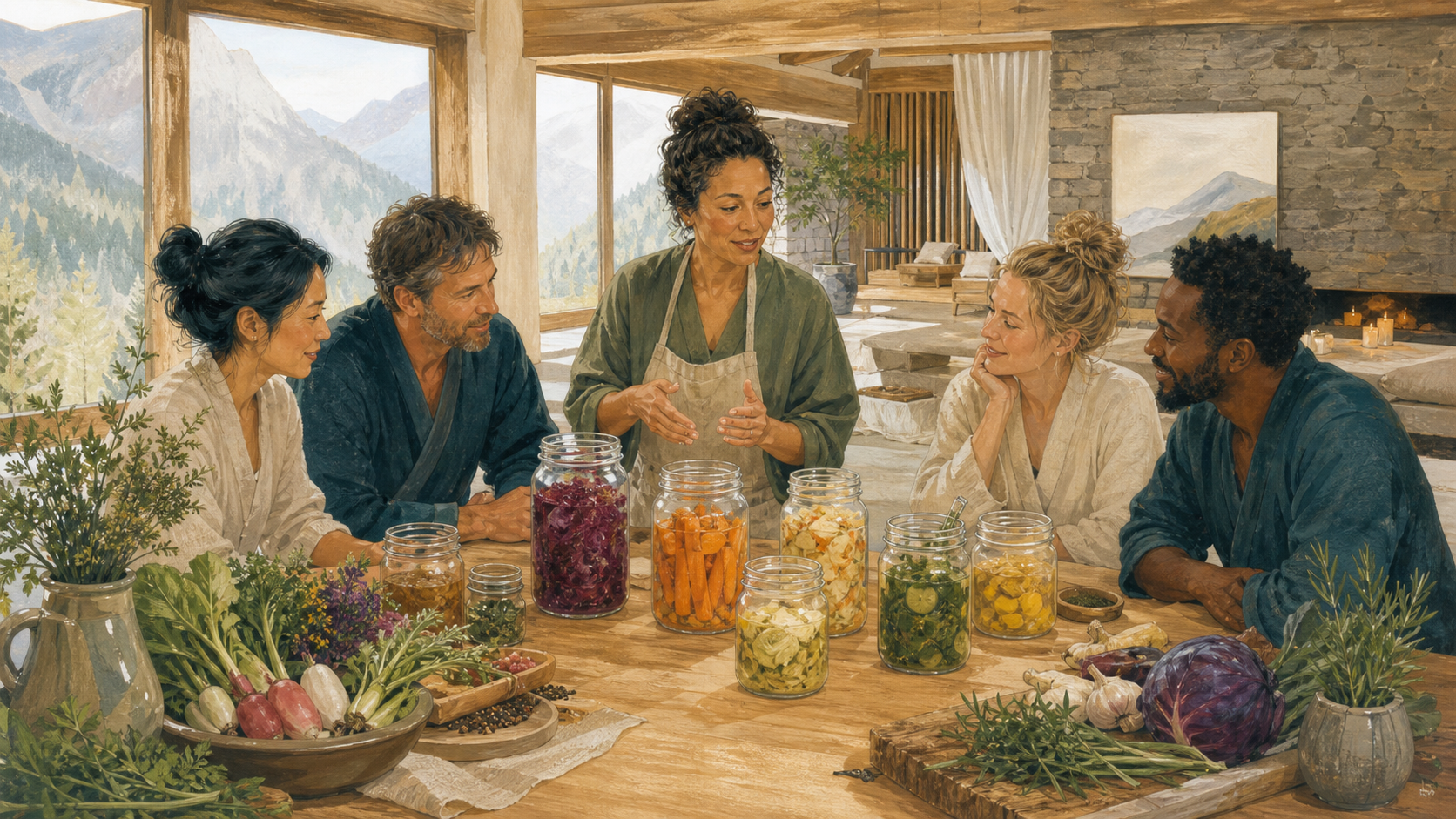
A newly announced programme makes fermentation wellness retreats a timely subject for spa and retreat operators. On 24 August 2026, Spa Business reported plans for a small-group Ferment Series at Naturhotel Lüsnerhof in South Tyrol, combining accommodation with workshops and tastings led by Edible Alchemy. The event is a useful industry signal; it is not evidence that fermented foods deliver a general health outcome.
The opportunity is broader than adding jars to a retreat timetable. A fermentation programme connects culinary education, live microorganisms, food hygiene, allergies, guest choice, workshop competence, take-home instructions and public claims. The experience can be valuable as culture, flavour and practical learning without being framed as treatment, diagnosis or a guaranteed route to a healthier gut.
This article uses the announced retreat to build an international operating framework. It distinguishes the event currently advertised from future delivery, fermentation from a probiotic claim, a learning outcome from a health outcome, and an appealing tradition from verified safety. It does not assess the retreat, taste its products, provide nutrition or medical advice, or infer a visit, partnership, nomination or award result.
What the current Ferment Series signal establishes
Naturhotel Lüsnerhof's live offer page lists the Ferment Series for 3-6 September 2026, describes three nights with its board programme and presents it as a deep dive into fermentation with Alexis from Edible Alchemy. Spa Business reports that demonstrations are intended to cover wild-herb ferments, water kefir and herbal sodas for a group of five to ten guests. These records establish an advertised future programme and its stated format.
Edible Alchemy's official site describes workshops, an online academy and fermentation activity dating from 2013. It also makes broad first-party claims about digestion, immunity and gut health. The site is useful evidence of the facilitator's stated experience and positioning, not independent substantiation of every health statement or of the September retreat's delivery.
One detail should be excluded from editorial copy: the price in the trade report differs from the live hotel page accessed for this review. Rates can also change. The event dates and format are supported by the current original page, but no price is repeated here. The retreat remains planned until delivered, and neither its listing nor its host property establishes guest satisfaction, health benefit, nomination or award merit.
Fermentation wellness retreats need a written programme boundary
Define what the guest is buying before designing the content. Is the activity a demonstration, a supervised practical workshop, a tasting, a culinary-history session or individual nutrition advice? Which items will guests prepare, taste or take away? Who supplies the ingredients and cultures? Which statements belong to hospitality education, and which would require qualified nutrition or healthcare scope?
Write the boundary in the booking path, arrival note and facilitator brief. A strong version might promise an introduction to selected fermentation methods, sensory exploration, safe preparation principles and recipes suitable for the demonstrated process. It should not promise to heal a gut, boost immunity, treat a condition, detoxify the body or produce a personalised clinical result.
The Journal's responsible-retreat implementation guide explains why qualifications, inclusion, consent, transparent booking and local relationships need operating evidence. Apply that same method to culinary wellness. Name the facilitator's role, the property's food-safety owner, the participant boundary and the route for questions that fall outside the workshop.
Separate fermented food, live cultures and probiotic claims
Fermented foods are diverse. Raw material, organisms, process, temperature, acidity, salt, storage and later treatment all matter. Some products contain live microorganisms when consumed; others do not. A fermented product is not automatically probiotic, and the presence of live organisms does not by itself prove a specific benefit for a particular guest.
A 2022 peer-reviewed review indexed by PubMed found that general health benefits are widely discussed but difficult to confirm across the body of human studies. It notes that foods, organisms and study designs vary, and that specific findings should not be expanded into a universal claim. This is a reason for precision, not a reason to dismiss fermentation as food or culture.
Use a three-column evidence file. The first describes the product: ingredients, process, relevant microorganisms and storage. The second records the experience: what was taught, tasted or made. The third contains any proposed health language and the evidence and authorisation relevant to it. Do not allow a colourful jar or the word “traditional” to bridge gaps between the columns.
Guest questions need the same discipline. Staff can explain what the workshop covers and identify ingredients. They should not improvise advice about symptoms, medicines, allergies, pregnancy, immune status or treatment. Establish a polite stop-and-refer phrase before the retreat begins.
Build food safety into the learning design
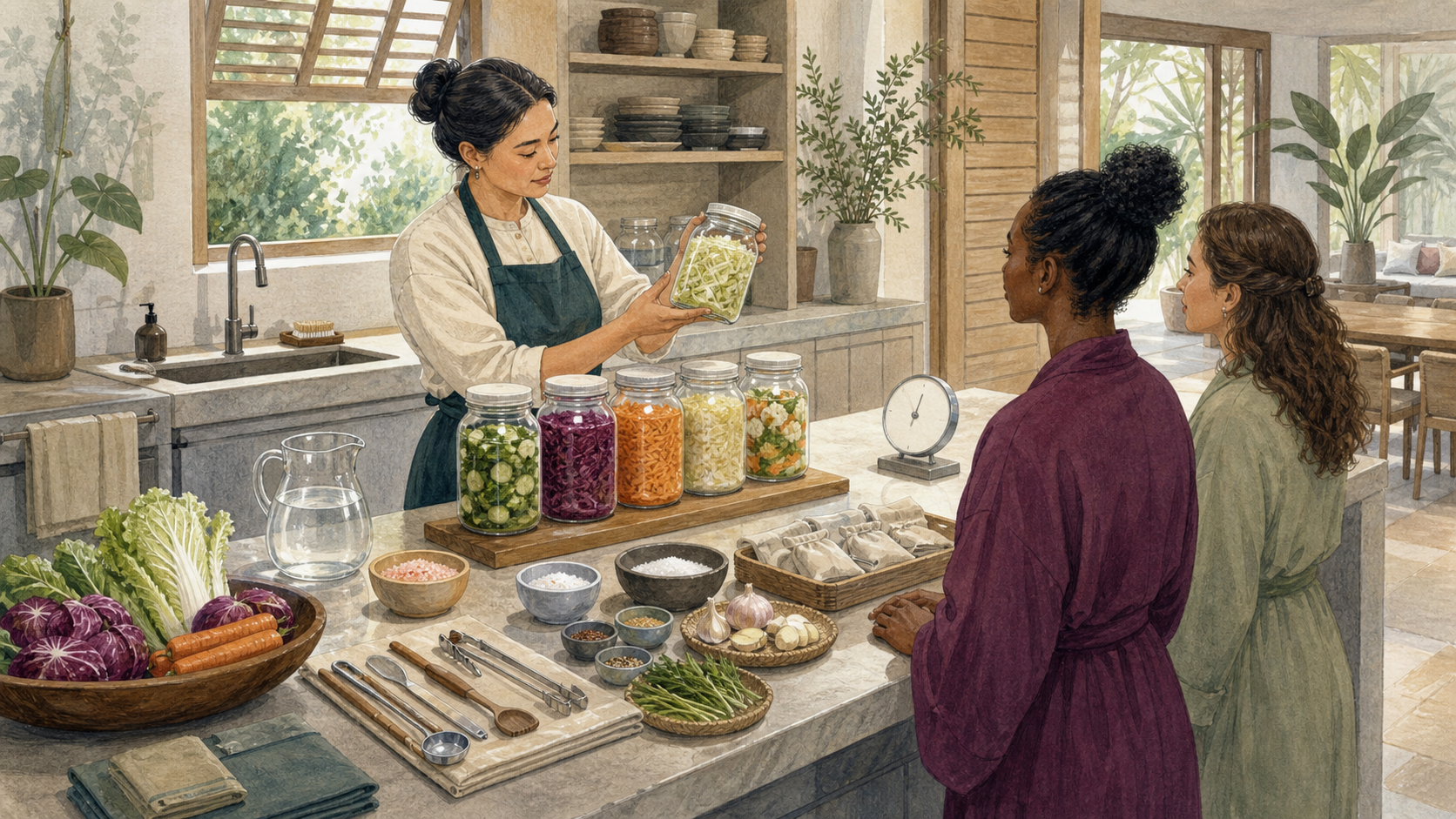
Hands-on education changes the risk profile because guests become food handlers. Map the complete flow: supplier approval, receiving, water, ingredient storage, culture management, washing, cutting, salt or starter measurement, vessel preparation, fermentation conditions, tasting, refrigeration, transport and disposal. Identify allergens and cross-contact risks at each step.
A joint FAO/WHO workshop report on household fermentation assessed both benefits and risks and highlighted process development and food-handler education. The message is still useful: fermentation can improve safety in some conditions, but it is not a universal kill step and an uncontrolled process can fail.
For an event in the European Union, Regulation (EC) No 852/2004 places primary food-safety responsibility on the food business operator and requires procedures based on HACCP principles. Operators elsewhere should identify their own law. In every location, the practical controls should be specific to the recipes, scale, participants and take-home products rather than copied from a generic checklist.
Set acceptance and stop rules with a competent food-safety lead. Record the approved process, critical limits where relevant, monitoring method, corrective action, batch identity and decision owner. Decide what guests may take home, how it is packaged, what storage instruction accompanies it and when it must be discarded. A demonstration that looks successful is not a release record.
Review every health statement before publication
Collect every phrase that links the food, workshop or retreat to digestion, immunity, the microbiome, mood, detoxification, disease risk or another bodily function. Include headlines, social posts, booking copy, facilitator biographies, menus, signage, scripts and take-home material. A claim can be implied by context even when it does not use medical language.
The European Commission says EU nutrition and health claims must be clear, accurate and based on scientific evidence, and points operators to the public register of authorised and non-authorised claims. A retreat is not exempt from careful review because the message appears in a workshop description rather than on retail packaging. Local legal advice may be necessary for the exact presentation and jurisdiction.
Separate four levels. A culinary statement describes taste, texture, ingredients or method. An educational statement describes what participants will learn. A nutrition statement concerns composition. A health statement links food or an ingredient to health. Each level needs its own evidence and rules; one cannot be substituted for another.
Keep participant testimony in the same review. A guest's account of enjoyment can be presented as opinion with appropriate permission. A testimonial claiming that the retreat resolved symptoms can become a health claim in marketing. Do not manufacture, coach or selectively edit testimonials into proof.
Measure learning without manufacturing outcomes
A retreat can measure whether it delivered the advertised programme. Confirm attendance, facilitator coverage, ingredient information, allergen communication, safe participation, accessible alternatives, practical confidence and whether take-home instructions were understood. These measures can improve the next session.
Do not convert satisfaction or confidence into a health result. A guest saying they feel able to prepare a demonstrated recipe is a learning indicator. It does not prove improved digestion, microbiome change, reduced waste at home or sustained dietary behaviour. If the operator later conducts research, that needs a defined question, consent, suitable methodology, privacy controls and honest limitations.
Keep sustainability claims in a separate evidence file
Fermentation can be part of a preservation practice, but an individual workshop does not automatically reduce food waste or environmental impact. The programme may buy additional ingredients for display, use energy for chilling or heat, discard demonstration batches, package take-home products and create transport. A traditional method and a local herb do not establish a net saving.
If waste reduction is part of the promise, define the boundary and measure it. Record ingredients that would otherwise have become surplus, edible output, failed batches, unavoidable preparation waste, packaging, storage and final disposal. Compare like periods and avoid counting a jar as “saved” before it is safely consumed. Keep home behaviour outside the retreat's result unless it is studied through an appropriate follow-up method.
Foraging needs its own control. Confirm lawful access, competent species identification, clean collection areas, seasonal availability and a safe substitute when conditions change. Do not let a marketing commitment to “wild” or “local” pressure the culinary team into using an uncertain ingredient. The verified experience is more important than preserving a picturesque description.

What does this mean for spa and wellness professionals?
For owners and general managers, approve one boundary across accommodation, food service, spa, marketing and the external facilitator. Budget for food-safety review, allergen controls, staff time, accessible alternatives, cleaning, storage and follow-up rather than treating the workshop as a simple add-on.
For spa and retreat directors, publish the precise live offer. The Journal's spa opening readiness framework shows why channels must match delivered scope. Apply it at programme level: if a tasting, ingredient or session changes, update the booking page, arrival communication and operations brief together.
For culinary teams and facilitators, agree who controls each batch, who may change a recipe, who answers allergy questions and who can stop service. Demonstrate only a process that can be explained and supervised safely. Keep guest-made and kitchen-produced food clearly separated where required.
For marketers and awards researchers, culture and education are legitimate value propositions. Do not inflate them into a cure. Active Spa Nomination Directory pages for Gaia Retreat & Spa, Byron Bay and COMO Shambhala Estate provide further retreat research routes; they do not indicate that either property offers the programme discussed here or has any relationship to the announced event.
A 30-day fermentation retreat review
Days 1-10: define the offer
Freeze the dates, sessions, facilitator role, participant number, recipes, tastings, take-home items and accessibility options. Create the source file for every public statement. Remove unverified health language and record the unresolved price discrepancy or other changing commercial details rather than copying them across channels.
Days 11-20: test the process
Rehearse receiving, preparation, fermentation, tasting, allergen communication, cleaning, storage and disposal with the actual equipment and team. Test late arrivals, ingredient substitution, failed batches, guests who cannot participate in tasting and questions outside facilitator scope. Correct findings and repeat affected steps.
Days 21-30: rehearse the guest journey
Run booking, arrival, consent, workshop, dining, spa scheduling, take-home handover and complaint response as one journey. Confirm who owns every transition. Release only the verified programme, monitor exceptions and compare the public promise with what the team can consistently deliver.
What remains unproven
This review did not visit Naturhotel Lüsnerhof, attend an Edible Alchemy workshop, inspect recipes, test food, verify qualifications, assess individual health claims or confirm future delivery. No concern described here is presented as an observed failure. The live hotel page and Spa Business report establish the announced programme only, and their price difference is deliberately not resolved by assumption.
Operators must identify applicable food law, health-claim rules, professional scope and competent advice for their own location. The illustrations are fictional, contain no copied property or event details and do not represent documentary access.
Frequently asked questions
Is every fermented food a probiotic food?
No. Fermented foods differ in organisms, processing and whether live microorganisms remain when consumed. A probiotic claim requires more than fermentation or the presence of microbes.
Can a retreat discuss traditional fermentation without making health claims?
Yes. It can focus on history, culture, flavour, food preservation and practical technique. Any statement linking the food to health still needs separate evidence and compliance review.
Does a successful workshop prove a health outcome?
No. It can show that the programme occurred, that safety controls were followed and that participants understood the demonstrated process. Those are delivery and learning measures, not proof of an individual or population health effect.
