

Cognitive accessibility in spas is not achieved by adding one quiet room or simplifying a treatment menu. It depends on whether a guest can understand, predict and control the whole journey: discovery, booking, arrival, changing, consent, treatment, thermal use, payment and departure. A new Spanish regulation makes that operating question especially timely. Published on 3 September 2026, Royal Decree 707/2026 establishes basic conditions for cognitive accessibility and is scheduled to enter into force on 2 January 2027.
The Spanish measure is a national legal development, not a universal rulebook for every spa. Its value to an international audience is as a precise signal. It treats information, orientation, communication, sensory conditions, error tolerance and support as connected parts of access. That is a more useful starting point than assuming a serene interior is automatically understandable. Every operator still needs local legal advice on the rules that apply to its services, building, digital channels and jurisdiction.
Cognitive accessibility in spas is now an operating issue
The official text of Royal Decree 707/2026 says cognitive accessibility helps people understand information from the environment, communicate with it and carry out activities without discrimination. Its principles include clear orientation, predictable use, tolerance for unintentional error and the ability to personalise or anticipate sensory conditions such as light, sound and movement.
For public-facing goods and services within its linked legal scope, the regulation addresses accessible service information, alternative communication support, appropriate assistance and staff preparation. It also calls for basic commercial information, contracting, consent and instructions to be conveyed in simple language, with visual support where possible. The measure does not say that a symbol, simplified leaflet or calm playlist is sufficient on its own. It frames accessibility as a system involving information, people, places and procedures.
This direction is consistent with a wider rights framework. Article 9 of the United Nations Convention on the Rights of Persons with Disabilities connects equal access to physical environments, information, communications, technologies and services open to the public. It also points to understandable signage, live assistance and training. A spa journey crosses all of those domains, sometimes within minutes.
The commercial implication is simple: cognitive accessibility cannot sit only with the architect, web agency or therapist. It needs one accountable owner who can see the complete service. A guest may navigate a perfectly clear corridor after struggling through an unpredictable booking form. Another may understand the website but lose confidence when staff explain consent differently. The weakest transition sets the practical level of access.
Map the journey before buying solutions
Start with a service map rather than a shopping list. Put each guest step on one line and record the information presented, decision required, environment entered, person involved, likely interruption and recovery route. The map should include remote channels as well as the building: search results, booking engines, confirmation emails, phone calls, transport information and post-visit messages.
At every step, ask four questions. What must the guest understand? What must the guest decide? What could create avoidable cognitive effort? What happens if the guest pauses, changes their mind or makes an error? A booking that times out, a locker that changes numbering logic and a thermal circuit with an implied sequence are not isolated details. Together they can turn a restorative visit into a chain of memory tests.
ISO 21902:2021 on accessible tourism for all provides an international reference for equal access and enjoyment across tourism policy, infrastructure, products and services. The standard is under systematic review in 2026, so operators should check its current status before procurement or certification decisions. Its published scope still reinforces an important principle: accessibility belongs across the tourism supply chain, including accommodation, leisure activities and connected service providers.

Make booking a preview of the real experience
A cognitively accessible booking path should answer the questions a guest will otherwise have to hold in memory. Where do I go? Who will meet me? What clothing is provided? Which activities are optional? How long will each stage last? Can I leave and return? What information should I prepare? What happens if I am late or need help? These answers should be available before payment, not hidden in a long policy attachment sent afterwards.
Use one term for each service and keep it consistent across the website, booking engine, confirmation and venue. If “thermal journey”, “spa circuit” and “hydrotherapy experience” mean the same thing, choose one public label. If they mean different things, explain the difference. Avoid relying on evocative names to communicate sequence, intensity or suitability.
The World Wide Web Consortium’s cognitive accessibility guidance notes that cognitive and learning disabilities can affect perception, memory, language, attention, problem-solving and comprehension. Existing web standards address navigation, readability, predictability, timing and input assistance, while W3C also publishes supplemental guidance beyond minimum conformance. For a spa, that means accessibility work should include task completion, not just an automated score.
Keep the critical path short. Show progress without forcing the guest to remember earlier choices. Explain errors next to the field that needs attention. Do not reset the whole form after a mistake. Offer a stable route to human help. If the guest starts by phone and continues online, staff should not require them to reconstruct every preference from the beginning.
Design arrival and wayfinding as one continuous explanation
The arrival message should match the building. A photo of the entrance, the exact reception point and a short sequence of what happens next can reduce uncertainty before travel. On site, signs, spoken instructions, colour, lighting and staff language should use the same logic. A beautiful icon is not useful if staff call the destination by another name or if the icon changes at the lift.
Progressive orientation works better than presenting the entire property at once. At reception, explain only the next few steps and provide a durable reference the guest can keep. At changing, show how the locker works, where personal items remain and how to reach the next zone. At a thermal area, distinguish required safety instructions from suggested ritual order. The guest should be able to identify an exit or ask for help without completing the experience.
Test route decisions from the guest’s eye level and at the time they will actually occur. Steam, dim light, reflective surfaces, background music, bare feet and the absence of glasses can change how information is perceived. A sign that works in a design review may fail beside three other signs or after a guest has removed a hearing device. Check the route with the normal operational lighting, noise, scent and staff traffic.
Use plain language without removing informed choice
Simple language is not the same as incomplete information. A guest still needs the purpose, material risks, alternatives, practical sequence, price and cancellation terms relevant to a decision. The task is to structure that information so it can be found, understood and used. Put the decision first, group related facts and replace unexplained technical terms. Provide detail in layers rather than forcing everyone through one dense block.
The Spanish regulation distinguishes plain, clear and easy-to-read approaches and points to recognised standards. In international practice, teams should avoid treating these formats as interchangeable. An Easy Read version may involve images, specialist adaptation and validation with intended users. A short marketing summary is not automatically Easy Read, and a legal document does not become cognitively accessible merely because its font is larger.
Updated UK government guidance on accessible communication formats offers a useful operational reference outside its own legal setting: involve disabled people in planning, make standard formats as accessible as possible, decide which alternatives are priorities and have a process for producing requested formats. It also recommends plain language, concise content and user consultation. Operators should apply the principle, then verify local duties rather than importing UK legal conclusions.
Separate explanation, consent and permission
A staff explanation does not replace the guest’s decision. Break consent into meaningful choices where the service permits it. A guest might accept a massage while declining photography, product profiling or a shared thermal ritual. Confirm the selected treatment, pressure or heat expectations, areas involved, stopping signal and any optional elements. Give the guest time to respond without filling the silence for them.
Record only what the service needs. A request for simple language, more processing time or a support person should not become an informal diagnosis in the customer profile. Staff need a respectful way to record practical preferences and a retention rule. The aim is a usable service, not a speculative label.
Offer sensory information and control before discomfort begins
Spa environments often intensify light, darkness, sound, heat, water movement, scent and touch by design. Cognitive accessibility requires more than calling that atmosphere “calming”. Tell guests what to expect and which conditions can change. Identify unavoidable features such as echoing pools, alarms, dark corridors, strong fragrance or group transitions before arrival. Make optional features genuinely optional.
Choice should be concrete. Can the music be lowered? Can a scent be removed? Is a door left ajar? Is a silent appointment available? Can a guest pause between heat stages? Does the treatment continue if the guest cannot tolerate a particular texture? Staff need agreed answers, not improvised goodwill that changes by shift.
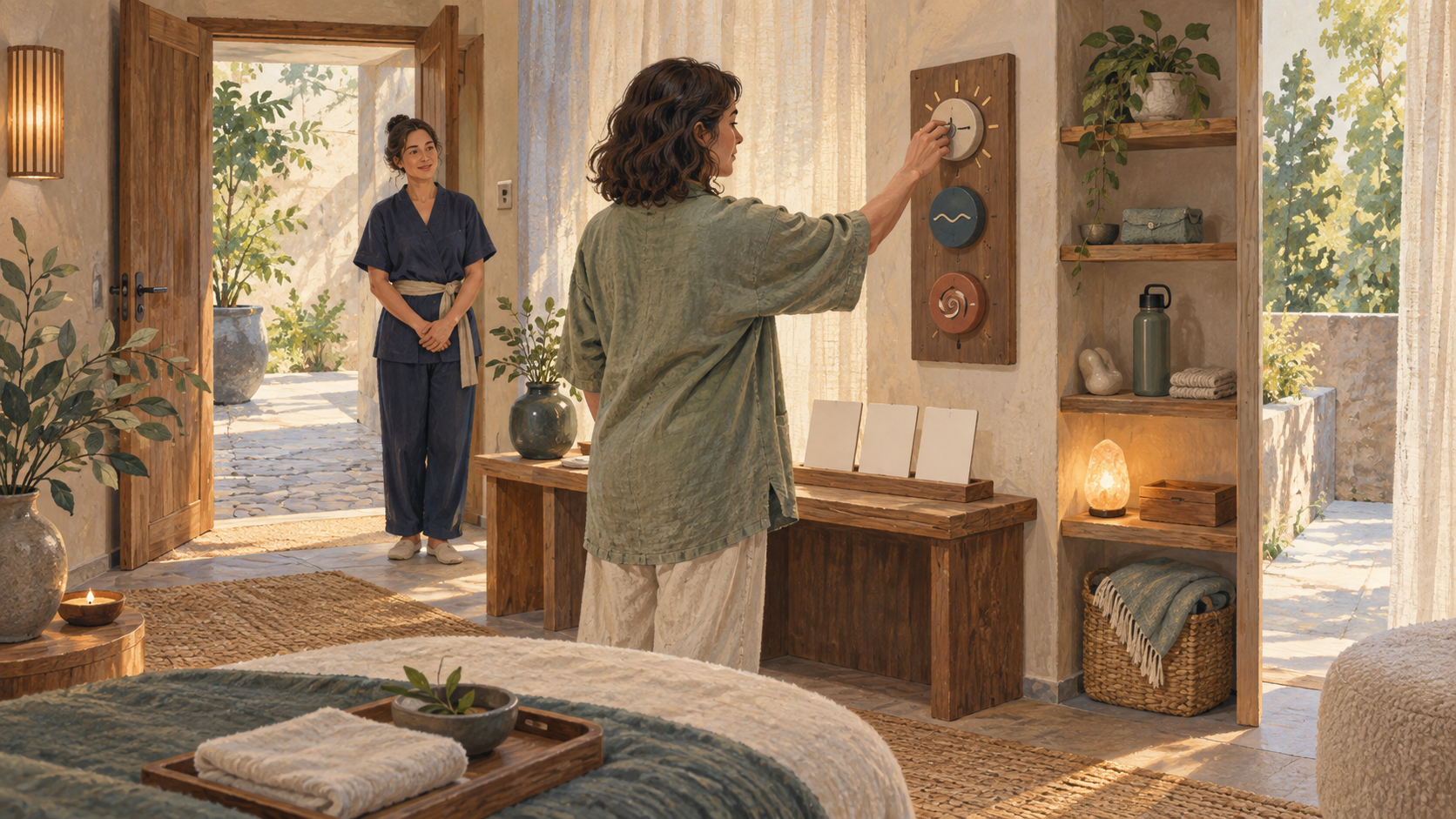
Build a quiet recovery route that does not feel like punishment or abandonment. The guest should know where it is, how to reach it and how to resume or end the visit. A pause should not automatically trigger a public discussion at reception. Payment, belongings and transport still need an understandable completion path if the planned treatment or circuit stops early.
Support autonomy instead of replacing it
Assistance is most useful when it helps the guest make and carry out their own choices. Ask what support is helpful. Address the guest directly even when a companion, interpreter or assistant is present. Do not assume that a person who communicates differently cannot consent, or that a companion may decide automatically. Equally, do not make independence a condition of dignity; some guests choose support.
Create a consistent help protocol. Staff should know how to slow the pace, repeat without irritation, demonstrate a step, offer a visual sequence, move to a quieter place and involve a chosen support person. They also need boundaries: a spa employee should not interpret a guest’s legal capacity, diagnose a condition or disclose personal information to a companion without an appropriate basis.
Service recovery should be cognitively accessible too. Explain what happened, the available options, any price effect and the next action in the same clear format used during booking. Complaint routes should not require a guest to reconstruct the entire journey under pressure. Confirm the resolution in a durable message and provide one contact point.
Test with users, not only with a checklist
Checklists can find omissions, but they cannot prove comprehension. Recruit and compensate people with varied cognitive and learning disabilities to test real tasks. Include people with different communication preferences, literacy, languages and support arrangements. Avoid asking one participant to represent everyone. The team should observe where a person pauses, backtracks, seeks reassurance or abandons a task, then ask why.
Test the busy version of the service as well as the rehearsed version. Run booking on a phone, arrival during a queue, locker use with wet hands, a treatment change after a delay and an early departure. Include staff handovers. An accessible script fails if only one trained champion can deliver it.
Measure completion and confidence, not just satisfaction. Useful signals include booking abandonment by step, requests for clarification, wrong-route events, locker resets, missed transitions, early exits, use of alternative formats, response time for assistance and successful resolution. Keep the data proportionate and voluntary. A guest should not have to disclose a diagnosis to report that a process was confusing.
What does this mean for spa and wellness professionals?
For owners, cognitive accessibility becomes a governance question: one leader needs authority across digital, design, operations and training. For spa directors, it becomes a consistency question: the guest should receive the same sequence and choices regardless of shift. For therapists, it means permission, pacing and stopping signals must be clear. For marketing teams, atmosphere cannot substitute for usable information.
The work connects with the Journal’s guidance on designing family spa access around safety, calm and choice and building access into spa employment. Guest and workforce accessibility are not identical, but both improve when roles, information, adjustments and feedback routes are defined before a problem occurs.
Readers exploring Spanish spas can use directory records such as AIRE Ancient Baths Barcelona and Spa at Four Seasons Hotel Madrid for discovery. Directory presence does not establish compliance with Royal Decree 707/2026, cognitive accessibility, certification, nomination or an award result. Those questions require direct, current evidence from the operator and the relevant authorities.
A 30-day cognitive-accessibility review
In week one, map one complete guest journey and collect every message, form, sign and script. In week two, remove inconsistent terms, shorten the critical booking path and create a plain sequence for arrival. In week three, rehearse help, sensory adjustment, treatment refusal, a lost guest and an early exit. In week four, conduct paid user testing, log failures, assign owners and set retest dates.
The control file should contain the journey map, language glossary, accessible-format plan, sensory information, support protocol, staff training record, consent versions, complaint route, user-testing evidence and unresolved issues. It should also state the jurisdiction and legal review date. A visual feature should never be promoted as regulatory compliance without a complete assessment.
What remains unproven
Royal Decree 707/2026 establishes a Spanish framework and a future effective date. The public text does not prove that any named spa is compliant, that one design solution works for every guest, or that an accessible journey produces a health outcome. UN, ISO, W3C and government guidance provide principles and methods; they do not certify a property or replace local legal, building, safety and professional review.
The credible claim is narrower and more useful. A spa can show that it mapped the whole journey, involved relevant users, reduced avoidable cognitive effort, trained staff, offered understandable choices and tested recovery when a step failed. Cognitive accessibility is not a mood. It is the evidence that a guest can understand what will happen, choose what happens next and receive support without losing control.
