

Spa heliotherapy starts with an exposure definition
Spa heliotherapy sounds simple: use natural sunlight as part of a guided wellness service. Operationally, it is not one action. Sunlight brings changing ultraviolet radiation, heat and glare; a wrapping material can retain warmth; a topical preparation can change skin exposure; the guest may move between shade, sun and recovery; and the marketing language may imply benefits that the service has not established.
A current industry signal makes the distinction useful. On 18 September 2026, Spa Business reported on a banana-leaf sunbath offered at ŪRJĀ Naturopathy Island at Four Seasons Resort Maldives at Kuda Huraa. The report describes an outdoor practice involving a preparation applied to the skin, banana-leaf wrapping and sunlight, with heat and duration adjusted by practitioners. It also records the operator acknowledging that research into the specific method remains early.
That is evidence that a named resort presents a named service. It is not proof of a cure, detoxification, improved circulation, suitability for every guest or a standard that another spa can copy. This article uses the offer as a bounded prompt for operators internationally: before selling sunlight as a treatment, define the exposure, the decision rights and the evidence behind every claim.
What the current sources establish
The original Four Seasons announcement dated 24 August 2026 presents ŪRJĀ as a naturopathy destination with four pathways, consultations and services including heliotherapy, fasting, acupuncture, movement and other practices. The resort’s current naturopathy programme page lists multi-day sleep, liver-detox and joint-care programmes and asks guests to book a complimentary consultation. These are issuer descriptions of a live commercial offer; they are not independent clinical evaluation.
The sources do not publish a complete guest-selection protocol, solar ultraviolet limits, stop criteria, incident data, study design or outcome dataset for the banana-leaf sunbath. They do not establish how local professional titles or service permissions apply. Silence on those points is not evidence that controls are absent, but it means this review cannot verify them.
The broader evidence boundary is clearer. The World Health Organization’s Global Traditional Medicine Strategy 2025–2034 supports evidence-based, safe, effective and people-centred approaches, together with appropriate regulation, cultural respect and autonomy. It does not endorse this resort, this treatment or naturopathy as a uniform regulated category across countries.
Separate every part of the sunlight service
A spa cannot control what it has bundled into one poetic name. Build a modality map that separates at least six components: solar ultraviolet exposure; ambient heat and humidity; any leaf, cloth or wrap that changes heat loss; any salt, oil, herb, clay or cosmetic applied to the skin; the body position and degree of skin coverage; and the recovery period. Add hydration, transport, privacy and practitioner observation as operating components rather than background details.
For each component, name the intended experience and the evidence level. “Warmth while resting outdoors” is an observable description. “Supports circulation” is a health-related benefit claim. “Detoxifies” is broader again and requires a defined substance, mechanism, population and outcome before it becomes testable. The components must not borrow evidence from one another: research about ultraviolet treatment for a specific medical condition does not validate a resort sunbath, and evidence about ordinary outdoor time does not validate a wrapped, heated protocol.
Write a control owner beside every component. Facilities may own shade, weather monitoring and the physical exit. A qualified service lead may own suitability rules. Procurement may own topical-product traceability. Marketing owns the public wording but not the scientific threshold. The spa director owns the decision to pause the service when one link cannot be controlled.
Build the exposure specification from live conditions
A menu duration is not an exposure specification. Solar intensity changes with latitude, season, time, cloud, reflection and the guest’s position. The WHO ultraviolet-radiation fact sheet notes that water and sand can increase exposure through reflection, that ultraviolet radiation cannot be felt, and that protection is recommended when the UV index reaches three or above. Warmth therefore cannot be used as a proxy for ultraviolet dose.
Before each operating window, record the weather source, UV index, air temperature, humidity, reflective conditions, shade performance and any reason the session should move indoors or be cancelled. Set limits for the property and protocol with appropriately qualified advice. Do not let a booking target override them. A screen, canopy or tree is a control only if the relevant exposure in the guest position has been assessed.
Specify the sequence: arrival in shade, explanation, preparation, any exposure increments, observation, stop decision, unwrapping, cooling and follow-up. Define the maximum continuous exposure and total session window separately. If a wrap retains heat, test and control that thermal load as its own variable. If a topical product is used, retain its ingredient record, directions, batch and compatibility information rather than assuming that “natural” means neutral.

Make informed choice specific and reversible
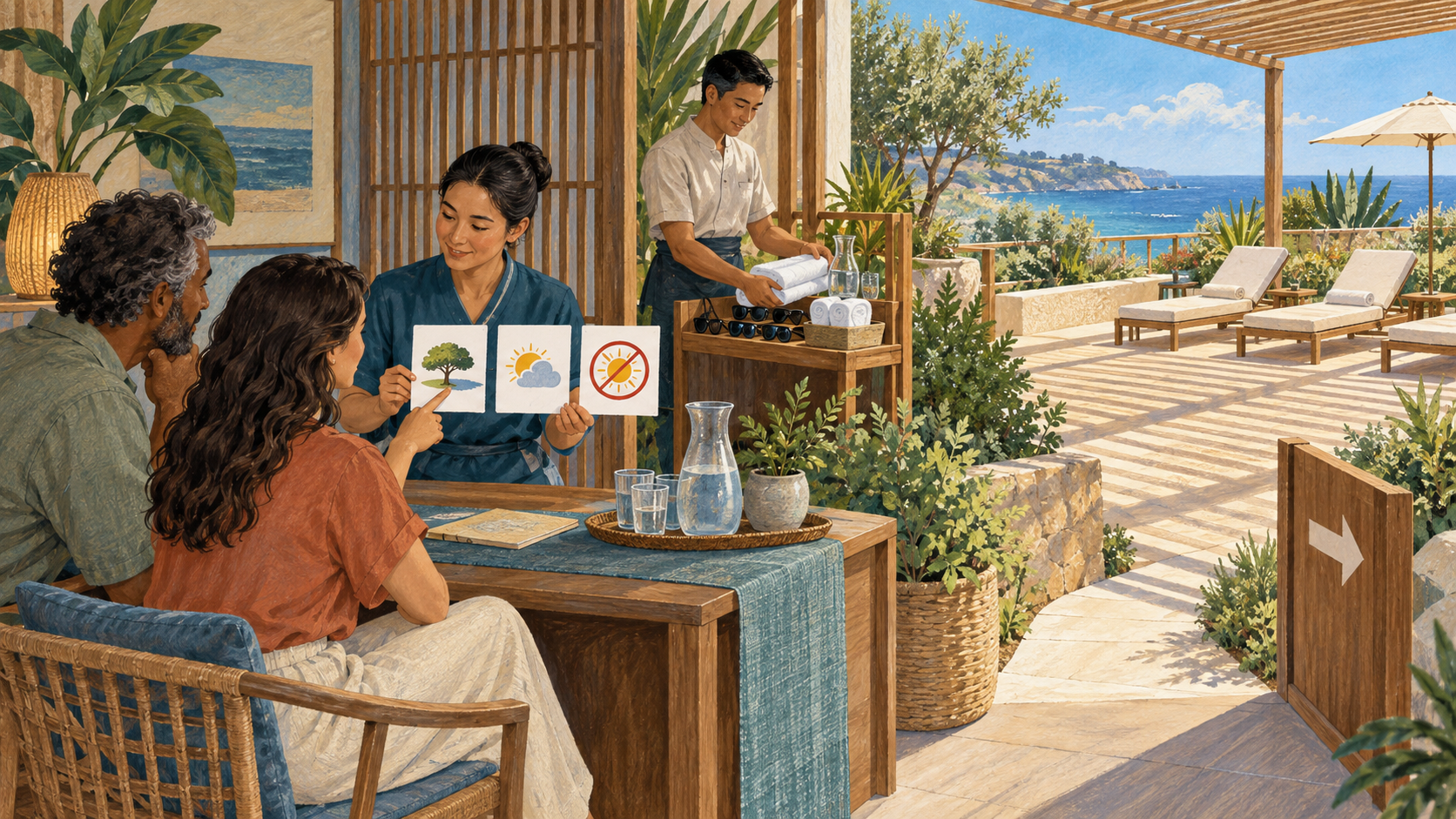
Consent to a spa appointment is not consent to sun exposure, heat, wrapping, a topical preparation, photography or a health claim. Explain each component in plain language before preparation begins. State what the guest may feel, what remains uncertain, what alternatives exist and how to stop. A shaded version, a different service or no session at all must be practical choices, not awkward exceptions.
A general waiver cannot repair an unclear service. The consultation should distinguish the guest’s goals from the spa’s claims and should not pressure the guest to accept a practitioner’s theory. Questions should be limited to information needed for suitability and safe delivery. If the answer creates uncertainty outside the team’s scope, the correct state is pause or referral, not improvised diagnosis.
Reconfirm choice when conditions change. Stronger sunlight, a different product, a longer wrap, discomfort, a staffing change or a move to another location creates a new decision point. The guest must be able to end the session without losing access to ordinary care, transport or the remainder of a paid stay.
Screen for risk without turning the spa into a clinic
Sunlight services need a suitability process, but more questions do not automatically produce safer practice. Define which factors change the protocol, which require appropriately qualified review and which put the service outside scope. The WHO identifies particular ultraviolet risks for children and adolescents, people taking photosensitising medication, people with certain skin characteristics or histories, and outdoor workers with cumulative exposure. That list is a public-health reference, not a ready-made resort questionnaire.
Translate risk into decisions the spa can consistently make: proceed under the documented protocol, modify a component, defer for qualified advice or do not provide the service. Staff should not promise to diagnose photosensitivity, skin disease, vitamin status or a systemic condition. A referral route should identify the kind of professional decision required without suggesting that the spa and clinician share one treatment plan unless a real, authorised relationship exists.
Protect the data created by screening. Record the minimum decision and rationale needed for continuity and incident review. Do not copy sensitive answers into general guest profiles, marketing systems or informal messaging. Retention, access and deletion should follow the applicable law and the service’s actual accountability needs.
Write stop rules before the first booking
Stop rules belong in the service design, not only in practitioner judgement. Define guest-requested stopping, observable discomfort, unexpected skin response, dizziness, confusion, weakness, equipment or shade failure, weather change and loss of supervision. Staff need authority to stop without seeking commercial approval.
The exit route must work for a guest who is wrapped, warm, wet, unsteady or simply wants privacy. Keep shade, seating, drinking water, communication and assistance immediately available. Define who unwraps or removes a product, who records the event, when emergency services are contacted and how the treatment room or outdoor area is isolated for review.
Test the response in the real space. A beautiful remote deck can become a weak control if help, shade or transport is slow. Rehearse the busiest plausible condition, staff breaks and sudden weather. Record corrective action and verify it before reopening; an apology, refunded treatment or revised marketing sentence does not prove the operating cause has been fixed.
Keep traditional practice, personalisation and evidence separate
A traditional or naturopathic rationale deserves accurate attribution, but heritage does not remove the need for safety or substantiation. Record who identifies the practice, what knowledge tradition is being referenced, whether the current service materially changes it, and who has authority to teach or adapt it. Avoid describing a recently assembled resort sequence as timeless knowledge.
Personalisation also needs boundaries. Adjusting shade, duration or comfort based on a guest’s stated preference is not the same as identifying a root cause or treating a condition. An assessment can guide a hospitality choice without becoming a validated diagnostic test. Marketing should say exactly which decisions the consultation informs.
The WHO strategy offers a useful discipline: evidence, regulatory mechanisms, safety, cultural respect, autonomy and people-centred care should advance together. None can stand in for the others. A respectful story does not establish efficacy; a published study does not prove lawful local scope; and a licensed practitioner does not make every surrounding brand claim accurate.
Make every health claim carry its own evidence
Create a claim register covering the menu, booking page, practitioner script, social posts, press material, partner copy and images. For each express or implied claim, record the exact wording, market, intended audience, supporting evidence, limitations, owner and review date. Visuals of intense sunlight, wrapping, perspiration or professional assessment can imply efficacy even when the text is cautious.
The US Federal Trade Commission’s health-products guidance is jurisdiction-specific but operationally useful: objective health claims require adequate substantiation, and the evidence must match the advertised product, benefit and conditions. Evidence for an ingredient or adjacent practice cannot automatically substantiate the complete service.
“Detox” needs particular restraint. The US National Center for Complementary and Integrative Health reports that research on commercial detoxification programmes is limited and identifies potential safety issues across fasting, juices, supplements, colon cleansing and sauna-related programmes. That source does not evaluate ŪRJĀ, but it shows why a spa should not convert perspiration or a programme name into proof that toxins were removed.
What does this mean for spa and wellness professionals?
For owners and spa directors, sunlight is an environmental exposure that must be commissioned like any other active part of a service. For practitioners, the job is to stay within defined competence, apply stop rules and preserve the guest’s choice. For facilities teams, shade, weather data, reflective surfaces, privacy and emergency access are treatment controls. For marketers, sensory language must not outrun the evidence.
Existing Journal guidance can extend the operating file. Contrast Therapy in Spas: Commissioning Heat, Cold and Flow explains why sequence, intensity and recovery must be controlled together. Spa Hypnotherapy: Define the Boundary Before the Session shows how a service label, practitioner biography and premium setting remain separate from scope and efficacy. Neither article validates spa heliotherapy.
Directory pages are useful only for discovery. Readers comparing other island-spa contexts can browse Miki Miki Spa at Four Seasons Resort Bora Bora and The Spa at The Ocean Club, A Four Seasons Resort, Bahamas. Their listings do not establish that they offer heliotherapy, share ŪRJĀ’s protocol, have been inspected for this article, or hold any nomination or award result.
A 30-day spa heliotherapy control review
Days 1–7: separate the service
Map sunlight, heat, wrapping, products, position, supervision and recovery. Record the intended experience, evidence level, owner and uncertainty for each. Freeze any claim whose supporting source does not match the complete service. Confirm the local professional and operational permissions that apply.
Days 8–14: write the operating envelope
Define data sources and limits for UV, weather, reflection and shade. Set preparation, exposure, observation, stop and recovery states. Inventory products and wrapping materials. Walk the exit route and verify water, privacy, communication, transport and escalation under realistic staffing.
Days 15–21: test choice and competence
Rehearse proceed, modify, defer and decline decisions. Test a guest request to stop, a sudden weather change and loss of shade. Observe whether staff can explain uncertainty without diagnosing or persuading. Correct gaps, record training evidence and retest the complete route.
Days 22–30: align claims and review
Compare the protocol with every public and partner claim. Remove implied outcomes that lack matched evidence. Publish practical information about the components, alternatives and limits. Start an incident, complaint and corrective-action log, and schedule periodic revalidation as weather, products, staff or service design changes.
What remains unproven
The reviewed sources establish that Four Seasons markets ŪRJĀ Naturopathy Island and related programmes, and that Spa Business reported a banana-leaf heliotherapy service with practitioner-adjusted heat and duration. They do not establish clinical efficacy, detoxification, improved circulation, universal suitability, local regulatory status, incident performance or the complete operating protocol.
WHO, NCCIH and FTC materials provide public-health, evidence and marketing context. They do not assess the named resort. This article does not report a visit, test, inspection, nomination, winner, partnership or award. Its conclusion is procedural: spa heliotherapy becomes more credible when operators separate every exposure, keep consent reversible, define stop rules, verify scope and make each health claim carry evidence that actually matches the service.

